Showing posts with label category romance. Show all posts

Friday, February 15, 2019

The Appeal (or not) of Compulsory Demisexuality

I've always had decidedly mixed feelings about the "fated mate" romance, but could never quite articulate why. Until this past week, when I came across the term "compulsory demisexuality." It's a fascinating concept, and one that helped me understand the sexist implications of the "I'm only sexually attracted to my one true love" ideology that's found in many single title and even more category romances.

Jodi McAlister, in her other guise as
YA author
Over the course of my years of reading about and studying gender and genre, I've often come across the term "compulsory heterosexuality." But this past week was the first time I'd heard the similar coinage, "compulsory demisexuality." The phrase appears in Lucy Neville's book Girls Who Like Boys Who Like Boys: Women and Gay Male Pornography and Erotica (about which I plan to write more in a future blog post), but the term was first coined by romance scholar Jodi McAlister. Wanting to find out more about this fascinating idea, I checked Neville's footnotes, and then tracked down the Australasian Journal of Popular Culture from 2014, in which McAlister's article, " 'That complete fusion of spirit as well as body': Heroines, Heroes, Desire, and Compulsory Demisexuality in the Harlequin Mills & Boon Romance Novel," was first published.

Lesbian feminist poet and essayist Adrienne Rich used the phrase "compulsory heterosexuality" to describe the way that our society compels its members to believe that opposite-sex attraction is normal and natural, and to regard same-sex attraction as unnatural and deviant. The phrase is meant to call into question these so-called "natural" assumptions, to point out that they are not inherent to humanity, but are instead social constructions.*

McAlister's riff on Rich's term, "compulsory demisexuality," has a narrower scope and but a similar purpose. At the start of the majority of Harlequin Mills & Boon category romances, the female protagonist, or heroine, is demisexual: she can only feel sexual desire towards someone for whom she first feels an emotional attachment. But compulsory demisexuality takes demisexuality one step further. As McAlister explains, "someone who is actually demisexual is capable of experiencing attraction to a number of partners, as long as they have an emotional attachment to those partners" (300). But in the HM&B romance, "demisexuality intersects with the narrative of one true love" (300), so that a romance heroine can only feel sexual desire for one man, the man who is her soulmate. Women, according to the category romance, are (or at least should be, if they are proper heroine material), innately demisexual. A heroine will know the man she loves because it is only with him that she will share "that complete fusion of spirit as well as body" (in the words of Denise Robins, author of the 1933 Mills & Boon romance Shatter the Sky).

McAlister goes on to make two additional important points about compulsory demisexuality in the category romance. First, that while the male protagonist in such books is rarely demisexual at the start of the romance, by its end, he, like the heroine, is decidedly demisexual. Think of those passages in your romances when, after being attracted to the heroine, the hero suddenly discovers that the pleasure he once took in looking at, or sexually interacting with, other women has suddenly disappeared. He's just not that into looking at other women, at playing the field, anymore; he only has eyes (and a hard-on) for her. Converting the hero to demisexuality signals the triumph of the heroine; she has brought him into her world, a world in which "sex and love are tied together." As McAlister pungently puts it, "she gives him love as a sexually transmitted disease" (307).

Cover of a 1961 edition
Second, the "way in which compulsory demisexuality has been realized within category romances has... changed over time." In Shatter the Sky, published all the way back in 1933, "the happy ending of the novel is less a victory for the heroine and more a victory for loving demisexual relationships in general... a victory for [heroine] and [hero], rather than a victory of [heroine] over [hero]" (308, emphasis added). But the demisexual paradigm becomes more, rather than less, associated with the feminine over the course of the twentieth century, especially in the period after World War II:

Although the idea that sex and love should be linked has been a consistent hallmark of the Mills & Boon novel, there seems to be a growing emphasis on the idea that this is a uniquely feminine viewpoint, and it is this viewpoint—her viewpoint—that triumphs at the end of the romance novel. (309)

McAlister describes the pattern of compulsory demisexuality in her article, but she doesn't speculate about its implications, or its potential effects on romance readers. Is it a problem that category romances demand compulsory demisexuality of their protagonists? And that many many single title-length romances do as well?

Sexier cover, same compulsory
demisexual message: 2009's
Desert Prince, Bride of Innocence
I think it is. First, by demanding compulsory demisexuality of female protagonists, category romances suggest that female sexual desire cannot and should not exist without first being activated by a man. And not just any man, but only by the "one true love" a heterosexual woman is destined to be romantically linked to for the rest of her life. If a reader identifies with the heroine of such romances, or sees said heroine as a role model, she may passively accept such beliefs without even realizing she is doing so. What's even worse, those beliefs implicit shame any girl or woman who experiences sexual desire before she meets her "one true love." Compulsory demisexuality functions to control female sexuality, to contain it within the safety of a patriarchal relationship. Hardly the sex-positive attitude a feminist would wish for her in her romance reading.

And compulsory demisexuality also works to instill the idea that there is and must always be a "one true love" for each and every woman in the world, a belief that can lead to the idealization of romantic relationships and unrealistic expectations of a romantic partner. It can also lead to the belief that life is not complete if one has not found "one true love," and/or to a justification for looking down on those who haven't yet found (or have no desire to find) a "soulmate."

Are there any upsides to compulsory demisexuality that I'm overlooking? Or when we come across messages of compulsory demisexuality in our romances, should we set them aside and look for romance options that don't promulgate the compulsory demisexuality message?


* Rich, Adrienne. "Compulsory Heterosexuality and Lesbian Existence." Signs: Journal of Women in Culture and Society 5.4 (Summer 1980): 631-660.


Photo credits:
Jodi McAlister: Goodreads


Friday, June 15, 2018

Popular Romance in the Classroom: Guest Post by Jennifer Wofford


Please join me in welcoming to RNFF Dr. Jennifer Wofford, a professor as well as a romance author, as she describes her recent experience of teaching first year college students through the "Category Romance Project."


My name is Jennifer Wofford. I teach writing and popular romance at Ithaca College in Ithaca NY. I also write historical romance under the name Giulia Torre. Along with Catherine Roach, I self-identify as an Aca-Fan, an academic who is also a fan of what she studies. I study romance while wholly immersed in it—reading, writing, teaching, and advocating for its importance and complexity on all fronts.

In the fall of 2017, in my first-year college writing seminar Reading Popular Romance, I piloted the "Category Romance Project," a classroom-based, large-group student research project that explored "vintage" category romances (20 years or older) from a social science perspective.

I proposed Reading Popular Romance as a social science course with the sponsorship of IC's Writing Department. Ever since the publication of Janice Radway's Reading the Romance (1984), scholars have been using social science to analyze the genre. Social science was the most exciting thing to happen to my relationship to text since I read my first Bantam Loveswept romance in 1984.

I was introduced to social science methods by Brian Street through the field of New Literacy Studies. NLS takes an "ideological approach" to the study of literacy—to reading, to writing, and to text in all its forms and contexts. Through language we create, acknowledge, and most often presume mythologies and master narratives that in turn guide and make sense of our actions.

Community of Inquiry model
Because of what I learned from NLS, my approach to teaching is a theoretical framework called "Community of Inquiry," or CoI. Learning is social, and therefore relies on participation in a community. The CoI model turns the classroom into a site of literacy research. I've found that this approach gives students the skills for recognizing their own identity filters, for designing research questions that in turn create strong claims, for creating compelling arguments and finding something to say, and ultimately for developing their own authentic voices. Simply, students write better papers when they use the CoI approach.


STEP ONE: FIND A SHARED LANGUAGE

My first step in creating a community of inquiry around a classroom research project is shaking out students' funds of knowledge, getting everyone's cards on the table. During sessions designed to focus on students' transition-to-college issues, we discussed issues related to race, gender, sexuality, and mental health. Student panels and speakers trained in conducting such conversations came to the classroom to tell us their stories, so students had a way of talking about real world issues and their own identities without having to use themselves as examples.

Also during these sessions, I asked students to bring in examples of popular love songs as well as  their favorite romantic movies. Songs and movies are an easy way to get students talking about romance. They can also serve as good ice breakers: students feel a teacher is a bit more approachable after seeing her dance to Tina Turner during the first week of class.

These initial conversations about romance and about identity served as points of reference throughout the remainder of the course. For example, in one section of my course, 9 out of 16 students self-identified to the group as having been diagnosed with anxiety or depression or as having suicidal thoughts. Reading Alexis Hall's Glitterland in the context of these students' experiences was far different than in sections where students did not identify so closely with the mental health challenges of Ash Winters, Glitterland's protagonist.


STEP TWO: INTRODUCE CONCEPTS IN POPULAR ROMANCE

While students recognized and shared their own knowledge about romance, I also introduced new concepts that weren't already a part of their own systems. Students learned the difference between romantic and popular romance and romanticism, as well as the definition of "trope" (and key examples from genre romance). Weekly lectures gave students the language of Romancelandia, as well as some of the tools by which they could analyze individual romances and the romance genre as a whole. In addition, we discussed theoretical concepts, such as Lyotard's notion of "master narrative," a story that explains society and cultural norms while at the same time legitimizing the status quo. Master narratives make it difficult to understand reality in any other way than the "dominant" narrative. Popular culture often uses counter-narratives to make make alternative narratives visible. One of the more well-known master narratives in the United States if the history of Columbus "discovering" America. The word "discovery—and the master narrative it implies—wasn't challenged until relatively recently. We discuss the ways that the HEA (Happily Ever After) of romance is a master narrative.


STEP THREE: INTRODUCE THE CATEGORY ROMANCE

Quite simply, I tried to explain the category romance to this generation of students. My students had a hard time conceptualizing the category romance, even when faced with a large pile of examples. I explained that category lines represent subgenres in mainstream romance publishing, and that these sub-genres have rules about authors' use of tropes, archetypes, and plot lines, rules that readers come to expect and use to guide their reading choices.

There seemed to be nothing like the category romance in their world.

Showing students covers of books with the same trope helped.


STEP FOUR: INTRODUCE SOCIAL SCIENCE METHODS

As an entrance into the analysis of texts by way of social science methodology, we read Lily King's Euphoria (2014), a work of fiction inspired by the story of anthropologist Margaret Mead. Set in 1930s New Guinea, Euphoria tells of a love triangle between three anthropologists in the field, each of whom is struggling with varying degrees of failure to "see" beyond their own limited perspectives. The novel represents the social life of text in various forms. The female protagonist writes field ethnographies. All three scientists hunker down over a colleague's monologue draft mailed to them from back home. The antagonist searches for an artifact that will prove a primitive culture had a written language.

After students finished reading Euphoria, I learned that they originally thought the book was a romance. But this book has one of the most heartbreaking and haunting endings in my memory. As un unanticipated teaching moment, students got to experience the phenomenon of reader expectation (and the dashing of same) in commercial romance.

In addition to reading Euphoria, students read brief, introductory articles in the fields of New Literary Studies and social linguistics. Social science is a valuable process of alienation, or de-familiarization. One activity proved particularly effective in demonstrating this process of alienation. I asked students to draw a sentence from an NLS article, and we browsed the results, looking for patterns. They realized that we're ruled by rectangles—paper (everyone drew on lined paper), tablets, screens, desk tops, even the very room that we were in. Standardization is a master narrative. It's invisible, and we think it's valuable (cost-efficient, replicable, consistent) without even questioning what gets lost when we sit, write, and think inside boxes.

By reading about anthropologists at work, a fiction focused on a central love story, through the lens of social science, students become attuned to looking at rather than through the water in which we swim.


STEP FIVE:  DEFINE THE DATA SET

So what exactly was our data set? We started with three category lines:

• Harlequin Presents
• Harlequin Romance
• Bantam Loveswept


Perilous stack of vintage category romances
(buttressed with a Heyer and a Woodiwiss)
Why these lines? For me, they are my everyday. I own them in the hundreds. I'm familiar with the plot structure, archetypes, and authors. And I love the covers. Not only because cover illustration is a lost art, but because covers are a clear visual representation of how the mainstream West allowed love, intimacy, sex, and gender to be represented over time. Covers were indeed a favorite topic for students.

We restricted our reading to books at least 20 years or older.

Were there problems with this data set? You betcha.

Vintage category romances are white, there are no two ways about it. But the utter absence of characters of color is, in and of itself, a wake-up call. It's a way to understand the full scope and impact of whitewashing, as well as the privilege of reading while white.

This data set is also unarguably heternormative. These books tell the story of heterosexual romance. In the very first book in the Loveswept line—Heaven's Price by Sandra Brown—the heroine's first long-term romantic partner was gay, which provided the logical reason for her still being a virgin. But that's as queer as these books get.

After butting up against these limits, we decided to expand the data set. I assigned questions that charged students to research on diversity and diverse voices in popular romance. They returned with blog posts on the closure of the Kimani line and segregation in romance publishing, as well as information on Bold Strokes Publishing and women writing romance with queer male characters. This diversity research provided some of the most interesting discussions in the course, and many students ended up choosing final paper topics on issues related to their diversity explorations. Each student expanded their own data set, but the limitations of the larger set remained intact. To a significant degree, it was the limitations of the set that taught students the most, both about research and about master narratives in romance. That said, when I teach this class next year, the data set will at the very least include early books from Harlequin's Kimani and Arabesque lines, as well as a canon-busting assignment to expand the classroom library.


STEP SIX: SOLICIT RESEARCH QUESTIONS

When presented with hundreds of gorgeous, but designed-to-be-ephemeral books, students were mesmerized and astounded, sometimes even shocked. They started reading the back covers and inside blurbs, and then began to reach them aloud to one another. It was a very natural process for them to start to ask questions about what they were reading.


All questions were shared among students and between sections. An important element of the course is to share questions so that students can also share findings. But it has the added benefit of giving students an understanding of what makes a good question.

Through the simple act of considering what they would have to do to answer their question, students learned an important lesson: some questions are unanswerable, given the constraints of both our data set and of the time allotted to the project.


STEP SEVEN: DEFINE CODES

In anthropology, coding is used to chunk and classify concepts in the social scientist's ethnography: the field notes and rich description of her subject. Coding feels a lot like textual analysis. When coding is applied to literary texts, it functions to highlight the text's cultural dimensions. I created a starter list of codes—single words or short phrases to signal a theme or topic or question—and shared them with the class. These codes directly represented their specific questions. As new questions emerged, students were charged with creating and sharing new codes.

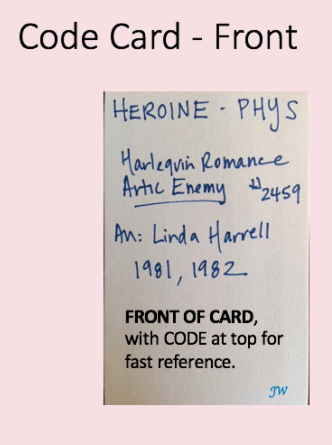
Students were then assigned code cards. Each student had to produce 10 cards to satisfy the larger category romance project assignment. I gave them time in class to read and search for codes in our data set books, and they also were allowed to use my books outside of class. Students also drew on the massive online library at the Romancewiki, as well as other online sources, such as Goodreads, AbeBooks, Amazon, and publishers' web sites.

As students turned in completed code cards, I scanned them front and back, and uploaded them to our online course site, saving them with titles that reflected the codes. As more cards were submitted, I continued to scan and upload. Students then had access to all other students' research on the codes or associated codes that provided responses to their chosen research question.

#metoo was very much in the headlines during the time we were working on this project, so students were encouraged by world events and by events happening on college campuses to ask questions about rape culture and consent, and their connection to romance reading.


CONCLUSIONS

In their final projects, students wrote on virginity, consent, race and ethnicity, sexism, and cover art. Some of the essays were outstanding; others were standard first-year fare. But students all walked away having grappled with important and complicated issues. Old school category romances are an on-ramp to complicated discussions of power: segregation in publishing; what it means for readers of color to be forced to read only of white characters; the prevalence of rape culture and "forced seduction," and the ways that popular romance reflects and reproduces that culture.

Happily Ever After is a master narrative, and I see this as one of the grand takeaways of this course. What happens to our personal narratives if partnership at the end of a story is removed? If it's not a (or the only) desired ending at all?

One of my students said during class one day, "Sometimes I think you hate these books, and sometimes I think you love them." YES. Her comment raises an important question: how can we acknowledge the historical moment in which these stories were written and respect their authors, while at the same time use them as examples of what not to do today?

The romance plot forces us to navigate ambiguity and complexity, to articulate this feeling of bothatonce (or many things at once). One thing is not ambiguous: popular romance is definitely female and almost universally denigrated. By studying popular romance in the college classroom, both scholars and students have the opportunity to develop language that acknowledges criticism but allows for imperfection, for our own sometimes conflicted ideas about the genre and ourselves as readers of it. Such study unambiguously asserts the importance of genre romance both as a body of writing and as one example of a communal representation of the female imagination.


Readers, if you had the chance to take a class on popular romance, would you? What research questions would you want to explore?


Note: This post is based on a talk given by Dr. Wofford at Bowling Green State University's Browne Popular Culture Library, at the Researching the Romance conference.

Tuesday, April 3, 2018

Thoughts on the original RITA winners

When I came across romance author Corinna Lawson's January 2018 post on B&N Reads' blog, "The Great RITA Read: In the Beginning," I was decidedly intrigued. Lawson announced her plans to read and then write about past winners of Romance Writers of America®'s Golden Medallion Awards, now the RITA Awards, as a way to "explore the history of the romance genre." This first column focused on the four books which were the first to be named Golden Medallion winners (back in 1982): one long and one short historical, and one long and one short contemporary romance. I thought it would be fun to try and find these books and read them too, and then talk about my findings here on the blog.

Given its place on a Barnes & Noble-sponsored web site, Lawson's post leans towards more toward the celebratory than the analytical. Lawson notes that she had some "preconceptions" about what the books would be like, given conventional wisdom about Old Skool romance. In particular, she worried that these books' heroines would be flat, tame damsel-in-distress. But actually reading the books quickly dispelled her preconceptions: "I had a collection of characters who would not be out of place in a contemporary romance," she argues.

I wondered if I would feel the same.

After reading the two short Golden Medallion winners, Constance Ravenlock's , Rendezvous at Gramercy (Candlelight Regency Special 1981) and Brooke Hastings' Winner Take All (Silhouette 1981), I can report that I both do and don't. Neither spoiled Regency rich girl Alexis Palme, nor window-turned-business-owner Carrie Spencer is your stereotypical passive heroine. Yet both are distinctly limited by the gender roles of the 1970s. And both of their narratives struggle, sometimes implicitly, sometimes explicitly, with questions about gender equality that the Women's Movement of the 1970s brought into the popular consciousness.

At the beginning of Rendezvous at Gramercy, our heroine, nineteen-year-old Alexis Palme, is a self-involved, rather heartless girl. Her American mother is dead; since that death, her Swedish diplomat father has "taken to spoiling his only daughter until the sweetness was little more than an evanescent mood and her prettily curved lips were more frequently hardened into a line of stubborn arrogance" (20). Ravenlock doesn't just tell readers this; she shows her protagonist's selfishness in the opening chapter, by having Alexis care more about her clothing than about the war raging across Napoleonic Europe; by showing her refusing her maid's request to remain in England with her sweetheart rather than travel with her to Gibraltar where she is to meet her father; and by having her keeping the ship upon which she is to travel waiting: "Naturally the ship's captain would understand a woman's last minute packing requirements, even if he had stressed the importance of her arriving at the latest by eight fifteen" (12). Alexis, then, is the type of heroine with whom readers are not expected to identify, at least at the start of the story. The romance will spend the bulk of its time tracking Alexis's transformation, from self-centered, thoughtless society girl to other-centered helper of the poor and downtrodden. Ironically, though, it is the very arrogance and self-assurance for which Alexis is condemned at book's start that allows her to succeed in her new role as smuggler and spy.

Early in the story, Alexis's ship wrecks off the north coast of France, landing her in Breton, or Brittany. Rescued by an elderly pair of aristocrats, Alexis's restless curiosity soon leads her to discover that the aloof Count and Countess de Chambord are deeply involved in smuggling goods from the British to help the impoverished Breton peasants. But when the Count is injured, Alexis ends up taking on his role in the smuggling rather than fleeing with the English smugglers herself, going out at darkest night to exchange French goods for British. Masquerading as the Count and Countess's niece, Alexis also pretends to flirt with the suspicious colonel at the local garrison, a man bent on discovering and routing the smugglers, to pump him for information. Said flirting felt pretty smarmy to me as a reader, in part because I got the feeling that Alexis enjoyed what she was doing, plying her feminine wiles to deceive the obviously dim Colonel. Alexis, then, is not a passive damsel, but an active protagonist, but she can only act under the guise of deception.

Another sign of the story's dated feminism is it's "mean girl" foil, a staple of 70's and 80's category romances. The de Chambourd's actual niece, Laure, who arrives mid-book from Paris to create more difficulty for the smugglers, bears a remarkable resemblance to Alexis at the novel's start, and serves primarily to show readers that Alexis is no longer the unfeeling creature she once was. For now, unlike Laure, Alexis is kind to the servants; she respects the poor and feels a landed gentry's responsibility to aid and succor them; and she disdains Laure's focus on finery and frippery (at least when it is the sole focus of one's attention and concerns).

This is a romance novel, but Alexis's love story takes a decided second seat to the derring-do of the smuggling plot. Her love interest is a doctor, Edouard Lautrec, a bitter, disillusioned former naval surgeon who initially suspects Alexis of "the vilest foppery and shallowness" (59). I'd expected that the two would end up working together by book's end, Edouard seeing beyond Alexis's false mask to her true, good smuggler self. But Edouard is pretty much a bystander to the majority of the action up until the very end of the story, after Alexis has stolen jewels from the smug actual niece of the Count and Countess, after she's duped the smarmy Colonel again and again, and after she's disguised herself as a drunken slop-bucket carrier to free her former fellow shipmate, an English seaman, from prison. Only after the dim Colonel finally catches on and imprisons and whips her does the good doctor come riding to her rescue. So yes, in fact, Alexis does need to be rescued at novel's end. But the rescue feels almost as gratuitous as the romance in the book, a cap added to appease the conventional trope of male hero saving the heroine which does little to mask the self-directed actions of the female protagonist we witnessed throughout the bulk of the story.


Caroline "Carrie" Spencer, the heroine of Brooke Hastings' Golden Medallion short contemporary Winner Take All, seems to be far more empowered at the start of her story than Alexis Palme was. She's the owner of Elliot Bay Electronics; she has a college degree; she even enjoys playing basketball in her spare time. A modern empowered woman, no? But this contemporary romance is far more ambivalent about female power than its historical counterpart.

Carrie only owns Seattle-based Elliot Bay because she inherited it from her dead husband. And her authority as owner is continually questioned, not just by other characters, but by Carrie by herself. And by the plot trajectory of the novel as a whole.

Within the first paragraph, we learn that "Caroline invariably felt inexperienced" by comparison to the company's longtime comptroller, and, a few paragraphs later, that "she never could have fulfilled her duties as president so competently without his encouragement and advice" (9, 10). And by page three, we hear that her former brother-in-law has just sold off his share of the company to corporate raider Matthew Lyle, a man who has a reputation for hostile takeovers of reluctant companies. The stage is set: alpha male Matthew against ice queen Carrie, cool on the outside but deeply insecure on the inside.

Carrie thinks to get the jump on finding out about Matthew by going to observe him when he speaks at a local boat show. Little does she realize that he's already out-manipulating her, arranging to casually "bump" into her and ask her out on a date, pretending all the while that he has no idea who she really is. The two have an enjoyable, if argumentative, dinner; when Matthew sees her home, he immediately begins to kiss her (this contemporary is far more interested in sex and sexuality than its historical winning counterpart). In typical Old Skool romance style, Carrie's mind protests, while her body can't help but respond:

Her lips were parted with punishing swiftness, her mouth probed and explored with passionate impatience.
     It was the first time Caroline had been kissed by a man with any real experience and technique. Matthew had gone too fast—demanded more than she could give—and initially she froze, her body objecting by means of a sudden, shocked stiffness. Her hands slid up to push against his chest, rejecting his rough invasion of her mouth. Although he loosened his hold, he refused to release her. His mouth became gentle and persuasive again, caressing, nibbling, teasing relentlessly.
     Caroline heard her own soft moans as she began to kiss him back. Now when he parted her lips the intimate feel of his tongue moving against her own was arousing rather than alarming. And when he deepened the kiss into a passionate conquest, Caroline was only too ready to be enslaved. (53)

Carrie, despite having been married, is a virgin (older, ill husband), and is decidedly skittish when it comes to sexual intimacy. Behavior which the arrogant Matthew interprets as teasing, a tactic to which he strenuously objects. He objects so much, in fact, that he makes her a bargain: spend a weekend away with him, and he'll stop his hostile takeover of her company. He'll settle for two seats on the board of directors and an immediate audit of the books.

Carrie, of course, objects to this crass bargain, but after she discovers that her kindly comptroller, on the instructions of her now-dead husband, bribed companies to win contracts for the firm, her former determination to fight the takeover begins to waver. Because the audit Matthew is insisting upon will likely send Sam Hanover to jail. Carrie worries for Sam, and for her late husband's reputation, but isn't at all happy about the idea of giving in to Matthew, even though subsequent meetings continue to demonstrate that when it comes to his sex appeal, Carrie's mind may protest, but her body inevitably gives in.

Twenty-first century rape victim advocates argue strenuously against the automatic equation of a sexually responsive body and affirmative consent to sex. But in early 1980s category romance, a sexually responsive female body is always read as a sign of willing, usually repressed, female sexual desire, a sexual desire that a strong male will insist takes precedence over any woman's verbal refusal to engage in sex. As Matthew explains in frustration, "When you stand there like that, not moving, I can't take it. Because I can feel you wanting me and resisting it. I can't stop myself from forcing you to respond when I'd rather not have to do that, Carrie" (93). A man knows better than a woman what she wants, and is rather put out when she refuses to acknowledge it.

Interestingly, Carrie's office assistant and close friend Maggie, a divorcee who lives with her boyfriend, offers a different take on female sexuality. Maggie gives Carrie the purportedly liberated woman's view of sex:

"Just remember that when you go to bed with someone, Caroline, you don't have to give him your soul, and you don't have to sacrifice your independence. You'll be giving Matthew Lyle your body for forty-eight hours—nothing more. From what you've told me [that she finds Matthew attractive], you'll probably enjoy doing it. Afterward, you can refuse to see him again, if that's what you want. There's no reason to become emotionally involved with him." (73)

But the 1980s category romance rejects any attempt to divorce emotional involvement from sex, at least for a woman. Though she plays basketball with men, and runs her own company, Carrie is not the liberated woman than Maggie is; she can't imagine sex divorced from love, and neither can the category romance. To Carrie, such a divorce is tantamount to using someone, and using herself.

Carrie is, however (perhaps like the average female reader of 1981?) interested in the women's movement. One of the books she's reading is "the latest novel by an aggressively feminist author who had raked the male sex over the coals in her three previous books" (87). Needless to say, Matthew isn't at all pleased to hear about Carrie's current book: "I'm not letting you near that one. By the time you've read two chapters, you'll probably throw it at me" (87). Feminism is tantalizing, but "aggressive," dangerous wrong. It's not surprising that by book's end, the liberated Maggie is planning her wedding.

Back to the story, from that quick diversion: In spite of her misgivings about his proposed bargain, Carrie ends up deciding to agree to Matthew's terms, reasoning that "It would cost her nothing to go up to the San Juan Islands with him, because if she found that she couldn't go through with it, she could walk out of his cabin and find a place to stay in town. He wouldn't drag her into bed—he was hardly the type to engage in rape" (74).

But Matthew is the type of engage in a bit of kidnapping, in the form of tricking Carrie onto his boat and taking her not to the populated San Juan Islands, but to a private island of his own. Carrie asked to return home, saying she's changed her mind, but Matthew arrogantly refuses: "By Sunday night you'll thank me for kidnapping you; I promise you that" (100). How quickly would an executive in 2018, acting like Matthew does, be hit with a sexual harassment lawsuit?

Carrie managed to fend off his advances, first by drinking too much and throwing up, then by crying, then by admitting she's a virgin. Matthew, of course, misinterprets her revelation:

"Make him happy? When you wouldn't let the poor guy near you? He must have been absolutely besotted with you, to marry you on those terms, His life must have been one long frustrated agony. And I thought he had hurt you! Just what kind of sadistic, manipulative woman are you?" (115)

But at least he stops importuning her. At least for a short while; not a month later, after hearing more kindly things about her from the son of his colleague, who is a basketball teammate of Carrie's, Matthew approaches her again, offering marriage rather than an affair. More bargaining ensues: if she marries him, will he call off the auditors? He says he will, but then breaks his word, which of course turns out to be justified (in order to get rid of the now not so kindly comptroller), once again undercutting Carrie's authority as head of her own company. By novel's end, the two are happy in their marriage, Carrie because Matthew loves her, and because he allows her to keep running a portion of her company (he's split off the government contract side of the business).

The book concludes with the two joking about women's lib:

     "I'm not about to object. I like the idea. Just think—our son could be the next Bill Bradley," he mused. "College All-American, Rhodes scholar, pro basketball player, United States senator. We've got all the right genes, sweetheart."
     "Really?" Caroline asked with feigned coolness. "And suppose we have a girl, you male chauvinist! Your mother wants a granddaughter, you know!"
     "Carrie, my beloved, enough is enough. I'll only accept so much liberation from the women in my family, and that's it! A corporation president for a wife is one thing, but no daughter of mine is going to make it her life's goal to get drafted by the Seattle SuperSonics!"
     "How about senator from the state of Washington?" Caroline countered.
     "If you don't shut up and let me get you where you belong, there won't be any offspring, Mrs. Lyle."
     "Who's talking?" Caroline giggled and held out her arms to him. (189)

In the world of award-winning early 1980's contemporary category romance, there is both acknowledgement of women's desire for greater power and independence, and also deep anxiety about that desire. Winner Take All acknowledges both the desire and the anxieties it provokes, then works to contain those anxieties by insisting that a woman can be liberated, as long as her liberation is palatable to her husband.

And as long as sex continues to be equated with emotional intimacy and love.


Photo credits:
Fort-La-Latte, Brittany: Dutch, Dutch, Goose!
San Juan Islands: Visit San Juan Islands

Friday, November 17, 2017

Is it time to retire the phrase "sweet romance"?

Author Barbara James, in the comments section of several recent RNFF blog posts, used the phrase "sweet romance" to describe her writing. At around the same time, other romance authors on several listservs to which I subscribe were complaining about the same term—"sweet romance"—as well as its counterpart,"clean romance," as a label or category. What, exactly, does "sweet romance" say to a potential reader? And why do some authors find the term problematic?

Barbara James pointed to one specific meaning when she noted in a comment, "But the sex [in my books] is closed door, because I don't think graphic sex scenes are necessary—these are sweet romances!"  By this definition, a "sweet romance" refers to any romance novel in which sex scenes are not depicted on the page.


[A brief digression here into bibliographic historiography; feel free to skip if you want to get directly into the whys & wherefores...

Who first began calling romances without sex "sweet"? I ran a Google Books phrase search for "sweet romance" between the dates 1970 and 1980, expecting to find the phrase turning up in this period, in reaction to the more graphic sensual historicals that poured out of New York publishing houses in the wake of Avon's 1972 publication of Kathleen Woodiwiss's The Flame and the Flower. How could you have a "sweet" romance until you had a "sexy" romance with which to contrast it? Before Woodiwiss, all romances were what we today would term "sweet," so there would be no need to create such a label or category.


Google Books Advanced search was not of much help, unfortunately. It cites Ann Hampson's 1978 contemporary Harlequin romance, Sweet is the Web, includes an advertisement at the back for another series, Harlequin Historicals, which uses the phrase. But as this line did not begin publishing books until 1986, this must be a later reprint copy, rather than an original 1978 copy:

HARLEQUIN HISTORICALS
The broad, bold sweep of history and the quiet times of sweet romance—powerful, sinister lords doing evil deeds, and great ladies in gem-studded silks brushing against ragged beggars and homeless waifs (193)

The search noted the phrase appears in the Library of Congress's 1978 Catalog of Copyright Entries Third Series, although whether it appears as a descriptive phrase, the name of a line of books, or as the title of an individual book or books, one can't tell, as the search doesn't show an inside view of the book.

Google also cites the 1979 Australian Parliamentary Papers, and shows a tiny snippet from the book:


But this looks more like a book title than a descriptive phrase to me.

Moving on to 1981-1985 turns up a single citation, in the 1985 New York Times obituary of bestselling author Taylor Caldwell: "Not sweet romance but melodrama was her stock in trade, laced increasingly with her own conservative political opinions."

In fact, the term as used to refer to romances without sex only starts to show up on Google Books' radar in the 1990s, in guides to writers interested in writing romances, and in the works of librarians and scholars:

Wayne Barton and Kristen Ramsdell's What Do I Read Next? (1993) 
A Poetics of Criticism (1994)
Eve Paludan's The Writers' Pink Pages (1995)
David H. Bourcherding's Romance Writer's Sourcebook: Where to Sell Your Manuscripts (1996) 
Kristen Ramsdell's Romance Fiction: A Guide to the Genre (1999)
Kay Mussell and Johanna Tuñón's North American Romance Writers (1999)

That the term doesn't appear very often before 1990 may be due to the fact that Google's Book search includes fewer books from before the Internet age. I'd be curious to know if anyone has pre-1990 romance novels that refer to themselves as "sweet romances," or which include the phrase "sweet romance" in their sell copy.

End of bibliographic/historiographic digression :-)]


Why do some authors get annoyed by the phrase "sweet romance"? The ones on the listservs I read had two main objections.

First, those who write romantic mysteries, or gothic romances, or other darker books with romance plotlines but which also did not include sex scenes, object that the term misrepresents what they are writing. Their novels may not include sex on the page, but books with haunted mansions, gruesome murders, and psychopath villains should by no means be termed sweet. To label them as such is to misrepresent their contents to potential readers.

Second, feminist-inclined readers object to the term because, taking a page from Deconstructionist literary criticism, they understand that the phrase serves as one half of a binary opposition. The other side of the opposition—"not sweet" romance, or "sexy" romance, (or, if we use the companion phrase, "clean romance," its opposite, "dirty" romance)—is not just other, but lesser. Because of the positive connotations that go along with the word "sweet, "sweet romance" becomes the positive term in the binary, while its opposite is held up as a negative: something to be avoided, shunned, or denigrated. Sweet romances do not feature sex; romances that do feature sex are therefore not sweet. The label "sweet romance" thus implies that sex is bad, shameful, a decidedly unfeminist position.


Why, then, do we not simply call romances that do not include sex scenes "no-sex romances" or "romances without sex"? I think in part because the term "sweet romance" carries some additional connotations, connotations that are about more than just sex.

I hear hints of these connotation when Barbara James brings up the phrase again, this time in a comment in response to an RNFF blog post about how to define "feminist romance":

I write sweet romances. So my characters might be seen as anti-feminist. They are in college, but they want to graduate with their Mrs. Degree, work, and have their first children by their mid-twenties. They would rather become stay at home moms, work from home, or work part time while their children are small.

"Sweet" here does not just refer, then, to the presence or absence of sex. "Sweet" is a political position packaged as a personal choice. It links not having sex (or not showing it on the page) with other personal choices: for a young woman to want to marry (a man); for her to want to have children by a certain age; for her to be the parent who remains at home with young children, rather than her husband. It never questions why certain women should want such things, or what role public policies and institutions might have played in shaping private, "personal" decisions.

Why can't a sweet romance feature a 40 year old heroine? A heroine who falls for another woman? A heroine who never wants to have children? Any of these storylines could be written without explicit sex scenes, couldn't they?

I'm guessing it is because "sweet" carries with it a whole lot of other meanings than just the sexual one.


What would you say to retiring the term "sweet romance" and replacing it with "romance without sex"? Or, in the case of the sweet romance in which "sweet" means just a little bit more, how about "traditional values romance"? Or "socially conservative romance"?


Photo/illustration credits:
Binary opposition: Slide Share