Showing posts with label teaching feminism. Show all posts

Friday, June 15, 2018

Popular Romance in the Classroom: Guest Post by Jennifer Wofford


Please join me in welcoming to RNFF Dr. Jennifer Wofford, a professor as well as a romance author, as she describes her recent experience of teaching first year college students through the "Category Romance Project."


My name is Jennifer Wofford. I teach writing and popular romance at Ithaca College in Ithaca NY. I also write historical romance under the name Giulia Torre. Along with Catherine Roach, I self-identify as an Aca-Fan, an academic who is also a fan of what she studies. I study romance while wholly immersed in it—reading, writing, teaching, and advocating for its importance and complexity on all fronts.

In the fall of 2017, in my first-year college writing seminar Reading Popular Romance, I piloted the "Category Romance Project," a classroom-based, large-group student research project that explored "vintage" category romances (20 years or older) from a social science perspective.

I proposed Reading Popular Romance as a social science course with the sponsorship of IC's Writing Department. Ever since the publication of Janice Radway's Reading the Romance (1984), scholars have been using social science to analyze the genre. Social science was the most exciting thing to happen to my relationship to text since I read my first Bantam Loveswept romance in 1984.

I was introduced to social science methods by Brian Street through the field of New Literacy Studies. NLS takes an "ideological approach" to the study of literacy—to reading, to writing, and to text in all its forms and contexts. Through language we create, acknowledge, and most often presume mythologies and master narratives that in turn guide and make sense of our actions.

Community of Inquiry model
Because of what I learned from NLS, my approach to teaching is a theoretical framework called "Community of Inquiry," or CoI. Learning is social, and therefore relies on participation in a community. The CoI model turns the classroom into a site of literacy research. I've found that this approach gives students the skills for recognizing their own identity filters, for designing research questions that in turn create strong claims, for creating compelling arguments and finding something to say, and ultimately for developing their own authentic voices. Simply, students write better papers when they use the CoI approach.


STEP ONE: FIND A SHARED LANGUAGE

My first step in creating a community of inquiry around a classroom research project is shaking out students' funds of knowledge, getting everyone's cards on the table. During sessions designed to focus on students' transition-to-college issues, we discussed issues related to race, gender, sexuality, and mental health. Student panels and speakers trained in conducting such conversations came to the classroom to tell us their stories, so students had a way of talking about real world issues and their own identities without having to use themselves as examples.

Also during these sessions, I asked students to bring in examples of popular love songs as well as  their favorite romantic movies. Songs and movies are an easy way to get students talking about romance. They can also serve as good ice breakers: students feel a teacher is a bit more approachable after seeing her dance to Tina Turner during the first week of class.

These initial conversations about romance and about identity served as points of reference throughout the remainder of the course. For example, in one section of my course, 9 out of 16 students self-identified to the group as having been diagnosed with anxiety or depression or as having suicidal thoughts. Reading Alexis Hall's Glitterland in the context of these students' experiences was far different than in sections where students did not identify so closely with the mental health challenges of Ash Winters, Glitterland's protagonist.


STEP TWO: INTRODUCE CONCEPTS IN POPULAR ROMANCE

While students recognized and shared their own knowledge about romance, I also introduced new concepts that weren't already a part of their own systems. Students learned the difference between romantic and popular romance and romanticism, as well as the definition of "trope" (and key examples from genre romance). Weekly lectures gave students the language of Romancelandia, as well as some of the tools by which they could analyze individual romances and the romance genre as a whole. In addition, we discussed theoretical concepts, such as Lyotard's notion of "master narrative," a story that explains society and cultural norms while at the same time legitimizing the status quo. Master narratives make it difficult to understand reality in any other way than the "dominant" narrative. Popular culture often uses counter-narratives to make make alternative narratives visible. One of the more well-known master narratives in the United States if the history of Columbus "discovering" America. The word "discovery—and the master narrative it implies—wasn't challenged until relatively recently. We discuss the ways that the HEA (Happily Ever After) of romance is a master narrative.


STEP THREE: INTRODUCE THE CATEGORY ROMANCE

Quite simply, I tried to explain the category romance to this generation of students. My students had a hard time conceptualizing the category romance, even when faced with a large pile of examples. I explained that category lines represent subgenres in mainstream romance publishing, and that these sub-genres have rules about authors' use of tropes, archetypes, and plot lines, rules that readers come to expect and use to guide their reading choices.

There seemed to be nothing like the category romance in their world.

Showing students covers of books with the same trope helped.


STEP FOUR: INTRODUCE SOCIAL SCIENCE METHODS

As an entrance into the analysis of texts by way of social science methodology, we read Lily King's Euphoria (2014), a work of fiction inspired by the story of anthropologist Margaret Mead. Set in 1930s New Guinea, Euphoria tells of a love triangle between three anthropologists in the field, each of whom is struggling with varying degrees of failure to "see" beyond their own limited perspectives. The novel represents the social life of text in various forms. The female protagonist writes field ethnographies. All three scientists hunker down over a colleague's monologue draft mailed to them from back home. The antagonist searches for an artifact that will prove a primitive culture had a written language.

After students finished reading Euphoria, I learned that they originally thought the book was a romance. But this book has one of the most heartbreaking and haunting endings in my memory. As un unanticipated teaching moment, students got to experience the phenomenon of reader expectation (and the dashing of same) in commercial romance.

In addition to reading Euphoria, students read brief, introductory articles in the fields of New Literary Studies and social linguistics. Social science is a valuable process of alienation, or de-familiarization. One activity proved particularly effective in demonstrating this process of alienation. I asked students to draw a sentence from an NLS article, and we browsed the results, looking for patterns. They realized that we're ruled by rectangles—paper (everyone drew on lined paper), tablets, screens, desk tops, even the very room that we were in. Standardization is a master narrative. It's invisible, and we think it's valuable (cost-efficient, replicable, consistent) without even questioning what gets lost when we sit, write, and think inside boxes.

By reading about anthropologists at work, a fiction focused on a central love story, through the lens of social science, students become attuned to looking at rather than through the water in which we swim.


STEP FIVE:  DEFINE THE DATA SET

So what exactly was our data set? We started with three category lines:

• Harlequin Presents
• Harlequin Romance
• Bantam Loveswept


Perilous stack of vintage category romances
(buttressed with a Heyer and a Woodiwiss)
Why these lines? For me, they are my everyday. I own them in the hundreds. I'm familiar with the plot structure, archetypes, and authors. And I love the covers. Not only because cover illustration is a lost art, but because covers are a clear visual representation of how the mainstream West allowed love, intimacy, sex, and gender to be represented over time. Covers were indeed a favorite topic for students.

We restricted our reading to books at least 20 years or older.

Were there problems with this data set? You betcha.

Vintage category romances are white, there are no two ways about it. But the utter absence of characters of color is, in and of itself, a wake-up call. It's a way to understand the full scope and impact of whitewashing, as well as the privilege of reading while white.

This data set is also unarguably heternormative. These books tell the story of heterosexual romance. In the very first book in the Loveswept line—Heaven's Price by Sandra Brown—the heroine's first long-term romantic partner was gay, which provided the logical reason for her still being a virgin. But that's as queer as these books get.

After butting up against these limits, we decided to expand the data set. I assigned questions that charged students to research on diversity and diverse voices in popular romance. They returned with blog posts on the closure of the Kimani line and segregation in romance publishing, as well as information on Bold Strokes Publishing and women writing romance with queer male characters. This diversity research provided some of the most interesting discussions in the course, and many students ended up choosing final paper topics on issues related to their diversity explorations. Each student expanded their own data set, but the limitations of the larger set remained intact. To a significant degree, it was the limitations of the set that taught students the most, both about research and about master narratives in romance. That said, when I teach this class next year, the data set will at the very least include early books from Harlequin's Kimani and Arabesque lines, as well as a canon-busting assignment to expand the classroom library.


STEP SIX: SOLICIT RESEARCH QUESTIONS

When presented with hundreds of gorgeous, but designed-to-be-ephemeral books, students were mesmerized and astounded, sometimes even shocked. They started reading the back covers and inside blurbs, and then began to reach them aloud to one another. It was a very natural process for them to start to ask questions about what they were reading.


All questions were shared among students and between sections. An important element of the course is to share questions so that students can also share findings. But it has the added benefit of giving students an understanding of what makes a good question.

Through the simple act of considering what they would have to do to answer their question, students learned an important lesson: some questions are unanswerable, given the constraints of both our data set and of the time allotted to the project.


STEP SEVEN: DEFINE CODES
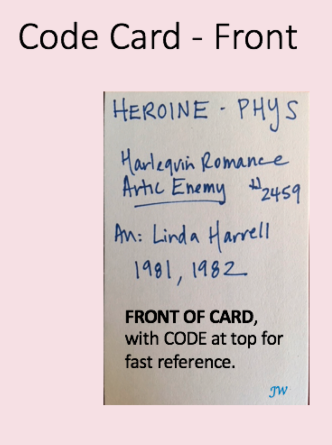
In anthropology, coding is used to chunk and classify concepts in the social scientist's ethnography: the field notes and rich description of her subject. Coding feels a lot like textual analysis. When coding is applied to literary texts, it functions to highlight the text's cultural dimensions. I created a starter list of codes—single words or short phrases to signal a theme or topic or question—and shared them with the class. These codes directly represented their specific questions. As new questions emerged, students were charged with creating and sharing new codes.

Students were then assigned code cards. Each student had to produce 10 cards to satisfy the larger category romance project assignment. I gave them time in class to read and search for codes in our data set books, and they also were allowed to use my books outside of class. Students also drew on the massive online library at the Romancewiki, as well as other online sources, such as Goodreads, AbeBooks, Amazon, and publishers' web sites.

As students turned in completed code cards, I scanned them front and back, and uploaded them to our online course site, saving them with titles that reflected the codes. As more cards were submitted, I continued to scan and upload. Students then had access to all other students' research on the codes or associated codes that provided responses to their chosen research question.

#metoo was very much in the headlines during the time we were working on this project, so students were encouraged by world events and by events happening on college campuses to ask questions about rape culture and consent, and their connection to romance reading.


CONCLUSIONS

In their final projects, students wrote on virginity, consent, race and ethnicity, sexism, and cover art. Some of the essays were outstanding; others were standard first-year fare. But students all walked away having grappled with important and complicated issues. Old school category romances are an on-ramp to complicated discussions of power: segregation in publishing; what it means for readers of color to be forced to read only of white characters; the prevalence of rape culture and "forced seduction," and the ways that popular romance reflects and reproduces that culture.

Happily Ever After is a master narrative, and I see this as one of the grand takeaways of this course. What happens to our personal narratives if partnership at the end of a story is removed? If it's not a (or the only) desired ending at all?

One of my students said during class one day, "Sometimes I think you hate these books, and sometimes I think you love them." YES. Her comment raises an important question: how can we acknowledge the historical moment in which these stories were written and respect their authors, while at the same time use them as examples of what not to do today?

The romance plot forces us to navigate ambiguity and complexity, to articulate this feeling of bothatonce (or many things at once). One thing is not ambiguous: popular romance is definitely female and almost universally denigrated. By studying popular romance in the college classroom, both scholars and students have the opportunity to develop language that acknowledges criticism but allows for imperfection, for our own sometimes conflicted ideas about the genre and ourselves as readers of it. Such study unambiguously asserts the importance of genre romance both as a body of writing and as one example of a communal representation of the female imagination.


Readers, if you had the chance to take a class on popular romance, would you? What research questions would you want to explore?


Note: This post is based on a talk given by Dr. Wofford at Bowling Green State University's Browne Popular Culture Library, at the Researching the Romance conference.

Tuesday, July 28, 2015

The Li.st Romance Panels: Is Romance Feminist?

Last week, eight romance authors, invited by the Li.st, gathered in a New York City work cooperative space to speak to an enthusiastic audience about romance, feminism, and sex. I was thrilled to be a part of the audience, and planned to write up a report for RNFF readers on the evening. Of course, now that I'm back home, unpacking after the RWA annual conference, which took place in the days following the Li.st panel, I can't for the life of me find the extensive notes I took as the authors talked and debated. Insert your favorite curse words here...

Luckily for me, fellow romance scholar Jayashree Kamble live-tweeted during the panels, and put her tweets together on Storify; you can find her tweets here.


"Feminism and Romance" panel: Alisha Rai, Sarah MacLean
Maya Rodale, and Carla Neggers. Photo from Alisha Rai's tweet
There are a few things that I'd like to add to Jayashree's thoughts. Maya Rodale, moderator of the first panel, "Romance Novels as a Feminist Trope Throughout the Centuries," opened the discussion by asking her fellow panelists "Are romance novels feminist?" Kamble suggests in her tweet that the response was "hell, yes" (or perhaps that was Kamble's answer?), but panelists' actual comments were more nuanced. There was a bit of silence at first, that funny pause that sometimes happens at the start of a panel talk when no one is quite sure who is meant to speak first, and Rodale interjected a few more questions "Are romances bad?" "Romances are written by women for women, about women, no?" MacLean and Rai then jumped in to note the difficulty of answering any of these questions with a simple "yes" or "no," especially given the breadth of the romance field at present. Carla Neggers, who has been publishing longer than any of the other panelists, added historical context, talking about many of the limits placed on romance authors when she was just beginning her career, and how many of those limits are no longer in place.

"How has the romance genre evolved over the past few decades?" was the next topic Rodale asked panelists to consider. The greater diversity of the genre, particularly in regards to the inclusion of romances featuring LGBTQ protagonists and protagonists of color. Rai had perhaps the best line of the night, though, when she noted that diversity still has a looooong way to go in the largely still-white world of romanceland: "We say evolution, but evolution is too slow. We need revolution." #weneeddiverseromance, indeed.

Sarah MacLean, who is white, did not disagree, but framed the issue somewhat differently, suggesting that the genre is on the edge of a huge shift, moving inexorably towards a more inclusive stance. Other panelists noted that diversity took hold first in the ranks of the self-published, and is only gradually (if at all) effecting the look of the pub lists of the big 5 romance publishers. It would be a cool research project, my academic self thinks, comparing the numbers of POC and LGBTQ characters in books by those publishers over the past 5, or perhaps 10, years...

Readers' often judgmental stance towards romance heroines formed another topic of discussion, but soon segued into thoughts about the prevalence of the billionaire hero in contemporary romance published in the past few years. MacLean put forth a theory that I've heard in other venues: that romance is a fantasy, and today, given the tough economic times and the dual role of worker and homemaker that the majority of American women have to play today, the fantasy of being swept away by a man who has so much money that you'll never need to worry about paying the bills again is vastly appealing.  Rodale concurred, focusing on the alpha male in billionaire romance not only being able to meet the heroine/reader's economic needs/worries, but also being able to address her other desires (sexual, emotional), desires that in everyday life often have to be pushed to the side. I get this argument, but I'm wondering why books in which the women are billionaires themselves, and fall in love with appreciative guys, aren't nearly as popular? Is there some gendered sense that a rich woman will be exploited? That a rich woman is somehow bad? That she must have had to do something not quite feminine in order to achieve wealth? That being a billionaire is hard work, but loving one is not? I'd love to hear readers' thoughts about this...

The question of happy endings—does romance require them, or can the genre take them or leave them?—concluded the first panel. Most audience members seemed to be in the former camp, despite Rodale's citing of many romance-writing and -reading friends who are happy to live without the HEA, or even the HFN. I wondered if there is anything inherently feminist, or anti-feminist, about the restrictiveness, of the HEA—what do you think?


"Erotic Writing and the Role of Women" panel. Photo from Alyssa Cole's tweet

The second panel, "Erotic Writing and the Role of the Woman," featured an entire panel of romance writers of color, a rarity at RWA or other meetings, unless the workshop/panel topic is about diversity (more about this in Friday's post). Feminista Jones, a sex-positive social worker, activist, blogger, and now BDSM romance novelist, moderated the discussion with fellow erotic romance writers Suleikha Snyder, Rebekkah Weatherspoon, and Jordan Silver.

I thought it was fascinating that all of the writers except for Jones began their writing careers penning fan fiction, then discovering through traditional or, more often, through self-publishing, that what they were giving away for free could be earning them money. Does the slash tradition of fan fiction make writers more comfortable with erotic romance publishing? Does the independence of fan fiction (no editors, no publishing houses) lead fan fiction writers more easily to self-publishing?

This panel, like the earlier one, talked about the changes in the romance genre over the past 20 years. The rise of self-publishing; the shift from heroines with no sexual agency to heroines whose sexual desires are affirmed; the rise of queer romance, and sex-positive romance—just a few of the changes the panelists noted.

A fascinating exchange occurred between Jordan Silver, who declared that she wasn't a feminist, that she liked alpha males and wanted to be taken care of, and Feminista Jones, who spoke about the often fraught relationship between black women and feminism (many black women feeling that feminism is a white girl thing, without any real relevance to their lives). Jones argued for a broader understanding of feminism and its focus on equality for women, no matter their race or ethnicity. The discussion highlighted a point made earlier in the evening, that there is no one black voice, no one black identity; the three women of African descent on the panel were all coming from different backgrounds and different cultures, and one's experience did not mirror that of the others'. Only when we have enough books with people of color will we be able to move beyond the assumption of a monolithic black identity.

Jones also spoke about the feminism she tried to portray in her BDSM romance, Push The Button, which she wrote partly in reaction against the misconceptions about the BDSM lifestyle she saw in the popular 50 Shades of Gray novels. A member of the BDSM community herself, Jones wrote Push to present the everyday life aspects of a s/D relationship. When I read Push, I didn't find it that feminist, to be honest. After hearing Jones speak, though, it's clear that she herself has a strong grounding in feminist ideas, and I'm curious to know more about how she sees those ideas playing out in her novel. I've emailed her to see if she might like to guest post here at RNFF; will keep you posted...

The panelists also discussed the difficulties in finding homes for their work with traditional publishers, in large part because of the paucity of agents and editors of color in the industry. I've seen far more younger editors in the business than there were when I worked in publishing (in the late 80s and the 90s), but until people of color hold positions of power within what are often very hierarchical publishing houses, the lack of real investment in the stories of writers of color is all too likely to continue.

Two other great comments from this portion of the evening: Feminista Jones took major issue with the idea that black women are not deserving of love; her goal in writing romance, she says, is to "show black women being adored." Suleikha Snyder mentioned that in one of her Bollywood novels, she had great fun writing one white character in her otherwise all Indian cast, ironically turning the tables on all of the token (insert minority identity here) portrayals found in the majority of American-published romance.

During the Q & A period, two questions white readers often ask of authors of color came to the fore: how do I find more books by writers of color, and how do I, as a white writer, include characters of color in my work without stereotyping/being offensive? The panel turned the first question back on the audience—rather than giving them places to find POC romance, the panelists challenged audience members to help create a publishing and consumer environment in which such romances will not be hard to find. Buy books by writers of color; use social media to promote writers of color; tell publishers that you want romances by writers of color. Don't let publishers off the hook by letting them continue to say that such romances do not sell.

The panelists were gracious in offering advice in response to the second question. Ask questions with thoughtfulness and respect, do research, run your stories by beta readers of color, even just make friends with people from cultures and ethnicities to which you yourself do not belong. What they did not say, but what I would like to add, is that it is not the responsibility of writers of color to make us white writers feel safe when writing about people outside our own cultures. We have to take a risk, be willing to make mistakes, be willing to be called out on them, learn from them, and keep going.

Just as writers of color have been doing all along.


More on Friday about the RWA National conference, and topics of interest there to feminist romance readers.

Friday, June 5, 2015

Teaching Feminism to the Younger Generation

Despite being a scholar of not only romance but also of children's literature, I'm not really all that keen on romance novels that feature kids as secondary characters. Romance novels are already inclined toward the emotional, and when kids appear on the scene, too often their emotion can slide into sentimentality (in the sense of emotion of the shallow, uncomplicated type). Kids put in danger in romantic suspense; kids used as comic relief in contemporary romance; sticky-sweet kids that urge us go "oooh" in all different subgenres—often the portrayal of children feels more like treating kids as objects, rather than as individual, unique characters. Thanks, but no thanks.

I was surprised, then, to find myself enjoying the interactions between the teen girl rugby players and the two adult romantic protagonists featured in Kat Latham's latest sports romance, Taming the Legend. In large part, I think, because both Camila Morales, the director of Camp Lake Sunshine, and Ash Trenton, retired rugby star turned temporary camp rugby coach, model feminist ideas and behaviors to their younger charges.

Such modeling isn't the point of the story, of course. Taming the Legend is a past-lovers torn apart only to reunite later tale, a staple romance novel trope, and the primary focus of the novel is on Ash and Camila's (re-)developing relationship. The fact that their modeling just happens, almost as if teaching kids about feminism is something both adults naturally take for granted, though, only makes it all the more appreciated.

Some examples of what I'm talking about:

During the first day of workouts, when Ash is introducing rugby to his rather reluctant female campers:

     Hannah raised her hand.
     "Yes?"
     "Running hurts my boobs."
     A couple girls snickered.
     "Yeah? I can't say it's all that comfortable for my bollocks either. I guess you'll have to get over it."
     ....
     "Let's get something straight." Ash said. "Being a girl is not a disability. Boobs, periods, cramps... I know you've got them, but I don't give a monkey's toss about them.... Look, I've spent my career training with men, but I don't care that your bits are different than theirs. They worked hard, and they've achieved great things. I expect the same from you, so I'm going to treat you the same." (Kindle Loc 1928)


And during the big rugby tournament, when one of the players spots Ash's former (hunky) teammate, whom she's been crushing on, with his girlfriend, Camila doesn't hesitate to call Tori on her sexism:

[Tori] glared at the petite woman Liam Callaghan had his arm around. "That bitch better get her hands off my man."
     "Tori. Language. And about a dozen other things, like he's clearly too old for you and already taken. And don't call other women bitches just because they have what you want. And did I mention too old?" [Camila said] (4370)


Small, brief moments in a much larger story, yes. But important, and exciting, nonetheless, such casual, taken-for-granted examples of everyday feminism being taught to the next generation. Something certainly worth noting, and even celebrating.


Can you recall any other romance novels that include such scenes of adults teaching, modeling, or enacting feminist ideals with or for child or teen characters?