Showing posts with label film review. Show all posts

Wednesday, June 7, 2017

Wondering about the Feminism of Wonder Woman, the film

Last night, I had the pleasure of accompanying my eighteen-year-old daughter to see the first big-screen iteration of the iconic feminist superhero, Wonder Woman. And of sharing my impressions about the film with her, and hearing hers in response, during our ride home together from the theater.  I'd like to share a few of those responses, those related primarily to the romance aspects of the film, with RNFF readers.

But be forewarned: movie spoilers lie ahead.

I'm not a big superhero film fan myself. With the exception of Margot Kidder's tough-talking Lois Lane in the first Superman films, such movies have not been all that feminist-minded in their depiction of the love interests of their male protagonists. Serving as rescue-fodder/bait, being killed by a baddie to provide emotional impetus to a crime-fighter, or functioning as objectified, hypersexualized object for the male viewer's gaze seem to be the only roles available to female love interests in such films. The situation isn't much better for actual super-heroines who have been featured as part of superhero groups, either. So I was more than a little doubtful going in to Wonder Woman that the filmmakers would be able to overcome this sexist history of female depiction, even when given a female heroine as their lead.

A fierce Robin Wright as the Amazon General, Antiope
Both my daughter and I were happily surprised to find far less sexism, and some outright feminist moments, in Wonder Woman. Most striking, perhaps, was the battle scene in the opening section of the film, when a troop of World War I Germans in pursuit of spy Steve Trevor land on the beaches of Themyscira (Paradise Island) and are immediately attacked by the protective Amazons. No fear, no shame, no worry appeared on any Amazon's face; each woman dove into the attack with energy and strength, wielding sword and bow with a skill any man would envy. Even as many of their comrades in arms fell to the hail of gunfire, none stopped to cry or mourn; each continued, unapologetically aggressive in their defense of their home against this onslaught of men.

I can't recall any similar scene in all of my years of film-viewing, one that depicted women behaving so aggressively and so competently, AND not fighting against one another but against a common foe. To my mind, the film would be worthy of praise if only for that one scene.

The battle does end with Diana, Princess of the Amazons, keening and cradling her dying aunt, the Amazon's general in her arms. But the scene does not serve to lessen Diana. Rather, it serves a dual purpose. First, to anoint her as her aunt's heir, the one who will take up her mantle as (in this film's mythology) the most powerful of the beings created by Zeus to help his human creations fight against the corruption of Ares, the jealous god of war. And second, to point to the film's underlying theme: the horror and human cost of war. For Diana, sheltered on Themyscira, war has only been a heroic story up until this point; the opening segments of the film depicted a battle-hungry child and teen eager to train and learn to fight her own battles. But now, Diana begins to understand not only the value of peace, but the costs of war.

On a lighter note, I enjoyed the flirting that takes place between the inexperienced but clearly knowledgable Diana and an attracted but morally upright Steve Trevor, both during their time on Themyscira and during their (improbably speedy) sail from the island to London. Diana may be a virgin, but she's not blushing over it; she's read all ten volumes of the Amazons' treaties about the pleasures of the body. From her reading, she knows that the Amazons have found ways to achieve such pleasures without the participation of males. Men may be required for procreation, but they are not required for sexual fulfillment. Does Diana wish to test this nostrum for herself? Or is she truly not that curious about the first male that she's ever seen? Both Steve and the audience are left in tantalizing doubt.
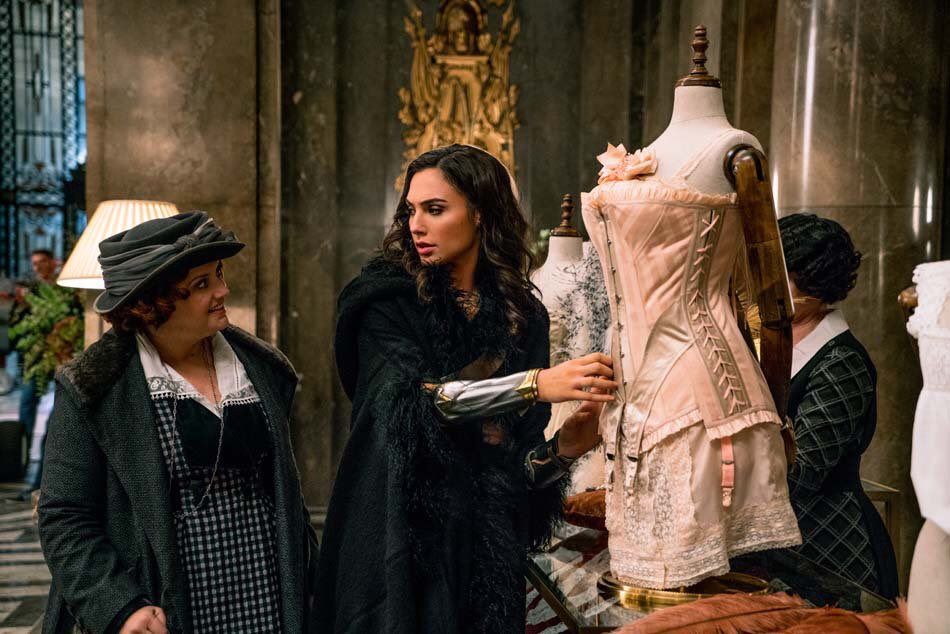
"Is this what London women wear for armor?" a puzzled Diana
asked Etta Candy
Another positive: many commentators have noted that female costumes in previous superhero films do not look as if much butt-kicking could be done while wearing them (see this great Everyday Feminist post for one example). Wonder Woman takes direct aim at this incongruity during a scene after Diana and Steve first arrive in London, and Steve asks his secretary, Etta Candy (great to see this old friend of Diana's from the early comic strip integrated into the film, albeit in such a limited role) to help Diana shop for more suitable London clothing than her Wonder Woman battle gear. Etta chooses one beautiful Edwardian outfit after the next, but grows increasingly frustrated as Diana kicks, punches, and stretches while trying each one; her main criteria is how easy (or not) the garment will be for fighting in. Her final garment of choice, a dark coat and long skirt set, buttons all the way up to her chin, neither revealing, nor highlighting through an overly tight fit, her bust, the main eye-candy for the majority of past screen superheroines.

The multicultural, primarily male, war-fighting quintent
Joined by a multicultural cast of male colleagues (a French-Morroccan actor; a Native American tracker; a Scottish marksman), Diana and Steve take off for the German front, seeking to destroy a secret weapon being devised by a German general and a facially-scarred female scientist. My daughter, a history buff, took exception to the depiction of the Germans in the middle part of the film, particularly the suggestion that they had "enslaved" civilians. This ahistorical enslavement serves as plot device, the vital impetus to Diana to go off-plan and rush to the rescue of innocent villagers, thereby proving not only her superhuman strength, but also her connection to the plight of those caught in war's crossfires. She did appreciate the fact that the one member of the group who cannot perform his military function is not Diana, but one of the men; vulnerability is coded not as female, but as male, and pays a historically accurate nod to the shell shock (what we would now term PTSD) which first emerged during World War I.

Despite its feminist strengths, though, my daughter and I both felt that the film missed some additional feminist opportunities, and, toward the latter parts of the film, sometimes undercut the strong messages it had set up earlier. After their rescue of the enslaved village, Steve and Diana watch the villagers sing and dance in celebration. Steve invites Diana to dance, and he then walks her to her hotel room. Are they going to kiss? To tryst? No words are exchanged, here, but the decision all seems to lie in Steve's hands. They both enter the room, then Steve turns back, as if he is going to leave. But then he shuts the door and turns back to a silent, receptive Diana. And... we cut to the next scene. No room for talking about sex, no room for depicting sex, not in this film. With all the weight hanging on the film to depict women positively, did the (male) writer and (female) director find it too difficult/fraught to imagine what a sex scene between their female superhero and their male human might look like? A disappointment, this refusal to engage more directly with Wonder Woman's sexuality.

Another disappointment is the disappearance of female solidarity portrayed at the start of the film. With the exception of the brief appearance of Etta Candy, Diana proves the only woman character to engage in the battle to stop the Germans from deploying their deadly poison gas.

And let's not forget spy Steve's attempts
to romance Dr. Maru to steal her secrets...
Diana is convinced that once she kills the god Ares, the world will be free once again from strife and violence. Smart viewers will know that the person she tags as Ares is not in fact the god of war. My daughter and I were rooting the actual Ares to be revealed as the one female antagonist in the film, Dr. Maru, the German scientist also known as Dr. Poison. Only after reading a bit more about Wonder Woman's past, and discovering that Maru closely resembles a foe of the superheroine in her early comic book days, did I realize that the good doctor will likely be playing a role in future Wonder Woman/Justice League films, and so could not serve as the real Ares decoy. But wouldn't it have been great if Ares, like Diana, had turned out to be a woman?

The emotional heart of the film's climax was intended to be Diana's "coming-of-age," her recognition that despite humankind's fallibility, its potential not only for good but also for evil, human beings are worth fighting for. Yet the construction of the ending undercuts both the importance of this message, and the message itself, in seriously disappointing ways. First, the film keeps cutting back and forth between scenes of Diana combatting Ares, and scenes of Steve fighting to keep the Germans from bombing London with their deadly poison gas. Unfortunately, it is Steve's poignant sacrifice, rather than Diana's successful battle, comes across as far more emotionally powerful.

Second, it is Steve's words of wisdom that Diana gives voice to at her moment of insight, making it feel as if she is only learning what the male in the film needed her to, rather than something she has come to understand for herself.  She fights for "love," she declares. But her her memory dips back to Steve telling her "I love you." I wanted to believe she was fighting out of love for of all humankind, warts and all. But this flashback makes it seem more like she is inspired by the love of a good man.

And finally, Diana's success in defeating Ares is due not to her own power and fighting ability, but rather to her ability to turn Ares' own strength back against himself. The film's depiction of a primarily defensive, rather than aggressive, Wonder Woman echoes the construction of the comic book's heroine: Wonder Woman fought for peace, and against violence, and was known for never killing her antagonists (at least until the end of Wonder Woman series #2, in the early 2000's). But given the film's early construction of Diana as a fierce fighter, and her killing of the mistaken-identity Ares without consequence or scruple, this defensive posture towards Ares struck both my daughter and me as rather unsatisfying.

All in all, a far better film that either of us had been expecting. But still, one that has not quite managed to throw off the weight of sexism and misogyny that has haunted superhero filmdom for far too long.


Photo credits:
Antiope: LA Times
Diana and Etta: Newsarama
5 war-fighters: LA Times
Steve & Dr. Maru: FrFanPop
Fighting Misogyny: The New Yorker


Tuesday, May 3, 2016

Making Fun of the Romance Reader

But when I consider a girl, who is nearly entering into life with a susceptible heart, instead of recommending novels in general to her perusal, I would strongly dissuade her from reading them.... Should we even allow, that the generality of novels are written without the least indelicacy, yet as their only subject is love, why should we wish to lead the mind to that disposition, which nature is sufficiently ready to supply without art!  —Honoria, The Female Mentor, or, Select Conversations (1802)


On a rare outing to the movies last month, a friend and I sat down to watch Sally Field in the newly released My Name is Doris. I didn't know anything about the film, but my friend's description of it—a middle aged woman who has lived with her mother all her life gets to explore her own interests after that mother dies—made it sound right up my alley. A coming-of-age story about a middle-aged woman? Bring it on!

Early on in the film, though, a single shot of Doris commuting to work from Staten Island to Manhattan told me that this movie was not likely to be an unequivocal celebration of an older women blossoming into independence and a new sense of self:


Can you see it? There, held in Doris's two slightly wrinkled hands. Yes, readers, Doris his holding a romance novel. A real-life romance novel, in fact: A SEAL at Heart by Anne Elizabeth, which was published in 2012.

Yes, Doris, our frumpy, out-of-touch, sixty-something heroine, is a romance reader. As soon as you see that paperback in her hands, with its hairless, bare chested cover model, sweeping ocean waves, and gorgeous sunset, you're supposed to make the leap: Doris reads romance, hence Doris has wildly unrealistic expectations about what her own romantic life can possibly be.

And the film goes on to demonstrate the inevitability of that linkage of romance reading with the usual clichés: Doris owns a cat; Doris is a secret hoarder; Doris doesn't have a boyfriend; Doris falls madly, ridiculously in love with John, a new coworker decades younger than herself.

Cue the laugh track.

Or, if you are a romance reader yourself, cue the gnashing of teeth.

Doris learning the ins and outs of Facebook from her best
friend's 13-year-old daughter
Doris's story is wildly uneven in tone. At times, it invites viewers to cheer Doris on as she starts to experience life far outside her traditional comfort zone of work, home, mother, and occasional dinner with her brother and his family. But at other times, it asks us to laugh at Doris's ridiculous dreams and expectations, especially when it comes to romance. Not the fault of Field, who does a marvelous job turning what could have been a figure of fun into a fully-realized human being. But because the script in which she is performing can't quite imagine how to portray a sixty-something woman whose sexuality is just beginning to blossom without making her appear, at least at times, a figure of ridicule.

And of pity.

Stalking her handsome co-worker leads Doris to exploring (and abusing) Facebook; attending (and enjoying) a "Baby Goya and the Nuclear Winters" electronica concert in hip Williamsburg; and joining her crush's girlfriend in a lesbian rooftop knitting circle ("I'm not a lesbian, but they are just so welcoming, you know?"). Doris really enjoys said activities, and we are invited to take pleasure in her pleasure, to be happy for her as she tries new things and finds herself welcomed by new people. But at the same time, viewers, more aware than Doris herself, are also meant to catch the cultural critique of hip millennial culture her unsocialized eye reveals.

And we're definitely meant to laugh (and, perhaps, cringe) at her Walter Mitty-like daydreams, daydreams not about her own heroism, as are Mitty's, but about being sexily wooed by co-worker John. Daydreams that are informed by the tropes of contemporary romance, be it in rom-com or novel form. Tropes that Doris has imbibed by reading romances during her daily commute to work.

And, if we've been reading our romance novel symbolism correctly, we should also be prepared for the painful crash when Doris attempts to bring her romance-inspired daydreams into real life. Romance readers are, by nature, deluded, immature, in need of a good dose of wide-eyed reality, aren't they? Or so asserts knowing pop culture.

Uneasiness about women who read, particularly women who read romance, has been a part of social discourse since the 18th century, as Jacqueline Pearson's intelligent book, Women's Reading in Britain, 1750-1835: A Dangerous Recreation clearly demonstrates. In the late 18th and early 19th centuries, that uneasiness manifested as fear, in particular, as fear that romance reading would lead to female sexual transgression: seduction, adultery, rape. Many, many novels of the period even used the types of books their female protagonists read as symbols of their virtue (or lack thereof).

Today, though, fear has been transformed into humor: we are invited to laugh at poor Doris, inspired by A SEAL at Heart and other romance novels to pursue a wildly unsuitable romantic partner. But behind that laughter, uneasiness still remains. Uneasiness at female sexuality, at female desire, and a hope that both might be safely contained, if only women would stop reading those damned romance novels.

Keep reading, Doris, I say. A dangerous "re-creation," indeed.


Have you noticed the trope of romance reader = deluded, repressed, or laughable in other current-day works of popular culture?


Friday, September 18, 2015

A story of pride and prejudice: Laurie Kahn's LOVE BETWEEN THE COVERS

Last December, I wrote about having the opportunity to meet with filmmaker Laurie Kahn and film editor Bill Anderson and view a rough cut of their documentary-in-progress about romance writers, Love Between the Covers. Earlier this month, I had the pleasure of watching the final version, when it was screened via a special Tugg screening at the Kendall Square Cinema here in Massachusetts. Back in December, Laurie asked me not to report on any of the film's details, but now, with the film "in the can," as it were, I'd like to share some thoughts about the film.

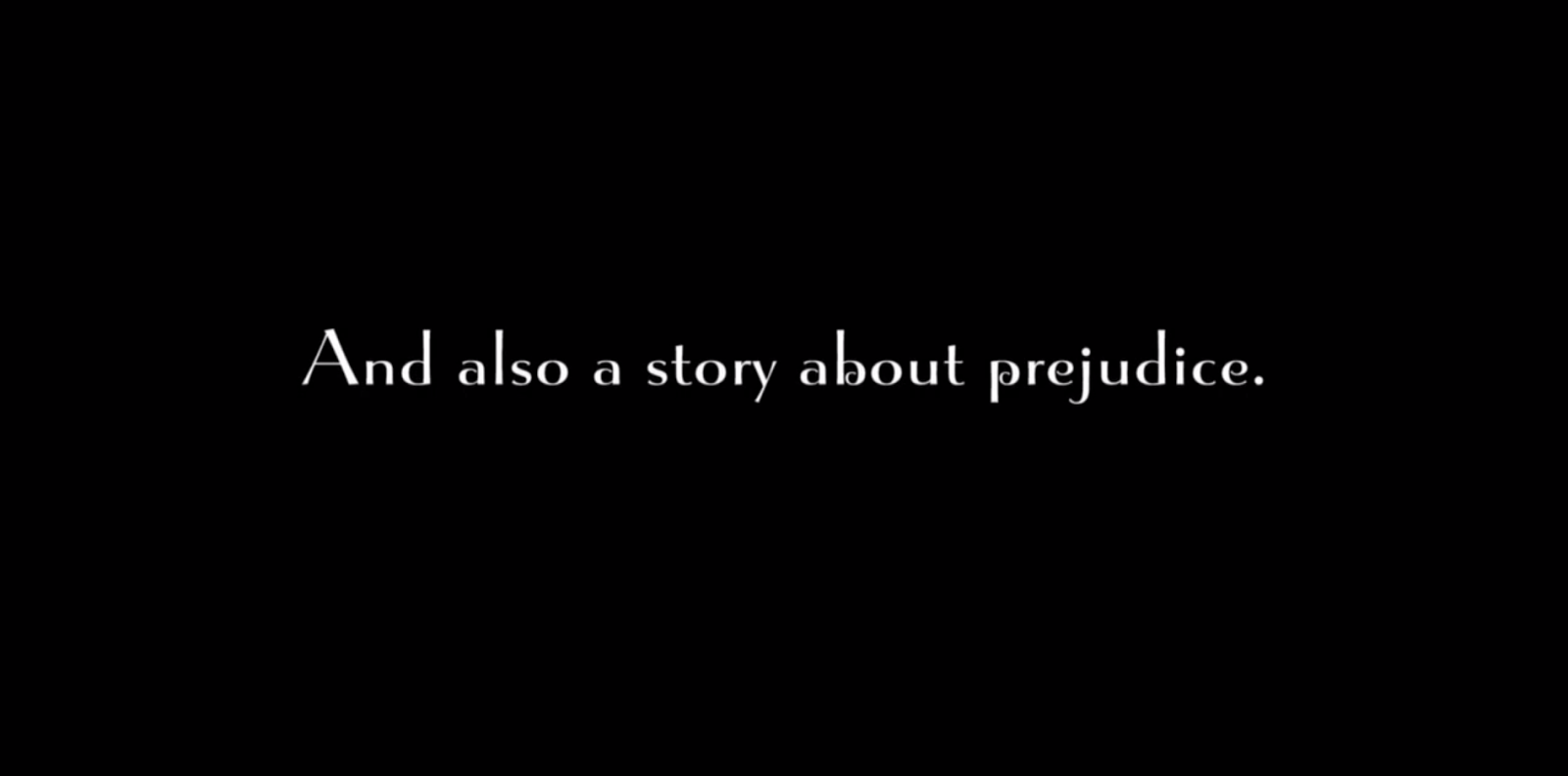
Kahn opens the film with a clever invocation of one of the ur-texts of romance. But she does it with an unexpected twist. A screen card appears with the words


We then see a shot of romance author Jane Porter, who, in an somewhat agitated voice, tells the interviewer, "I'm so proud of what I do, and what I do is so important. And it means so much to me, I don't care what critics say. I don't care."


Porter's words are immediately followed by another screen card:


After which we see romance blogger Sarah Wendell, who tells the camera, "I will have people standing above me [imitating riding on the subway], going 'You read that?'"

Though twentieth and twenty-first-century romance writers have long been plagued by derogatory stereotypes both of themselves and of the books they write, Kahn's opening statements insist that, unlike Mr. Darcy, authors of romance have no "improper pride" they must give up in order to achieve their happy endings. Instead, Love Between the Covers shows us a community of romance writers, justly proud of their many amazing achievements, especially in light of the many prejudices they face from other writers, from society, and sometimes even from their own friends and families. Many of those prejudices are confronted and challenged by the authors in the film, while others remain tantalizingly open or unaddressed.

Invoking (and poking fun at) the vilification of romance
covers by incorporating them into the film credits
Kahn's interviewees also tackle some of the major issues that scholars and readers of romance have been grappling with for decades: What is the continuing appeal of romance as a genre? Who writes romance? Who reads it? Why is romance so looked down upon, far more than are other popular (popular as in mass market) genres? What is different about romance readers than readers of other popular fiction? And what's up with those lurid, clinch-filled covers?

While the film includes interview snippets from dozens of romance writers, romance scholars, romance industry insiders (editors, book designers, publishers, etc.), and, of course, romance readers, Kahn focuses in more tightly on five representative authors—European historical romance writer Eloisa James (otherwise known as literary scholar Mary Bly, daughter of the poet Robert Bly); African-American historical romance writer Beverly Jenkins; contemporary romance writing partners Celeste Bradley and Susan Donovan; and lesbian romance writer and publisher Radclyffe (Len Barot). The diversity of the featured authors, as well as the extra camera time given to each, encourages viewers to identify and/or empathize with these authors as people, rather than holding them as objects of derision or scorn. These authors show up again at later in the film, when other, broader questions about the genre come to the fore, preventing viewers from getting lost in a sea of talking heads.

One of those questions is "what is the continuing appeal of romance?" Kahn's interviewees provide many possible, but no definitive answers. Writer Jayne Ann Krentz argues that romance invokes archetypes that go back thousands of years, and that we learn core values from popular fiction. Blogger Sarah Wendell argues that romance is the "one place where you will consistently find women's sexuality treated fairly and positively." Author Jennifer Crusie points to the sexism underlying much of high literature, contrasting the fates of women in books she studied in college with those she reads in romance:

You know, just those toxic stories, no matter how great literature they are, they're toxic to women. If you're free and sexual and you go after what you want, you're going to die horribly. Or end up with a scarlet letter on your chest celibate for the rest of your life because boy did you screw up. But in romance fiction, it's not there. You get rewarded for going after what you want. And you can have sex without dying horribly, which I thought was a plus.

Nora Roberts and Beverly Jenkins both point to the inevitable happy ending (the H.E.A, or happily ever after that is one of the defining characteristics of the genre) as the genre's major draw. But neither the writers, nor the several scholars who appear in the film, mention issues of gender—whether romance reinforces patriarchal gender roles, as many early scholars of the genre often posited—as another potential contributor to the genre's appeal. Romance is far more popular in the west and in the south of the U.S., in red states more than in blue ones; but the film is not interested in such issues of politics and gender.

Gender is decidedly brought up when authors comment about why their genre has been the target of so much popular and scholarly criticism. Jenkins observes, "It's a fantasy, yes. But so are Arnold Schwarzenegger movies. Arnold's never killed at the end of his movies? So why beat up women, because they're reading an HEA? And guys have the same kind of HEA. Sylvester Stallone never dies."  "Why is romance sneered at?" scholar and now romance editor Sarah Frantz Lyons asks. "I'm going to give the same answer everyone else has given. It's sneered at because it's written by women, for women, and it's written about women." Kahn, though, isn't interested in digging into the content of romance novels; there is little in the film about whether the genre as a whole, particular sub-genres, or even individual books promote or undercut the "empowered woman" message that the "by women, for women, about women" line that has become so ubiquitous in the romance community in the past decade asserts.

Romance readers who met online share stories in person at the RWA
convention
That sense of community—among writers, among readers, between authors and their fans, between established writers and aspiring ones—that is where Kahn's real fascination lies. "Romance has been so dismissed. So people who read it really bonded. Had to conglomerate for safety, almost. To say it's okay to read these things," author and reader Nicole Peeler notes, adding "Romance reading isn't solitary, like other reading." Romance communities are empowering for women, no matter what the books may have to say about gender relations, Kahn's film quietly but consistently asserts. The fan girl culture of romance; the pay-it-forward attitude of the majority of romance authors; the friendships and rivalries and lifetime bonds that form, primarily between women, because of their love of romance books—this is what interests Kahn, what she most wishes to convey about romance. And convey it she does, with artistry, humor, and above all, respect.


I was going to end this post with a series of memorable quotes from the film. But it's not just quite the same, reading such quotes rather than hearing them and seeing them on film. So instead, I'm going to encourage you to go out and see the film for yourself. The producers of Love Between the Covers have hooked up with Tugg, a company that brings "on demand films to local theaters," and are in the midst of planning a series of 50-100 screenings of Love across the globe this coming fall and winter. They have been working to team up scholars, readers, and librarians with local romance writers to host such screenings.

If you are interested in bringing the film to a movie theater near you, here is the relevant contact information:

or fill in the form at lovebetweenthecovers.com/screenings.
 

Tuesday, December 16, 2014

Film and Novel Feminism: Diana Wynne Jones' HOWL'S MOVING CASTLE

This past weekend, my daughter and I took some time-out from December's rush to have a mom-kid movie night. Our film of choice? The 2005 animated Howl's Moving Castle, adapted by Hayao Miyazaki from the 1986 novel by British fantasist Diana Wynne Jones. Miyazaki is a filmmaker of great imagination, one who does not feel bound to stick slavishly to his original source material when crafting an adaptation. Interestingly, though, in spite of their differences, both Miyazaki's film and Diana Wynne Jones's novel have been called "feminist" by various writers and critics. As I watched the film, I found myself thinking about the differences between it and Jones' novel, and wondering how those differences impacted the feminist messages of each.  Such wondering gave me the perfect excuse to indulge in a comfort re-read of Wynne Jones' novel.

In the film version of Howl, Sophie Hatter's problem at story's start is her lack of self-esteem. Unlike her mother or her sister Lettie, or the other girls in the hat shop where she works, Sophie is not that attractive. Plain, shy, and gray, Sophie is more upset than charmed when two handsome but large and looming male soldiers attempt to flirt with her in the town's streets. "Do something for yourself for once, will you?" sister Lettie calls to her as Sophie gradually edges away from the busy pastry shop where Lettie works, pointing to Sophie's penchant for self-sacrifice and linking it to her lack of self-esteem.

For Sophie of the novel, looks are not at issue; both she and her two sisters "grew up very pretty indeed" (1). Rather, her problem lies in her belief that story has the power to shape destiny. "In the land of Ingary," the novel opens, "where such things as seven-league books and cloaks of invisibility really exist, it is quite a misfortune to be born the eldest of three. Everyone knows you are the one who will fail first, and worst, if the three of you set out to seek your fortunes" (1). Though the book's second paragraph hints that stories are not infallible (though the birth of Sophie's second sister "ought to have made Sophie and Lettie into Ugly Sisters," it had not), Sophie herself misses the hint. "She had read a great deal, and very soon realized how little chance she had of an interesting future. It was a disappointment to her, but she was still happy enough, looking after her sisters and grooming Martha [the youngest sister] to seek her fortune when the time came" (1). For the reader, the humor lies both in imagining a world where fairy tale tropes determine one's future, and in laughing at a character who buys into the convention, even when the evidence to disprove it is as close as the nose on her face.

With its focus on storytelling rather than feminine self-confidence, the book's opening may appear to be less feminist than the film's. But DWJ is a sneaky writer, with a lot of hidden agendas up her sleeve. Even while we're encouraged to chuckle at Sophie, we're also invited to think more deeply about the ways that story—in the form of social and gender conventions—can and do shape us, often despite our own better judgment. About which, more below.

The bulk of both versions take place after the Witch of the Waste comes to Sophie's hat shop and, for reasons only hinted at, lays a curse on her, a curse that makes her appear to be an old woman rather than a seventeen-year-old adolescent. Before moving to that section of the story, though, I want to discuss two significant differences between film and book that occur before Sophie's transformation. Sophie of the book is wont to talk to the hats as she trims them, spinning stories about their own futures: "You have mysterious allure"; "You are going to have to marry money!" "You have a heart of gold and someone in a high position will see it and fall in love with you" (7). Though the narrator does not come out and say it directly, astute readers will quickly pick up on the fact that Sophie's predictions turn out to be true for the women who buy and wear her hats. While Sophie believes that story has the power to shape her life, in fact it is Sophie who has the power to tell stories that shape the lives of others. But it is a power of which she, unlike the reader, is woefully unaware. Because she is so invested in the stories her society tells her?

A fearful Sophie being rescued by a handsome stranger
Unlike book Sophie, film Sophie has no latent magical powers. And film Sophie's first meeting with her future love interest, the purportedly evil Wizard Howl, is significantly different from book Sophie's. In the film, a slim, blond man rescues Sophie from the importuning of the above-mentioned flirty soldiers, claiming her as his "sweetheart" and using magic to send the soldiers marching away. We're immediately distracted from this "rescue" by the arrival of a new threat ("Don't be alarmed, but I'm being followed" the man tells Sophie as inky snaky blob creatures ooze out of the walls around them), but a rescue it is all the same. Though the girls of the town spread rumors about how Howl eats girls' hearts, they're clearly enchanted rather than threatened by the prospect, a course that Sophie is invited to follow. Some men may be threats, the film suggests, but this man (who we later discover is the wizard Howl) is not. "That's my girl," he tells her when he leaves her on Lettie's balcony, clearly the adult to Sophie's frightened child.

In the novel, though, it is not soldiers, but "a young man in a fantastical blue-and-silver costume" who spots Sophie and accosts her on the crowded street (9). Book Sophie's response to the man (who, again, turns out to be Howl) is similar to movie Sophie's response to the soldiers: "Sophie shrank into a shop doorway and tried to hide" (9). But the novel casts Sophie's response, not Howl's actions, as abnormal:

Crowds of young men swaggered beerily to and fro, trailing cloaks and long sleeves and stamping buckled boots they would never have dreamed of wearing on a working day, calling loud remarks and accosting girls. The girls strolled in fine pairs, ready to be accosted. It was perfectly normal for May Day, but Sophie was scared of that too. (9)

At the costumed man's pitying look, Sophie realizes that she's overreacting, and feels ashamed. Sophie's fear of aggressive masculinity, which in the film is justified by Howl's rescue, here is cast as part and parcel of her problem. Could that problem be less about believing in the stories her society tells, and more about using those stories to hide from her own fears? Does film Sophie lack self-confidence, while book Sophie fears her own powers? Including her own power to attract the opposite sex?

The Witch of the Waste's curse on Sophie "compels [Sophie] to seek her fortune" in both book and film. What fortune does she find? What is her quest? In the book, Sophie's transformation from maiden to crone allows her to free herself from many of her fears. A trapped dog frightens her, but "The way I am now, it's scarcely worth worrying about," she tells herself, and goes about freeing the canine with her sewing scissors (20). "Still, I don't think wolves will eat me. I must be far too dry and tough. That's one comfort," she thinks later in her trek (22). And finally, when she encounters Howl's moving castle on the moorland, one more comfort: "Wizard Howl is not likely to want my soul for his collection. He only takes young girls" (23). And thus old Sophie risks knocking on the castle door.

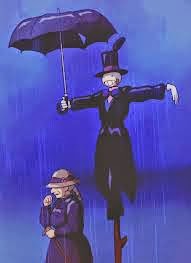
In contrast, film Sophie wanders rather helplessly on the moors, and relies on the help of a turnip-headed scarecrow, who gives her a cane, finds her a place to stay, and urges her to enter the moving castle in spite of her doubts and fears. Old Sophie initially has far more agency in the novel than in the film.

Once inside the castle, though, both book and film Sophie find themselves talking back to Wizard Howl. "What a nosy/outspoken/unruly old woman you are," Howl teases book Sophie, responding to her nosy, outspoken, unruly words and behavior. Far from the shy "mouse" he named her at their first meeting, old Sophie isn't afraid to speak her mind, or to act on her own behalf, in her own self-interest. Without having to worry about romance, about attraction and sex, book Sophie feels safe enacting an identity far different than the shy, mousy girl she's been playing for most of her life.

Film Sophie is initially a bit more cautious, a bit more tentative. But her anger at being suspected of being in league with the Witch of the Waste spurs her to throw off her caution: "I'm sick of being treated like some timid little old lady," she cries while attacking the dirty castle in a domestic cleaning spree. Both book and film Sophie invert the typical quest pattern of leaving the domestic to go and seek adventure. Instead, Sophie goes to seek adventure and finds herself hard at work in the domestic sphere.

Film Sophie crying over
 her lack of beauty
Film Sophie's personal quest turns out to be accepting her own beauty. In the novel, the uproariously comic scene in which Howl cries in despair after Sophie mixes up his potions while cleaning the bathroom, leading him to inadvertently dye his hair red, serves as another sign of his character: vain, self-centered, and entertainingly dramatic. But in the film, the scene serves to reveal Sophie's deep pain over her lack of looks. "I see no point in living if I can't be beautiful," Howl melodramatically despairs, to which Sophie responds, "Fine. So you think you've got it bad? I've never once been beautiful in my entire life!" Fleeing the castle, Sophie ends up outside, crying on the moor.

Interestingly, Sophie's curse seems to fade at this moment; the film pictures her as a young woman again. And throughout the rest of the film, at moments when Howl pays attention to her—remaking the castle to give her her own room, resetting the magical door to open upon a beautiful flower-covered plain, giving her presents—Sophie looks younger. The Witch of the Waste may have initially laid the curse of age on Sophie, but the film suggests that it is Sophie's lack of self-confidence that keeps it in place.

Significantly, film Sophie remains old even after the Witch of the Waste is stripped of her powers by the evil wizard Madame Suliman. Only after Sophie takes action to save Howl (by moving the castle) does she throw off her old-woman disguise for good.

At the climax of the film, after Sophie has figured out how to save Howl from the curse he has been under, Howl awakens and exclaims, "Wow. Sophie, your hair looks just like starlight. It's beautiful." Sophie's response—"You think so? So do I."—indicates that Sophie has finally accepted herself, finally believes in herself. Embracing feminine self-confidence is certainly a feminist message. But having beauty function as a proxy for self-confidence, rather than any sense of achievement, is troubling at best. And that Sophie regains her youth by acting to save another, rather than acting to save herself or to achieve her own goals, reinforces messages that women are meant to meet others' desires rather than their own.

In contrast, the climax of the book occurs when Miss Angorian, a woman whom the love-em-and-leave-em Howl has been courting, is captured by the Witch of the Waste. Sophie feels she's the one who put Miss Angorian in danger because she felt jealous of Howl's attentions to her, and immediately sets off to rescue the woman. Saving another woman, a woman endangered because of her jealousy, rather than saving a man with whom she is in love, sends quite a different message about Sophie's agency.

But Wynne Jones' message gets even more complicated. Because after she and Howl join forces to defeat the Witch of the Waste, it turns out that Miss Angorian is not as innocent as she initially appeared. And Sophie must act again, this time to rescue Howl. But also to rescue herself, from being too femininely nice, so nice that she's allowed others—her stepmother, Miss Angorian, even Howl—to take advantage of her.

New York Times film reviewer A. O. Scott may be right that Miyazaki's film "resonate[s] with... determined, somewhat romantic feminism," and that its Sophie "joins an impressive sisterhood of Miyazaki heroines, whose version of girl power presents a potent alternative to the mini-machismo that dominates American juvenile entertainment." But given a choice, I'd take Diana Wynne Jones' version of feminism every time.