Wednesday, June 7, 2017

Wondering about the Feminism of Wonder Woman, the film

Last night, I had the pleasure of accompanying my eighteen-year-old daughter to see the first big-screen iteration of the iconic feminist superhero, Wonder Woman. And of sharing my impressions about the film with her, and hearing hers in response, during our ride home together from the theater.  I'd like to share a few of those responses, those related primarily to the romance aspects of the film, with RNFF readers.

But be forewarned: movie spoilers lie ahead.

I'm not a big superhero film fan myself. With the exception of Margot Kidder's tough-talking Lois Lane in the first Superman films, such movies have not been all that feminist-minded in their depiction of the love interests of their male protagonists. Serving as rescue-fodder/bait, being killed by a baddie to provide emotional impetus to a crime-fighter, or functioning as objectified, hypersexualized object for the male viewer's gaze seem to be the only roles available to female love interests in such films. The situation isn't much better for actual super-heroines who have been featured as part of superhero groups, either. So I was more than a little doubtful going in to Wonder Woman that the filmmakers would be able to overcome this sexist history of female depiction, even when given a female heroine as their lead.

A fierce Robin Wright as the Amazon General, Antiope
Both my daughter and I were happily surprised to find far less sexism, and some outright feminist moments, in Wonder Woman. Most striking, perhaps, was the battle scene in the opening section of the film, when a troop of World War I Germans in pursuit of spy Steve Trevor land on the beaches of Themyscira (Paradise Island) and are immediately attacked by the protective Amazons. No fear, no shame, no worry appeared on any Amazon's face; each woman dove into the attack with energy and strength, wielding sword and bow with a skill any man would envy. Even as many of their comrades in arms fell to the hail of gunfire, none stopped to cry or mourn; each continued, unapologetically aggressive in their defense of their home against this onslaught of men.

I can't recall any similar scene in all of my years of film-viewing, one that depicted women behaving so aggressively and so competently, AND not fighting against one another but against a common foe. To my mind, the film would be worthy of praise if only for that one scene.

The battle does end with Diana, Princess of the Amazons, keening and cradling her dying aunt, the Amazon's general in her arms. But the scene does not serve to lessen Diana. Rather, it serves a dual purpose. First, to anoint her as her aunt's heir, the one who will take up her mantle as (in this film's mythology) the most powerful of the beings created by Zeus to help his human creations fight against the corruption of Ares, the jealous god of war. And second, to point to the film's underlying theme: the horror and human cost of war. For Diana, sheltered on Themyscira, war has only been a heroic story up until this point; the opening segments of the film depicted a battle-hungry child and teen eager to train and learn to fight her own battles. But now, Diana begins to understand not only the value of peace, but the costs of war.

On a lighter note, I enjoyed the flirting that takes place between the inexperienced but clearly knowledgable Diana and an attracted but morally upright Steve Trevor, both during their time on Themyscira and during their (improbably speedy) sail from the island to London. Diana may be a virgin, but she's not blushing over it; she's read all ten volumes of the Amazons' treaties about the pleasures of the body. From her reading, she knows that the Amazons have found ways to achieve such pleasures without the participation of males. Men may be required for procreation, but they are not required for sexual fulfillment. Does Diana wish to test this nostrum for herself? Or is she truly not that curious about the first male that she's ever seen? Both Steve and the audience are left in tantalizing doubt.
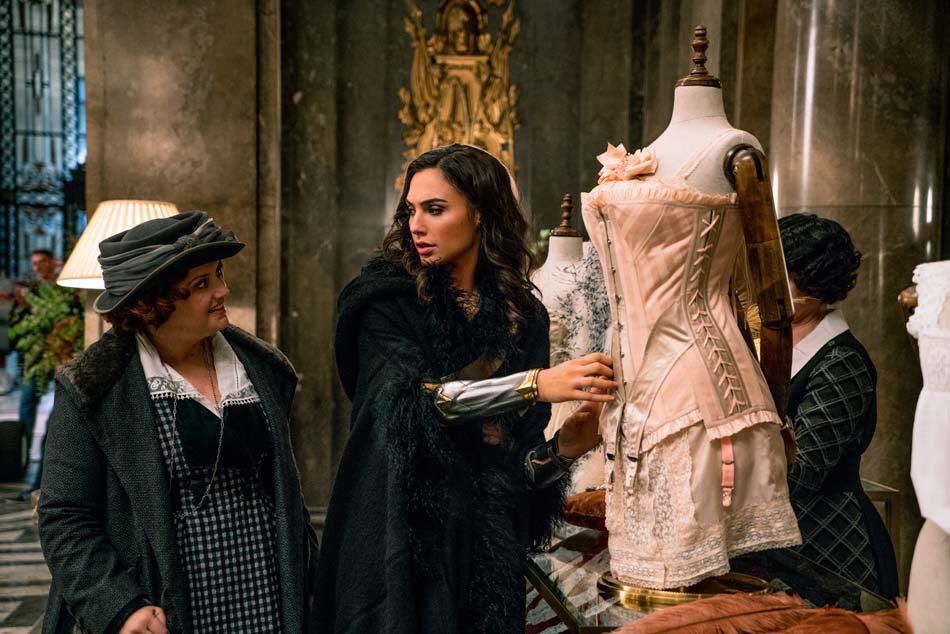
"Is this what London women wear for armor?" a puzzled Diana
asked Etta Candy
Another positive: many commentators have noted that female costumes in previous superhero films do not look as if much butt-kicking could be done while wearing them (see this great Everyday Feminist post for one example). Wonder Woman takes direct aim at this incongruity during a scene after Diana and Steve first arrive in London, and Steve asks his secretary, Etta Candy (great to see this old friend of Diana's from the early comic strip integrated into the film, albeit in such a limited role) to help Diana shop for more suitable London clothing than her Wonder Woman battle gear. Etta chooses one beautiful Edwardian outfit after the next, but grows increasingly frustrated as Diana kicks, punches, and stretches while trying each one; her main criteria is how easy (or not) the garment will be for fighting in. Her final garment of choice, a dark coat and long skirt set, buttons all the way up to her chin, neither revealing, nor highlighting through an overly tight fit, her bust, the main eye-candy for the majority of past screen superheroines.

The multicultural, primarily male, war-fighting quintent
Joined by a multicultural cast of male colleagues (a French-Morroccan actor; a Native American tracker; a Scottish marksman), Diana and Steve take off for the German front, seeking to destroy a secret weapon being devised by a German general and a facially-scarred female scientist. My daughter, a history buff, took exception to the depiction of the Germans in the middle part of the film, particularly the suggestion that they had "enslaved" civilians. This ahistorical enslavement serves as plot device, the vital impetus to Diana to go off-plan and rush to the rescue of innocent villagers, thereby proving not only her superhuman strength, but also her connection to the plight of those caught in war's crossfires. She did appreciate the fact that the one member of the group who cannot perform his military function is not Diana, but one of the men; vulnerability is coded not as female, but as male, and pays a historically accurate nod to the shell shock (what we would now term PTSD) which first emerged during World War I.

Despite its feminist strengths, though, my daughter and I both felt that the film missed some additional feminist opportunities, and, toward the latter parts of the film, sometimes undercut the strong messages it had set up earlier. After their rescue of the enslaved village, Steve and Diana watch the villagers sing and dance in celebration. Steve invites Diana to dance, and he then walks her to her hotel room. Are they going to kiss? To tryst? No words are exchanged, here, but the decision all seems to lie in Steve's hands. They both enter the room, then Steve turns back, as if he is going to leave. But then he shuts the door and turns back to a silent, receptive Diana. And... we cut to the next scene. No room for talking about sex, no room for depicting sex, not in this film. With all the weight hanging on the film to depict women positively, did the (male) writer and (female) director find it too difficult/fraught to imagine what a sex scene between their female superhero and their male human might look like? A disappointment, this refusal to engage more directly with Wonder Woman's sexuality.

Another disappointment is the disappearance of female solidarity portrayed at the start of the film. With the exception of the brief appearance of Etta Candy, Diana proves the only woman character to engage in the battle to stop the Germans from deploying their deadly poison gas.

And let's not forget spy Steve's attempts
to romance Dr. Maru to steal her secrets...
Diana is convinced that once she kills the god Ares, the world will be free once again from strife and violence. Smart viewers will know that the person she tags as Ares is not in fact the god of war. My daughter and I were rooting the actual Ares to be revealed as the one female antagonist in the film, Dr. Maru, the German scientist also known as Dr. Poison. Only after reading a bit more about Wonder Woman's past, and discovering that Maru closely resembles a foe of the superheroine in her early comic book days, did I realize that the good doctor will likely be playing a role in future Wonder Woman/Justice League films, and so could not serve as the real Ares decoy. But wouldn't it have been great if Ares, like Diana, had turned out to be a woman?

The emotional heart of the film's climax was intended to be Diana's "coming-of-age," her recognition that despite humankind's fallibility, its potential not only for good but also for evil, human beings are worth fighting for. Yet the construction of the ending undercuts both the importance of this message, and the message itself, in seriously disappointing ways. First, the film keeps cutting back and forth between scenes of Diana combatting Ares, and scenes of Steve fighting to keep the Germans from bombing London with their deadly poison gas. Unfortunately, it is Steve's poignant sacrifice, rather than Diana's successful battle, comes across as far more emotionally powerful.

Second, it is Steve's words of wisdom that Diana gives voice to at her moment of insight, making it feel as if she is only learning what the male in the film needed her to, rather than something she has come to understand for herself.  She fights for "love," she declares. But her her memory dips back to Steve telling her "I love you." I wanted to believe she was fighting out of love for of all humankind, warts and all. But this flashback makes it seem more like she is inspired by the love of a good man.

And finally, Diana's success in defeating Ares is due not to her own power and fighting ability, but rather to her ability to turn Ares' own strength back against himself. The film's depiction of a primarily defensive, rather than aggressive, Wonder Woman echoes the construction of the comic book's heroine: Wonder Woman fought for peace, and against violence, and was known for never killing her antagonists (at least until the end of Wonder Woman series #2, in the early 2000's). But given the film's early construction of Diana as a fierce fighter, and her killing of the mistaken-identity Ares without consequence or scruple, this defensive posture towards Ares struck both my daughter and me as rather unsatisfying.

All in all, a far better film that either of us had been expecting. But still, one that has not quite managed to throw off the weight of sexism and misogyny that has haunted superhero filmdom for far too long.


Photo credits:
Antiope: LA Times
Diana and Etta: Newsarama
5 war-fighters: LA Times
Steve & Dr. Maru: FrFanPop
Fighting Misogyny: The New Yorker


Friday, June 2, 2017

Romeo or Robot? Penny Reid's DATING-ISH

If you could choose between a human lover, with all the flaws of any typical human being, and an "AIC"—"an Artificial Intelligence Companion," one tailored to your individual preferences and needs, programmed to meet the emotional and physical demands you specifically desire in a romantic partner—which would you pick?

Even the possibility of such a choice sounds fantastic, no? But as Penny Reid's latest Knitting in the City novel, the fiercely smart and hilarious Dating-ish suggests, the day when that choice might be before you may be far closer than you think.

Reporter Marie Harris is on the verge of cancelling her her FindUrParnter.com account when she gets a surprising message: "You and Derek are the perfect match." Wary but hopeful, Marie decides to give Internet dating one final whirl, waiting for her "perfect match" in a local cafe when Dating-ish opens. But the man who finally shows up looks nothing like the fellow Marie "stalked" online. Nor does he seem at all interested in the same things that their dating profiles told her they both "loved." And rather than romancing her after greeting her awkwardly, he instead begins to grill her about her dating preferences, acting as if he, not she, is the reporter.

Or an academic, interviewing women as part of his research for creating the above-mentioned AIC. Not "Derek" at all, but Matt Simmons, Ph.D., computer science nerd. Which Marie finds out only after she ditches the guy in the coffee shop, only to discover later that day that he's the next-door-neighbor of one of the women from her weekly knitting klatch.

Marie and Matt begin to verbally mix it up almost from the minute she discovers that Matt's research is focused on developing a "Compassion AI—as a replacement for human relationships" (35). Marie, along with most of her knitting friends, finds the idea deeply creepy, if not outright sad: "It felt like giving up. Like we were handing over the keys to our humanity, giving it away for free for the sake of saving ourselves from being inconvenienced" (43). But for Matt, who grew up with distant parents and who never felt all that connected to his (now ex-) wife, a Compassion AI seems the perfect solution to humanity's "archaic dependence on each other as a source of fulfillment and support":

    "You think relying on another person is archaic?"
     "It's not archaic if it's a choice, freely made and healthy." He shrugged, his tone growing lofty, academic. "But, I do think the practice of sacrificing oneself at the altar of physical urges and the fantasy of emotional equivalence in the pursuit of empathy, endorphins, and tachycardia is archaic" (35-40).

Given that this is a romance novel, the savvy reader will expect Matt's point of view on human vs. robotic connection to be firmly trounced by book's end. But what made Dating-ish such a fascinating read is that Reid, through reporter Marie's work on a series of articles about how "women, all of female humanity—can replace romantic relationships by using either paid services or robots," gives both sides equal, and equally compassionate, airtime.

It turns out that while Compassion AI technology is not quite ready for the market, there are already quite a lot of paid services currently available designed to meet one or more of the needs usually fulfilled by a romantic partner—"Professional cuddlers and massage for touch. Professional dry humpers for thrilling touch. Escorts for dinner dates, life coaches for affirmation, personal trainers for activity and movement"—even meditation salons that provide guided orgasm therapy. All perfectly legal, none based on the subjugation of a weaker person for a stronger one, and all in service of meeting unfulfilled human needs. Fiercely curious Marie cannot help but be drawn to the idea of exploring other creative ways of "solving loneliness" besides Internet dating.

Of course, for the second part of her series, the part focusing on robots, Professor Simmons proves to be the perfect source. He's direct, honest, and curious, characteristics he shares with Marie. And though Marie's "whoremones" ("That's what I called my hormones when they betrayed my good sense. Sandra said I was slut-shaming my body's appreciation for the opposite sex. I told her I was okay with that if it meant I remained free of STDs" [76]) begin to act up around the younger, rumpled, quirky, but decidedly good-looking professor, Matt's nothing but direct about not wanting to get involved in any kind of romantic relationship. Marie is looking for someone to settle down with, not fool around with, but she enjoys Matt's company so much that she asks if the two of them can be friends when the interviewing for her article is done.

Though Matt's a bit taken aback at being so directly "friend-zoned," he readily agrees to Marie's proposal. And the two begin to hang out together. A lot. Far more so that workaholic Matt ever did with any of his previous friends, or even with his wife. So much so that many of Marie's male friends assume the two are dating, or at least engaging in a bit of friends-with-benefits nookie. And as the line between friendship and flirt-buddies begins to grow ever fuzzier, and the two share not just quips but vulnerabilities, Marie finds herself wavering between squashing all fantasies about a long-term relationship with cagey Matt and throwing her body, if not her heart, directly into his sexy path.

Only after Marie begins to realize that she might just be using Matt as a crutch, and announces that "maybe there's such a thing as sharing too much . . . between friends" can she and Matt begin to stop dancing around the truth of what their relationship has become, rather than what they assumed it would be. A Companion AI, Reid's book suggests, might be the perfect solution for many people—the bereaved and grieving; the deeply lonely; children in foster care; and a long list of others. But as for Matt and Marie, they've already found the perfect companions—one another.


Illustration Credits:
Online dating graphic: Globe and Mail, via Holykaw
Cuddling: Cuddle Professionals International
Medical robot: Radio Canada International


Dating-ish
Knitting in the City #6
Caped Publishing, 2017

Friday, May 26, 2017

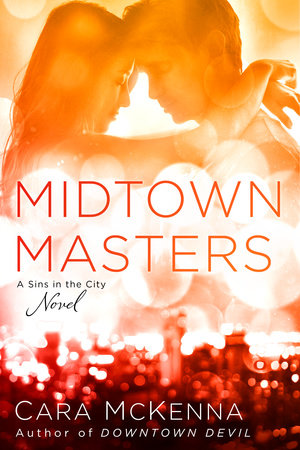
Monogamy +One: Cara McKenna's SINS IN THE CITY series

Cara McKenna has been one of the go-to authors for this blog, guaranteeing with almost every book not only a sheet-burning romance, but also a decidedly feminist erotic sensibility. I had my doubts, though, when I heard that McKenna had signed a deal with Penguin Random House to write a "sexy, edgy trilogy that plays with the boundaries of desire"—said boundaries being those of the monogamous heterosexual couple. In moving from Penguin's e-book only Intermix line to their paperback first line, would McKenna's "edge" be blunted? Either in regards to her typically direct, honest, and messy depiction of sex, or to her story's undergirding by feminist ideals?

So glad that my worries turned out to be unfounded. Each of McKenna's SINS erotic romances is as edgy, and as feminist, as any of her previous work. Each features a male/female couple, either already romantically established (the married Asian Indian-American Samira and white Mike of book one Crosstown Crush), on the cusp of dating (biracial Clare and Mica of book two, Downtown Devil), or, in the most unconventional pairing, former lovers/now friends who continue to have sex together (Korean-American Suzy and Jewish-American Meyer of the final book, Midtown Masters). But each pairing proves not entirely satisfying to one or more of its partner. Mike has a cuckolding kink that can only be satisfied by "catching" his wife cheating on him with another man. Mica, who is bisexual, has long been drawn to his best friend Vaughn, and maneuvers Clare into tempting Vaughn into their bed. Suzy, who has totally enjoyed sex-camming in all its kinky variations with Meyer to earn some extra funds, begins to dream about the kind of vanilla lovemaking that one of their clients, shy "Miss Lindsay" prefers. Each story shows how a monogamous couple opens their lives, and sometimes, their hearts, to allow a third person into the intimacy of their sexual play.

The sex that follows proves not only incendiary, but also grounded in equality. Consent is central, particularly when there are not just two, but three adults participating. Some of those adults are eager, while others are curious but cautious, but no one is shamed, manipulated, or coerced into doing anything that he or she does not first agree to. And as they all grow more comfortable with the nuances of both their partners and their unconventional relationships, both women and men ask for what they want from their partners, and give their partners instructions for how to satisfy their desires. Some even discover desires they hadn't even known they'd had:

     "There's something I've been missing," Sam said, looking at each of them in turn. "And maybe it's time has passed, or maybe it'd have to be worked up to gradually, but I miss when you two . . . touch each other. In any way, really," she added quickly. "It doesn't have to be hard-core, like it was, but just a little something." She'd not have come out and asked for this back in the spring and summer, even though she herself had been happy to exit her comfort zone for both their desires—her shyness about being filmed, for Bern, and the entire experiment to begin with, for her husband. But she had distinct wants of her own now, and the balls to name them. (Crosstown Crush, 313).
    

Not all of the heterosexual pairings which begin each book survive to story's end (some interesting, although not entirely unexpected, partner swapping takes place). Other couples seem in danger of imploding, but manage to negotiate the unexpected emotions opening a relationship to another can cause. But each story concludes with a heterosexual pairing, with the occasional plus one of a third, always male, partner. McKenna, speaking through Suzy, offers an interesting, possibly gendered explanation for why this third party is always male:

     "Meyer has two modes, when it comes to sex—hook ups and . . . everything else. Anything that last longer than a night, basically. If you're attractive, he'll fuck you and probably not ask your name. But if, during the course of the sex—or if you meet him with your clothes on—you manage to make him think, let him argue, intrigue him in some way . . . then it's on. It's different. If he wants to impress you, you'll feel it. If it's just sex with a good-looking, willing stranger, it's more disposable."
     "I can't imagine doing that. Having sex with someone within an hour of meeting them." [says John]
     She smiled and rolled her eyes, nodded. "Try ten minutes, and yeah, I'm kind of with you. I mean, I'm no stranger to hook ups, but it's different when you're a girl, I think. It is for me, anyway. I want to make sure a guy deserves it, first. He has to make me laugh, or have something interesting to say. There's got to be that spark of something, even if it's something pretty shallow. With Meyer, it's just got to be chemical.
     "I'm not sure if I'm horrified by that or envious."
     She shrugged and sipped her wine. "Depends on what you want out of sex, I suppose. I have a suspicion that you're after more than an orgasm."
     He nodded. "That's the thing. Anonymous hook ups . . .  Why not just stay home and . . . you know."
     "Rub one out?"
     "Yes, if you're only going to treat someone like your right hand. Not to be crass."
     "Not at all. I think it's a difference in wiring. I think for someone like Meyer, he needs there to be an actual, other person. That excites him way more than porn or some horny daydream might. Me, I'm more in your camp than his. Again, possibly because I'm a woman, so the stakes are just higher, when it comes to anonymous sex. If I was thinking I wanted to hook up one night, I'd have to weigh the chance it's a bull's-eye and I meet some person I'm attracted to, respected by, who's good in bed, and cares that I get off, and doesn't secretly record the whole thing. Versus the guaranteed good time I could have at home, alone." (Kindle Loc 4884, boldface added)


Do you agree with Suzy/McKenna's reasoning here? Have you read any realistic monogamous +one romances in which the +one is a woman, rather than a man?

Tuesday, May 16, 2017

Tropes and Tone: Lorelie Brown's FAR FROM HOME

When you begin to read a romance that draws on a familiar plot trope, do you have expectations not only about what will happen in the book, but also about the tone in which those events will be conveyed? When I picked up Lorelie Brown's RITA nominated short contemporary romance Far From Home and saw that it drew on the "marry for a green card" trope, I was expecting a light, funny read, á la the film Green Card and other similar romantic comedies that update the marriage of convenience trope for modern times. So when I began to read, I was surprised to discover that Far From Home isn't a comedy at all. Rather than have her two protagonists marry for convenience and then gradually, comically fall in love when they are forced into far more intimacy than a typically dating couple would experience, Brown uses a realistic, even at times melancholy, tone to explore several rather weighty issues: sexual identity; immigration rules and regulations; interracial relationships; mental health and recovery from addiction.

"I would marry you," says Rachel Fizel, the white first person narrator of Brown's romance, in the book's opening line. Rachel makes her joking offer in response to Pari Sadashiv, a friend of a friend who has come to Los Angeles from India courtesy of a H-1B work visa but would far prefer to be an independent consultant than remain with her current employer. Rachel's friends all assume her offer must be a joke; though she doesn't date much now, Rachel spent her teen years seeking approval by sleeping with a long series of guys ("poor vaginal choices," is her wry description of this period in her life [Kindle Loc 289]). But later at the party they are both attending, Pari, a "gold-star lesbian," seeks Rachel out, asking if she's perchance bisexual, and if the "large bills and a job that doesn't keep up" might just be incentive enough for Rachel to change her joking offer into a real one (104).

Rachel suddenly senses that this could be a life-changing moment, just like the moment when she finally admitted to her best friend, Nikki, that she had an eating disorder. Her job at a small studio doesn't really pay enough for her to keep up with the loans she accrued while earning her MFA in film, and it would be nice really to share expenses with another person. Especially a person as self-assured as Pari; maybe some of that young woman's assuredness will rub off on her, Rachel wishes.

Though she's typically reluctant to take chances, Rachel decides that it might be worth her time to go on a date with the elegant, composed, and occasionally minx-ish Pari. A date which quickly leads to an engagement. Which in turn leads to the arrival of Pari's mother, Niharika, from India, intent on planning a large, traditional Tamil wedding. And taking up quarters in Pari's two-bedroom apartment, forcing Rachel and Pari into the same bedroom. And the same bed.

Despite the myriad comic (and painfully stereotypical) possibilities of the above situation, Brown doesn't play her story for laughs. Instead, she allows us deep inside Rachel's head, showing how her distant parents and own "craving to be noticed" and "abhorrence of feeling superfluous" have shaped her starkly judgmental view of herself ("I'm aware that I'm medically still too skinny at the same time that I feel fat as a cow" [791]). And how her admiration of Pari, which initially takes the form of wishing she were more like her confident roommate ("Maybe if I was her, I wouldn't have to be me"), gradually transforms into an appreciation of Pari's intelligence, drive, and love of her own body and the pleasures it offers her. And an appreciation of the ways in which Pari forces her/allows her to pull down her protective guard, showing her real self, rather than the self Rachel constantly constructs to win the approval of others. And, finally, an appreciation of her own budding sexual desire, desire which only burgeons when she can engage in sex with a partner with whom she is emotionally as well as physically intimate.

But falling in love, even when that falling is mutual, puts a lot of pressure on a person. Pressure that Rachel, still prone to the self-doubts and self-hatred common to those who suffer from anorexia, does not want to admit she's feeling. Pressure that only mounts as the day of her wedding to Pari grows closer and closer. Will Pari's family, as tight-knit and loving as her family is distant and cold, accept her if they see that her anorexia is not fully under her control? Will Pari still love her if she's still sick?

Despite (or perhaps because of) thwarting my comic expectations, Far From Home proved a deeply satisfying read, a romance that doesn't shy away from important issues, but which never allows them to subsume the heart of any good marriage-of-convenience romance: how two people who thought only to help one another unexpectedly find themselves falling in love.


Photo credits:


Far From Home
A Belladonna Ink Novel
Riptide, 2016

Tuesday, May 9, 2017

The Feminism of Pain? Sarah Taylor Woods' HOLD ME DOWN

Daddy fetish and feminism? If someone told me five years ago that I'd be putting those two ideas in the same sentence, I'd have laughed them out of the room. But since returning to romance reading in the intervening years, my eyes have been opened to a far broader spectrum of human sexual practices that my white middle class upbringing ever even acknowledged. And I've learned that the feminism or lack thereof in any sexual practice depends not just on the practice itself, but on the people who partake of it, and their reasons for so doing. So, daddy fetish and feminism? Sarah Taylor Woods, you've convinced me it's possible.

Woods' debut romance novel, Hold Me Down, is told in the first person by Talia Benson, a junior at the University of South Carolina. Talia's been in therapy ever since her mother found her cutting herself in high school, an emotional reaction, everyone assumed, to the messy divorce her parents just went through, to her father's verbal abuse, and to her boyfriend of three years unceremoniously dumping her. Talia knows that she's emotionally a mess, but her reasons for the cutting are far more complicated. Ever since she can remember, Talia's been fascinated by bondage and pain—wrapping curtain cords around her wrists when she was six; playing as many contact sports as she could as a kid and a teen; masturbating to fantasies of being held down by a faceless man who bites her and hits her when she was twelve; asking her boyfriend to tie her up as a present for a teenaged birthday (which led to the above-mentioned unceremonious dumping).

Woods, through Talia, explains in a way I've rarely seen in a romance novel, why pain is so appealing to a masochist:

    "So what is it? Why do you do it?"
     I shrugged. "Because it feels good."
     "What does that mean, 'It feels good'?"
     "You know how funerals make people horny? It's that. It's affirmation. Like I'm reminding myself I'm here and alive and this is all I've got." (1240)

     "But it's like... you want to do this thing, right? A hard thing. You have to work for it, and it hurts. It takes time and energy and effort. And you get the shit kicked out of you for your efforts—like roller derby, right? and at the end of the day, you see these visible, physical reminders of your ability to take what's thrown at you. To take it and keep going and come out the other side. It almost doesn't matter if you win." (Kindle Loc 1258)


But Talia's fantasies and desires bother her, especially in light of her progressive values:

Never mind that I'd identified as a feminist since I learned the definition of it. I was so invested in determining y own future and making my own decisions and being as good as any man walking down the street—but as soon as I got my clothes off, boss me around, hurt me, threaten me, humiliate me.
     How on earth was I supposed to reconcile that? (2068)


Because of her ambivalence, Talia hasn't engaged in a romantic relationship since high school. And because she's not found anyone at all interested in the same sort of "not normal" desires that she has. Until, at a lunch get-together sponsored by her Archaeology professor, she meets doctoral student Sean Poole:

     Pooley was hot.
     Hot like, Thor moved to Portland and got a job in a logging company hot. Blond hair pulled back into a little knot. Beard. Plaid button-down, solid tie. Flat front chinos, broken-in work books, and—
     Jesus. Legs for days. (135)

Talia finds herself initially tongue-tied by this gorgeous specimen of male pulchritude, but her usual brashness quickly reasserts itself, a combination that catches Sean's attention. And Sean, who always goes for what he wants, immediately asks sassy, mouthy Talia out.

As the two gradually begin to date, it becomes clear that they share a lot more than a love of archeology. Sean's a fairly experienced dominant, a sexual sadist who gets off not just on control, but on marking the bodies of his lovers—biting, bruising, and whipping them. But Sean, who has been taught how to do BDSM safely, recognizes Talia's ambivalence about her own desires, and will not engage in any kinky behavior with her unless she gives her consent first:

     He let me go, and I wanted to slap him. I couldn't stop my hips rolling toward him, pushing back against the door. He reached down and swiped his shirt off the floor. "Someone told me I wasn't allowed to boss her around."
     I gaped at him.
     "And I promised I wouldn't until she asked me to." Grinning, he laid a hand over his heart. "And I am nothing if not a man of my word."
     "Sean."
     "I'd hate to violate your trust." He pulled his shirt back on. "Relationships are based on trust."
     "Oh my God. Sean."
     "Yes, Talia? What is it?"
     I opened my mouth to ask him to boss me around, but for some reason, the words wouldn't form. I couldn't deny I wanted him to. But why? Why this insane urge for him to hurt me and push me around? What would Olly [her psychotherapist] think?
     What would my other think? Where was the independent girl she'd raised?
     Forget all that. What should I think? (1405)

No one's ever suggested to Talia that sexual desires such as hers are "real and normal and attainable" before Sean. And so Talia gradually grows comfortable enough to give her consent, and  the two begin a Dom/sub romantic and sexual relationship, one in which Talia eventually finds herself calling Sean "Daddy" and Sean calling her "little girl." (Given Talia's very real issues with her own domineering father, I had to do some outside reading here to get a handle on why people in Dom/sub relationships might use such language; this article in Broadly helped a lot).

Talia's never been happier in than her unusual romantic relationship with Sean. But Talia's friends and family aren't quite so sanguine. Especially after catching sight of the marks Sean leaves on Talia's body, Talia's roommate and longtime BFF Mallory, her therapist Dr. Oliver, and eventually her mom begin to challenge her belief that her relationship with Sean is a healthy one:

     "But I worry about you," [Mallory] said gently. "I worry that you get so wrapped up in seeking male approval you forget about all the approval the rest of the world is throwing at you.... You know you don't need some human with a penis to make you appreciate how awesome you are. Penises are just really well-irrigated skin tags." (2169-77)


     "I'm not talking about consent," [Dr. Oliver] said. "I don't doubt you're both very interested in what you're doing. That you're both very excited by it. But that doesn't make it healthy. Do you see the difference?"
     I did. God help me, I did.
     "Talk to me," she said. "Tell me what you're feeling."
     "I'm feeling really judged," I said. "And I didn't think that was a thing that was supposed to happen in here."
     "I'm not judging you," she said. "I'm diagnosing you." (3809)


    "How does he talk to you?" [Talia's mother] asked.
     You're not in any position to question me.
     I swallowed. "What do you mean, how does he talk to me?"
     "Does he tell you how to be better? How to do better? Because that's how your father talked to me.
     Wear a skirt.
     I'll tell you when we're done.
     We're going to talk about self-preservation
     Don't drink too much.
     Someone oughta teach you some patience. (4250)

I loved that the narrative didn't just brush off these questions as unimportant, or make out that the people asking them are stupid or uninformed. They all question Talia out of caring, out of worry that her decisions are not wise.

But at the same time, the story, through Sean, offers a counter-narrative:

You are probably the bravest woman I know.... It takes a lot of guts to ask for what you have, and guts to go through with it."
     "Because it's weird?"
     He took a deep, steadying breath, his jaw working under his beard. He said, "No. Because everyone keeps trying to convince you it is, and you want it anyway, bad enough to ask for it. Baby, I need you to know I don't give a fuck about those people and you shouldn't, either. Okay?" (3056)


Talia's not always comfortable buying into Sean's take on her desires. And deep into the story, when up until now her perfect boyfriend makes a huge misstep during their sexual experimentation, Talia's trust in him, and in her own judgment, takes a nosedive.

Where was the line between getting off on someone else's pain and being a fucking monster? Was I rationalizing? Was that something abuse victims did? Justify it with but we're both getting off? Could one-sided violence really be consensual? (2677)

That Woods offers no easy answers to these questions, but ultimately grants her protagonist the freedom to decide for herself what will be her own normal, what best constitutes her own happiness, makes for an unusual, and decidedly feminist, romance.


Photo credits:
Cord around wrist: Claireabellamakes.com
Consent heart: University of Wisconsin-Platteville
Daddy Vanilla card: Etsy


Hold Me Down
(Carolina Girls #1)
indie-published, 2017

Friday, May 5, 2017

What Does "Sex Positive" Mean in Your Community?

Several of my past posts have been inspired from things overheard at the latest New England Chapter of the Romance Writers of America Conference, and today's post is, too. During a workshop on sex positivity in romance, author Alyssa Cole noted that what counts as sex positive is different in different times, and in different places. As a reader and writer of historical romance, the first part of Cole's claim seemed obvious to me: what counts as embracing your sexual self looks a lot different in Regency England as it does in 21st century America. The example that Cole used—that the forced sex in the "bodice ripper" romances of the 1970s and early 80s may appear sexist and regressive to today's readers, but the trope can be interpreted as sex positive when put into the historical context of women's liberation movements and pushback against the same—was one with which I was also familiar.

The idea that sex positivity can look different not just across time, but across communities and cultural groups living during the same historical period, though, wasn't one that I had given a lot of thought to before hearing Cole's words. But of course my idea of sex positivity growing up as the child of white American parents who had grown up in the working class but who had through education moved into the middle class, likely looked a lot different from that of a child who grew up in the Australian outback, or under the Communism of the USSR, or on a Native American reservation during the same time period. Norms of culture vary not just across time, but across social group.

So I'm wondering: what does it mean to you to be sex positive? Have your ideas about what is sex positive/sex negative changed over time? Have they changed as/if you've moved from one social group to another during your life?


Tuesday, May 2, 2017

Queer Community: Cass Lennox's TORONTO CONNECTIONS series

My thanks to SB Sarah at Smart Bitches Trashy Books for turning me on to Cass Lennox's Canadian-set romance series, Toronto Connections. With three books now published, and a fourth on the way, Lennox has penned an interrelated series of love stories about different twenty-somethings' relationships to their own genders and sexualities that in some way fall under the label "queer": characters who feel no desire for sex, but do desire a romantic attachment; characters who feel they were assigned the wrong gender at birth, and take steps to change that mistake; characters who are struggling to put behind them their teenage shame of their queer sexuality; characters who are bi-romantic; characters who like sex, but only "under the right circumstances, with the right person" (Finding Your Feet Kindle Location 2594). As Lennox notes in a blog post about writing asexual characters, "discovering that you run against the grain of culture in a very particular, deep way that seems to really piss (some) people off" is deeply unsettling. Crafting a fictional world in which her characters are in the process of coming to understand that the cultural expectations they've grown up with about sex and romance are not necessarily true, and finding community with a group of friends and with romantic partners who are also working to "unpick the toxic crap" of those cultural expectations alongside them, makes for liberating, and validating, reading.

Blank Spaces, the first book in Lennox's series, centers plot-wise on a Toronto art gallery experiencing a string of thefts. The mystery serves primarily to bring together two young men who otherwise might not have had much reason to connect: Vaughn, who works in the gallery, is romantically attracted to men but has gone on a dating hiatus because he's just not that interested in sex; and Jonah, who works for the company that insures the gallery, and who is known through Toronto's gay bars as a "total slut" because he likes to have sex openly and often, with as many different men as he can. So often in romance novels, a character who has lots of hook-ups and one-night-stands is assumed to be psychologically damaged, only having sex as a way to escape or avoid his/her problems. And a character who doesn't want sex at all is often viewed through the opposite end of the same judgmental lens. Lennox disrupts both of these assumptions by having "a guy who wants nothing but romance, and a guy who wants nothing but sex" fall for each other—and by showing how they craft a workable relationship that does not require either of them to change their sexual practices for the other.

Fav lines:
     "You would seriously rather be single and without sex than in a relationship where you had to have sex?" he asked.
     Vaughn gave him an odd look. "Which would you rather be: celibate or married to a woman and expected to have sex with her? And to enjoy it?"


At first glance, book two in the series, Finding Your Feet, might appear to be a straightforward heterosexual romance. But readers early on learn that heroine Evie, a white English girl on holiday in Toronto, is, like Vaughn, on the asexual spectrum. Unlike Vaughn, though, Evie has already realized that while she is romantically attracted to people of both genders, her sexual behavioral preferences lean towards not having sex with anyone whom she is not seriously intimate with. In fact, she's looking forward to finally meeting other asexuals with whom she's been chatting online in person. What she doesn't expect is to become involved in a dance competition as a representative of Toronto's newest queer dance studio. Or to be falling for her teacher, biracial cute guy Tyler.

For his part, Tyler isn't eager to jump into a relationship, especially after just breaking free of his previous, often abusive girlfriend. Not only insanely jealous, said girlfriend continually policed his masculinity because he's a trans man. But working with Evie, listening to her own difficulties coming to terms with her bi-romanticism and her asexuality, Tyler gradually begins to understand the difference between insta-physical attraction and deeper, more honest love.

Fav lines:
    "I don't think there's another ace participating in this. You're a rare bunch."
     Evie shrugged. "Not really. One in one hundred. It's the same ratio as redheads in the general population" (953)

     There had definitely been bad times for him too, not least heightened by the fact that he couldn't seem to do the girl thing in any way. Hindsight explained all, but at the time he'd felt like someone had given him a stick shift to drive and he only had the instruction manual for an automatic. He could still sort of drive it, but he knew he wasn't doing it right and it felt wrong and made everything just that much harder. (1218)


The third book in the series, Growing Pains, may be the hardest for traditional romance readers to appreciate, in large part because its part-time drag queen protagonist has definitely not internalized the message given to many girls and young women learning to perform femininity: that emotions are embarrassing, and are better when kept under tight control. Gigi and Brock, both white, played secondary roles in Finding Your Feet: Gigi as the out and proud fellow teacher at the dance studio where Tyler works, and Brock as Gigi's teenage crush who broke his heart when the two were caught necking and Brock pretended it had all been Gigi's idea, not his. While working as a cameraman for a filmmaker making a documentary about the dance competition, Brock is stunned by the gorgeousness that is now the chubby boy he once knew as Toby, and wants to do anything he can to rekindle their teenage romance. Gigi, drama queen to the max, makes Brock grovel, and perform the big public apology gesture, before he forgives him for his past transgressions and agrees to start dating him.

At the start of Growing Pains, Brock and Gigi have been happily dating for months, although Brock has been acting rather strange of late. Gigi's sister is about to marry her boyfriend back in their hometown of Maney, and while Brock has told Gigi he most definitely does not want to go back home again, Gigi insists that a real boyfriend would put his own feelings aside and be there for him when he has to face hometown homophobia. Brock, not one for talking about his own feelings, hasn't been able to tell Gigi that he lied when he said he was out of the closet to everyone back in Maney; he also hasn't been able to tell Gigi about the far less public but just as scarring traumas he experienced as a child and teen before leaving his family behind. Desperate to keep Gigi happy, Brock reluctantly finds himself on a road trip back to his own personal hell.

Gigi's hilarious, but he's also a self-absorbed pain in the ass. Which makes it easy to blame him for the way their relationship implodes during the wedding weekend. But Brock, a shy type whose family taught him it is better to keep quiet than to make waves, is also responsible for the disconnect in their relationship. And for the subsequent blowup when he finally finds his voice.

Happily for them both, Gigi's parents are much more supportive than Brock's ever were. I especially liked this passage, where Gigi's mother helps Brock make sense of the "reactive, loud, and seriously self-involved" creature that is Gigi :

     "I love my son deeply, but he can be a total pain in the ass."
     Brock paused, jeans in hand. He looked at her again. She gazed back, totally serious. Okay. Wow.
     "I guess you heard us," he said.
     "A lot of us did. Are you packing?"
     He nodded.
     "I'm not going to stop you, Brock, but please don't think you're unwelcome just because my son can be immensely selfish and shortsighted."
     He let out a bark of laughter. "Should you be saying that?"
     "I raised him, so I'm allowed to say it. I got all of it. Years of singing and dancing and tantrums about stuff I barely understood." She shook her head. "Sometimes the way he swung between loving something and hating it drove me nuts. The way he's so open, so completely free with his emotions, it's an incredibly wonderful and beautiful thing, but it is tiring to the rest of us who maybe don't need to share everything all the time." (2577)

When Gigi finally does get it, when Brock finally explains why he's been shutting him out and keeping secrets, Gigi doesn't apologize, doesn't back down, doesn't grovel. Instead, he explains just what it means to be in a relationship: that he's got Brock's back, just as Brock has always had his.

Other fav lines:

All that, the feminine mannerisms and the occasional male edge freaking got to Brock. He loved how the whole gender thing played... Knowing that under the padding and cloth and mascara and lingerie there was a very toned and hard male body was such a goddamned turn on (1187-1204)

Dudes can be dudes together, even if they're different kinds of dudes (1356) [Gigi at the bachelor party!]


The final book in the series, The Wrong Woman, which features two lesbians in a "lets pretend we're dating" storyline, is due out at the end of May, and will be on the top of my TBR pile as soon as it is released.

I wanted to write about this whole series in one blog post, because it seems to me that Lennox is doing something pretty unusual here: crafting a series that features both homo and heterosexual couples, as well as queer characters all along the different spectrums of sexual behavior, sexual desire, and gender. Am I wrong in thinking that the world of queer romance has been a largely segregated one, publishing-wise, before this? With authors typically writing only lesbian romance, or m/m romance, or gay romance, rather than depicting truly queer communities? If you know of other series that feature romances between character of the same and opposite sexes, AND characters at multiple points along the spectrums of romance, sexuality, and gender, I'd love to hear about them...