Showing posts with label sexual double standard. Show all posts

Friday, December 5, 2014

The Beauty Double Standard


"There's only one problem with going to an Ivy League school," a (male) friend of mine once said as we made our way, bleary-eyed, into our college dining hall one post-exam morning. "The women here don't make any effort to look good. See, they're all hanging out in ratty sweats and mangy t-shirts, no makeup, no dresses. Some of them haven't even washed their hair. Girls here care more about their grades than they care about their looks," he concluded, shaking his head in chagrin.
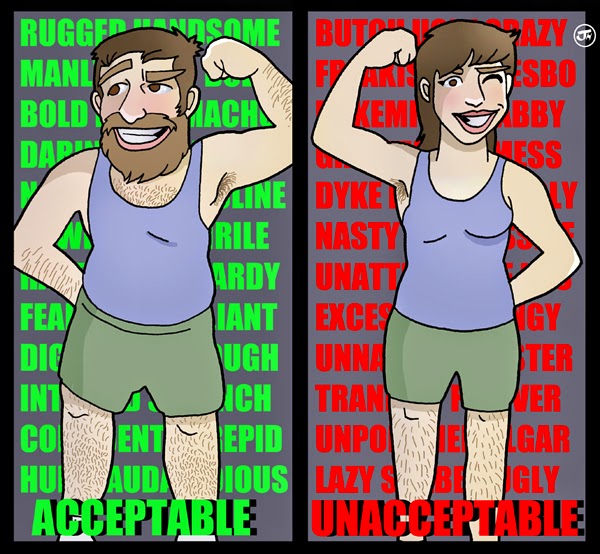
We're all familiar with the gendered double standard about sex. Men who like sex, who engage in it for its own sake rather than in the context of a relationship, who collect sexual partners as if they were baseball cards or comic books—those men are studs, worthy of admiration and awe. Women who like sex, who engage it in outside the context of a romantic relationship, who sleep around—those women are sluts, whores, worth only our most cutting epithets. But reading witty Brit Stella Newman's anti-romance novel, Pear Shaped, brought back memories of that less talked-about, but equally sexist, double standard: the double standard of beauty. No matter how unattractive they may be themselves, most men feel entitled to the admiration of the most beautiful women in the room. Entitled to get the girl they want. And girls should work their hardest to make themselves attractive, because, damn it all, that's why there here: to look good for men.

Snarky Sophie Klein, the first-person narrator of Pear Shaped, experiences this double standard first-hand. When she meets wealthy James in a bar, she's a little surprised when he calls her "skinny." She may be a size 10 (U.S. size 6), but she'd got "tits and an arse," unlike the other girl James was chatting up before talking with her ("one of those girls you can count the vertebrae of through her silk shirt") (Kindle Loc 87). Sophie and James hit it off right away, though, Sophie drawn to his carefree charm, boundless energy, and confident ways. He's far from drop-dead gorgeous, and he's forty-five to Sophie's thirty-three, but he's just Sophie's type: "a big man," "tall and broad, with a stomach he wears well" (301). Before long, Sophie's falling for him, big time.

But James? He's not so sure. Over dinner one night, after the two have been dating (and shagging) for three months, Sophie thinks James might on the verge of proposing. But instead, his declaration turns out to be embarrassingly insulting: "I'm worried.... you're not my normal type.... physically..... I know I'm no Adonis, but..."  "BUT WHAT?" Sophie thinks to herself. "You're rich and male so it doesn't matter?" (1137) But Sophie keeps her outrage inside, not challenging James about the sexism that has him feeling that he's somehow less than a man if he doesn't have a trophy woman on his arm.

Sophie realizes that James' worry doesn't actually have "anything to do with me not being his type. It's either his ego's need for a trophy, or his fear of commitment. Whatever the problem is, I reckon it's about his head, not my body" (Loc 1167). Later, she tells him straight out what she thinks of his worry:

Whatever your 'type' is, that 'type' clearly hasn't been working out for you so well. Some men have a turning point in their lives where they realise what long-term relationships are all about. Love isn't all about crazy hot sex in a glass lift. It's about finding someone you fancy and like and respect and who you can be yourself with. Find that and you're very, very luck. The reason I'm calling you back is because I don't think you're a total idiot; I think you might be smart enough to grow up and realise that.  (1126)

Yet even though she's both furious and crushed by James' unfeeling revelation, Sophie can't stop herself from longing for him, both emotionally and physically, and ends up taking James back, even though he never openly acknowledges the truth of her interpretation of his fears, or even apologizes for his obnoxious comments. He asks her to move in, and even proposes.

James certainly thinks of himself as a nice guy, and thus, of course,
deserving of a trophy girlfriend
But over time, it becomes more and more obvious that James has not grown out of his worry, or at least out of the assumptions of male entitlement that lie behind it:

His thoughts about Sophie's friend, who is suffering from postpartum depression: "He's supposed to be eternally grateful that she's a lard arse? A wife should make an effort for her husband. She should get down the gym, get on the high heels and suspenders, that'll sort out their marriage better than some stupid therapy" (2013)

Sophie's impression of his thoughts when he introduces her to his business associates: "When he says 'this is my girlfriend, Sophie,' the word 'girlfriend' sits heavily on his tongue like an ulcer" (2137)

" 'One of your eyes is bigger than the other,' he says. I have noticed this only recently myself.... It is truly a microscopic difference, but he has spotted it and seen fit to comment on it. Not in a 'your flaws make you unique/beautiful to me' way. Just in a 'you are not perfect' way" (2300).

Sophie watching James fixate on a model: "James is staring at her in a way that I have never, ever seen him look at me. It is the way he sometimes looks when he is driving his car too fast" (2162).

James' only half-way joking comment when Sophie rolls on top of him to admire his good looks: "Get off me, you big lump" (2284).

After a lot of determined avoidance on Sophie's part, and a lot of wiggly, passive-aggressive behavior on James', James finally admits that he just can't overcome his worries. The two part ways, and in the second half of the book, Sophie goes into, and climbs her way back out of, a major emotional trough, chronicled with equal parts humor and pain. Sophie's well aware of what went wrong:

The truth is I am furious: furious that I took him back, furious that I didn't pick him up on all the comments about my weight, furious that I didn't assert myself more, furiuos that I shagged him in the car when he was almost definitely seeing Noushka (the model), furious that I put his value above mine, furious that I believed his version of me.  (3818)

But its not so easy for her feelings to catch up with her brain. Especially because she, like many white middle class women, has been "conditioned to think of anger as ugly, ugly, ugly" (4681).

Sophie does end up with a different, far better man by book's end. But the climax of the story is less about her new romance, and more about her acceptance, not only of her own strengths, but also of James' limitations:

I know what my life would be like with James. If I stayed slim and well maintained and aloof and played a constant game and kept him on his toes all the time, he'd eat out of my hand, for a while. If I never had a bad day, never showed weakness, never put on weight, never needed reassurance, never gold old, I'd be just fine..... And while I want him to fight for me, and tell me he's realised he's making a mistake, and that he wants me, fat, think or in the middle, the truth is, he really isn't built that way. And for the first time I actually start to feel sorry for him.  (4255; 4274)


I wonder if someone could write a romance with a hero who starts off with the same entitled attitude as James, but who gives it up/moves beyond it? And not because he falls in love (changed by the love of a good woman trope), but because he comes to understand how limiting it is, both for women and for himself?


Illustration credits:
Beauty double standard: Good Men Project
Entitled to a girlfriend: The Lion's Roar


Pear Shaped
Avon, 2012;
ebook by Bookouture, 2014

Tuesday, October 2, 2012

Behind Every Good Rake... Review of Courtney Milan's UNCLAIMED


RNFF BOOK REVIEW


The rake abandons his pregnant betrothed


A mainstay of contemporary historical romance is the dashing figure of the rake. The word rake originated as an abbreviated version of rakehell, which, according to the Oxford English Dictionary, came into use during the sixteenth century as a derogatory term for "a thorough scoundrel or rascal; an utterly immoral or dissolute person; a vile debauchee." As the shortened version of the word gradually began to replace the longer, so, too, did the term's connotations began to shift. By the late eighteenth century, rake could refer to the somewhat less reprehensible "man of loose habits and immoral character," and even to the fairly harmless "idle, dissipated man of fashion."*


The rake as fop
But for today's Regency romance readers, the rake is a man not to be shunned or made fun of, but to be desired. All About Romance describes the rake as "a ladies' man, a bon vivant and possibly a libertine." A search at amazon.com for books with the word "rake" in the title turns up more than 800 in paperback alone, a testament to the popularity of the once derided figure.

Embodying the same appeal as the leather-jacketed rebel of the 1950s, the rake is valued by historical romance readers for his virility, his air of danger, and his unwillingness to conform to the strict social (and sexual) standards of his time. As a 2009 discussion of the rake on the Dear Author website suggests, the fantasy of being able to "tame" or "reform" such a figure is also a big part of the ungentlemanly gentleman's appeal. "I think the whole concept plays upon women's fantasies of being that one special someone who can affect positive change," argues author Maggie Robinson. "Lord knows in real life, men are not so amendable to reformation, or even putting the toilet seat down..."

But behind the figure of the rake looms an all-too-often forgotten shadow, Courtney Milan suggests in her historical romance, Unclaimed: the women whom he has seduced and abandoned.


A 1837 sex conduct book
Milan begins her questioning of our love affair with the rake by making her protagonist his very opposite. Unclaimed's Mark Turner is not only a virgin, but also the very public embodiment of early Victorian male sexual abstinence. When he writes A Gentleman's Practical Guide to Chastity, Mark thinks it just another philosophical treatise, one that will be printed then quickly forgotten. But to his surprise, his philosophizing draws the attention of young Queen Victoria, who knights him for his efforts. Mark becomes the rock star of his generation, known far and wide for being a man who won't succumb to any woman's physical charms. Mark is hounded by newspapermen eager to report his every move to his adoring fans; annoyed by his publisher, who is making a mint from subscriptions to the Male Chastity Brigade (MCB), a group inspired by his book; and tortured by well-meaning MCB members, who compare him to Christ, proudly inform him how many days they've gone without sex ("Forty-seven, sir!" Tolliver squeaked), and act in ways that clearly demonstrate they've never read his book.


Everyone in the rural village of Shepton Mallet, where Mark retreats to avoid the reporters and groupies who dog his every footstep, tries to matchmake on his behalf, believing that such a perfect man will want a similarly perfect woman. But Mark, and Milan, know better.

Jessica Farleigh is a courtesan, a woman who has sold her body for sex. She's followed Sir Mark to Shepton Mallet in order to win the cash prize, offered by a rival of Mark's, to any woman who can prove she's seduced the morally upright gentleman. Jessica believes the seduction will be easy: "If Jessica knew anything, she knew men. She knew what men wanted, and she knew how to give it to them.... [A]s with all men, she only needed to imply she was available. Sir Mark would be a willing participant in the destruction of his own reputation" (46). But what draws Mark to Jessica is not what all men want; thought he notices her beauty and her provocative dress, he won't be driven by it:

No doubt the inhabitants of Shepton Mallet had no idea what to make of a woman like this one—or a gown as daring as the one she wore. But Mark knew. That was the sort of dress that commanded: look at me.
    Mark had never taken well to commands. He turned away. (34)


Regency courtesan Harriette Wilson and her "look at me" dress

What convinces Mark to reconsider is not how Jessica looks, but the incongruity between her dress and her actions. Though her gown signals sexual availability, the way she flinches when the local rector touches her arm clearly signals stay away:

For one instant, she had more the look of scalded cat about her than graceful swan, and that half-second of response betrayed her air of worldly sensuality. She was not who she appeared at first blush.
     Mark was suddenly interested—interested in a way that a low-cut gown and a striking figure could never have accomplished. (36)

Mark sees the specific, the individual in Jessica, refusing to universalize. Unlike Jessica, he refuses to insist that all women are anything. And what he wants in a romantic partner is someone who can see him for who he really is: not the pious, sexless plaster saint the fans of his book assume him to be, but the man who desires, yet chooses not to act on that desire.

If he feels sexual desire, why does Mark choose to remain celibate? First, because he refuses to buy into the popular wisdom that places all blame for sexual impropriety on the woman. "A man must claim responsibility for his own temptation, and not pin it on the woman who arouses him," he tells the young MCB member who urges him to kick the all-too-alluring Jessica out of a town picnic held in his honor (87). As Jessica discovers when Mark refuses her seduction attempts, Mark believes there's an important distinction between thought and deed: "Yes, I want you, he'd as good as told her, but I won't act on the want" (89). In many historical romances, a hero's loss of sexual self-control in the face of the woman he lusts after is a positive sign; through Mark, Milan asks us to consider sexual self-control as a sign of respect.

Second, Mark realizes that the double standard makes indulging in sex far more risky to the woman than to the man. Frustrated by the misguided principles of the MCB, Mark lectures the group:

You should hold to chastity not because you fear what your cohort will say, but because when you indulge your own lusts, the woman you indulge them with is hurt. She is the one who will weather the censure of society. She is the one on whom the burden and expense of an unanticipated pregnancy will fall. She is the one who will be cast out. (243)


Mark's words point to the debilitating double standard of his society (and, far too often, of our own), a clearly empowering feminist message. Intriguingly, though, by insisting that it is the male alone who is responsible for making the choice about whether or not to indulge in sex, Mark comes dangerously close to justifying the same male privilege as his words decry. Such a protective attitude toward women can all too easily lead to a man making all the choices on behalf of his beloved, Milan's novel cautions. And given Jessica's history, the choices that she's made and the choices that have been made for her, that is a danger that bodes ill for any worthwhile romantic relationship.

Before Jessica and Mark can reach their happily ever after, then, Mark needs to accept that Jessica is not just a victim waiting for his knight in shining armor to rescue her and absolve her for her sins. She doesn't need him to stifle her with his protection, taking away her choices just as much as did any of the "protectors" who gave her money rather than love. Instead, she needs him to accept her, flaws and all, and to let her fight her own battles. The novel's climax allows Jessica to act as her own savior; the specific means by which she accomplishes this may not be very historically likely, but they are intensely satisfying to the feminist reader.

The opposite of a rakehell isn't a prude, Unclaimed asks us to believe, but rather a man who takes responsibility for his own sexual desires, and for their consequences. And a man looking for a relationship of equality with a woman will not smother her with his protection, but will allow her to ride to her own rescue, all the while admiring "how brightly [her] armor shone" (400).

* "Rakehell" and "rake." Oxford English Dictionary, 2nd edition on CD-ROM. Oxford UP, 2009. 


  Courtney Milan, Unclaimed. Book #2 in the Turner series.    
  HQN Books, 2001.


Photo credits:
• William Hogarth, first painting in The Rake's Progress series (1735). Wikipedia.
• Detail from George Cruickshank, Monstrosities of 1822. Reprinted in Mark Bills, The Art of Satire: London in Caricature. London: Philip Wilson/Museum of London, 2006.
• Harriette Wilson, from the BBC Radio 4 web site
• Sylvester Grahame, Grahame's Lectures on Chastity, specially intended for the serious consideration of young men and parents. Internet Archive.
• Self-Rescuing Princess T-shirt. Thinkgeek.com


Next time on RNFF: It's a guy thing...


Tuesday, September 25, 2012

Sex Roles in and out of Bed: Victoria Dahl's START ME UP


RNFF BOOK REVIEW


"Baby, that is one fine ass..."

So opens Victoria Dahl's provocative contemporary romance, Start Me Up. Hardly an auspicious beginning for a reader in search of feminism in her romance reading, a reader might be forgiven for assuming. But Dahl, sneaky writer that she is, has baited her readers only to switch the linguistic rug out from underneath them. For if you read past that offensive opening line, you discover that the  sexist language comes not from the mouth of an overbearing male, but from the raunchy lips of Molly, the best friend of the novel's protagonist, Lori. As the opeing scene progresses, and Molly's comments grow increasingly lewd, car mechanic Lori joins in, adding her own sexual double entendres to the mix. Molly and Lori thus use a technique common to traditionally oppressed groups: re-appropriating the language of the oppressor to undermine its power. Molly and Lori subvert the restrictions of sexist languge by making it an object of humor.

With her novel's opening scene, then, Dahl signals her book's feminist concerns: not just to laugh at, but to explore the limits and powers of conventional gender roles. In the novel that follows, Dahl proceeds to give readers not only a laugh-out-loud funny story, but also a thoughtful model of ways to undermine the power differentials that mark out "feminine" and "masculine" roles.


Estrogen, major contributor to female sex drive
One model Dahl provides is an acknowledgement that women have sexual desires separate from, and prior to, any particular male object. Conventional wisdom takes it for granted that heterosexual men desire sex, regardless of whether or not there is a particular woman to whom they are attracted. But it simultaneously implies that a woman's sexual desire appears only after a man steps onto the stage: not "I want," but "I want you." Romance novels all too often buy into this false belief about the differences between male and female desire. Women do not want sex, we're supposed to believe; they want a man. The man turns them on, makes them feel sexy, makes them want to engage in sexual activity, rather than some drive or desire inside them that exists separate from any particular partner.

Dahl openly questions such assumptions about female sexuality by having her protagonist, Lori, openly discuss her wish to "do someone" (42). When friend Molly eagerly asks which man Lori has in mind, Lori answers, "I don't know who I want to do. Just someone. Someone tall and strong and cute" (43). Lori's elaboration—"The point is I'm not looking for a relationship. I just want to use someone for sex" (52)—humorously turns traditional gender stereotypes on their ear. But it also makes it crystal clear that her sexual desire exists prior to, and separate form, any specific male object.


Dahl acknowledges, though, that the sexual double standard often makes it difficult for a woman to be so straightforward in discussing, never mind acting upon, her own sexual desires. After she mistakenly believes that Molly has told her brother, Quinn, about Lori's desire for a sexual fling, Lori backs off, claiming it was only a joke. Even after Quinn, a former nerd who has always been too absorbed in his work to be a good boyfriend, tells her he'd like to have meaningless sex with her, Lori, embarrassed, initially refuses. Finally, realizing that she's tired of being so passive, Lori takes the plunge and asks Quinn to be her friend with benefits.

During their subsequent affair, Lori often has difficulty telling Quinn just what she wants sexually, too shy or self-conscious to speak of her own desires:

     If this were one of her books, she'd put a stop to this dinner business. She'd unzip the back of her dress and strip down to her brand-new underwear and matching bra. Tell him all she wanted to eat was him. Tell him she wanted it hard and fast and now.
     But she was just Lori Love, girl mechanic, and she didn't have the guts to put what she wanted into words even if it was the whole point of this date. Pitiful. (95)

I, for one, somehow bought into the idea that because my desire had been created by a man, he should also be able to satisfy that desire without any direction from me. Such assumptions set me, and all women, up for disappointment, Dahl's novel argues. Dahl uses Lori's character development to move Lori, and through Lori, her readers, beyond the fear of speaking about what turns us on. Lori learns it is more than worth it to take an active role in expressing one's sexual desires, rather than passively waiting for a partner to magically intuit them. Like Lori, women need to grab the courage to tell their partners what they like in bed:

     Lori clenched her eyes shut. She couldn't possibly ask him [to speak Spanish during sex].
     "Please," he murmured.
     This was supposed to be her fantasy. If she couldn't ask for what she wanted from Quinn, right here, right now, she'd miss her chance to live a dream. Lori held her breath and gathered up her courage and whispered into his shirt. (182)

The most surprising lesson Dahl's book taught me is that the role one prefers in bed may be radically different than the role one prefers to take on in day-to-day life. Quinn reads Lori's book of short story erotica, taking special note of the ones she's marked as her favorites: "There'd been a clear common thread in the two stories she'd liked. Both heroes had been aggressive. Not rough, per se, but not the least bit tentative in getting what they wanted" (133). In fact, Quinn discovers, Lori fantasizes about being tied up during sex. Though Quinn, who's been a polite, considerate sexual partner in the past, is a bit nervous about taking on a more dominant role, he gamely gives it a try, and the resultant sex is explosive for them both.

But whenever Quinn tries to take on the "saving the damsel in distress" role in real life—acting overly protective of Lori, wanting to pay for her to travel as she's always dreamed of, asking her to give up her life to move in with him—Lori immediately takes offense. She may like a decisive, take-charge sexual partner, but that doesn't mean she's eager, or even the least bit willing, to cede her control over everyday decisions to him. Lori and Quinn's relationship can only move beyond being friends with benefits when Quinn can see that "there weren't any wussy heroes" in the erotic stories Lori likes, but "there weren't any damsels in distress," either. "Lori didn't need saving any more," Quinn realizes, "but maybe it wouldn't hurt to ride up on a stallion and ask if she wanted a ride" (251-52).

Many women believe that being a feminist means never being weak, always being in control, even in their fantasy lives. This is a message I for one internalized, even if it wasn't ever directly stated in any feminist theory I'd read. But Dahl's novel shook up my belief, arguing that while feminism may insist that women be given the opportunity to take on a role of power in their sexual and romantic relationships, it doesn't demand that every opportunity be taken. Particularly when it comes to the roles we choose to play in bed.


Victoria Dahl, Start Me Up. HQN 2009.


Photo/Illustration credits:
• Estrogen t-shirt: chemicalshirts
• Sexual Double Standard cartoon: Cartoons by Sheila © Sheila Hollingworth
• Heart book: Miss Erika


Next time: What can a feminist get from reading romance?