Showing posts with label fantasies. Show all posts

Tuesday, July 28, 2015

The Li.st Romance Panels: Is Romance Feminist?

Last week, eight romance authors, invited by the Li.st, gathered in a New York City work cooperative space to speak to an enthusiastic audience about romance, feminism, and sex. I was thrilled to be a part of the audience, and planned to write up a report for RNFF readers on the evening. Of course, now that I'm back home, unpacking after the RWA annual conference, which took place in the days following the Li.st panel, I can't for the life of me find the extensive notes I took as the authors talked and debated. Insert your favorite curse words here...

Luckily for me, fellow romance scholar Jayashree Kamble live-tweeted during the panels, and put her tweets together on Storify; you can find her tweets here.


"Feminism and Romance" panel: Alisha Rai, Sarah MacLean
Maya Rodale, and Carla Neggers. Photo from Alisha Rai's tweet
There are a few things that I'd like to add to Jayashree's thoughts. Maya Rodale, moderator of the first panel, "Romance Novels as a Feminist Trope Throughout the Centuries," opened the discussion by asking her fellow panelists "Are romance novels feminist?" Kamble suggests in her tweet that the response was "hell, yes" (or perhaps that was Kamble's answer?), but panelists' actual comments were more nuanced. There was a bit of silence at first, that funny pause that sometimes happens at the start of a panel talk when no one is quite sure who is meant to speak first, and Rodale interjected a few more questions "Are romances bad?" "Romances are written by women for women, about women, no?" MacLean and Rai then jumped in to note the difficulty of answering any of these questions with a simple "yes" or "no," especially given the breadth of the romance field at present. Carla Neggers, who has been publishing longer than any of the other panelists, added historical context, talking about many of the limits placed on romance authors when she was just beginning her career, and how many of those limits are no longer in place.

"How has the romance genre evolved over the past few decades?" was the next topic Rodale asked panelists to consider. The greater diversity of the genre, particularly in regards to the inclusion of romances featuring LGBTQ protagonists and protagonists of color. Rai had perhaps the best line of the night, though, when she noted that diversity still has a looooong way to go in the largely still-white world of romanceland: "We say evolution, but evolution is too slow. We need revolution." #weneeddiverseromance, indeed.

Sarah MacLean, who is white, did not disagree, but framed the issue somewhat differently, suggesting that the genre is on the edge of a huge shift, moving inexorably towards a more inclusive stance. Other panelists noted that diversity took hold first in the ranks of the self-published, and is only gradually (if at all) effecting the look of the pub lists of the big 5 romance publishers. It would be a cool research project, my academic self thinks, comparing the numbers of POC and LGBTQ characters in books by those publishers over the past 5, or perhaps 10, years...

Readers' often judgmental stance towards romance heroines formed another topic of discussion, but soon segued into thoughts about the prevalence of the billionaire hero in contemporary romance published in the past few years. MacLean put forth a theory that I've heard in other venues: that romance is a fantasy, and today, given the tough economic times and the dual role of worker and homemaker that the majority of American women have to play today, the fantasy of being swept away by a man who has so much money that you'll never need to worry about paying the bills again is vastly appealing.  Rodale concurred, focusing on the alpha male in billionaire romance not only being able to meet the heroine/reader's economic needs/worries, but also being able to address her other desires (sexual, emotional), desires that in everyday life often have to be pushed to the side. I get this argument, but I'm wondering why books in which the women are billionaires themselves, and fall in love with appreciative guys, aren't nearly as popular? Is there some gendered sense that a rich woman will be exploited? That a rich woman is somehow bad? That she must have had to do something not quite feminine in order to achieve wealth? That being a billionaire is hard work, but loving one is not? I'd love to hear readers' thoughts about this...

The question of happy endings—does romance require them, or can the genre take them or leave them?—concluded the first panel. Most audience members seemed to be in the former camp, despite Rodale's citing of many romance-writing and -reading friends who are happy to live without the HEA, or even the HFN. I wondered if there is anything inherently feminist, or anti-feminist, about the restrictiveness, of the HEA—what do you think?


"Erotic Writing and the Role of Women" panel. Photo from Alyssa Cole's tweet

The second panel, "Erotic Writing and the Role of the Woman," featured an entire panel of romance writers of color, a rarity at RWA or other meetings, unless the workshop/panel topic is about diversity (more about this in Friday's post). Feminista Jones, a sex-positive social worker, activist, blogger, and now BDSM romance novelist, moderated the discussion with fellow erotic romance writers Suleikha Snyder, Rebekkah Weatherspoon, and Jordan Silver.

I thought it was fascinating that all of the writers except for Jones began their writing careers penning fan fiction, then discovering through traditional or, more often, through self-publishing, that what they were giving away for free could be earning them money. Does the slash tradition of fan fiction make writers more comfortable with erotic romance publishing? Does the independence of fan fiction (no editors, no publishing houses) lead fan fiction writers more easily to self-publishing?

This panel, like the earlier one, talked about the changes in the romance genre over the past 20 years. The rise of self-publishing; the shift from heroines with no sexual agency to heroines whose sexual desires are affirmed; the rise of queer romance, and sex-positive romance—just a few of the changes the panelists noted.

A fascinating exchange occurred between Jordan Silver, who declared that she wasn't a feminist, that she liked alpha males and wanted to be taken care of, and Feminista Jones, who spoke about the often fraught relationship between black women and feminism (many black women feeling that feminism is a white girl thing, without any real relevance to their lives). Jones argued for a broader understanding of feminism and its focus on equality for women, no matter their race or ethnicity. The discussion highlighted a point made earlier in the evening, that there is no one black voice, no one black identity; the three women of African descent on the panel were all coming from different backgrounds and different cultures, and one's experience did not mirror that of the others'. Only when we have enough books with people of color will we be able to move beyond the assumption of a monolithic black identity.

Jones also spoke about the feminism she tried to portray in her BDSM romance, Push The Button, which she wrote partly in reaction against the misconceptions about the BDSM lifestyle she saw in the popular 50 Shades of Gray novels. A member of the BDSM community herself, Jones wrote Push to present the everyday life aspects of a s/D relationship. When I read Push, I didn't find it that feminist, to be honest. After hearing Jones speak, though, it's clear that she herself has a strong grounding in feminist ideas, and I'm curious to know more about how she sees those ideas playing out in her novel. I've emailed her to see if she might like to guest post here at RNFF; will keep you posted...

The panelists also discussed the difficulties in finding homes for their work with traditional publishers, in large part because of the paucity of agents and editors of color in the industry. I've seen far more younger editors in the business than there were when I worked in publishing (in the late 80s and the 90s), but until people of color hold positions of power within what are often very hierarchical publishing houses, the lack of real investment in the stories of writers of color is all too likely to continue.

Two other great comments from this portion of the evening: Feminista Jones took major issue with the idea that black women are not deserving of love; her goal in writing romance, she says, is to "show black women being adored." Suleikha Snyder mentioned that in one of her Bollywood novels, she had great fun writing one white character in her otherwise all Indian cast, ironically turning the tables on all of the token (insert minority identity here) portrayals found in the majority of American-published romance.

During the Q & A period, two questions white readers often ask of authors of color came to the fore: how do I find more books by writers of color, and how do I, as a white writer, include characters of color in my work without stereotyping/being offensive? The panel turned the first question back on the audience—rather than giving them places to find POC romance, the panelists challenged audience members to help create a publishing and consumer environment in which such romances will not be hard to find. Buy books by writers of color; use social media to promote writers of color; tell publishers that you want romances by writers of color. Don't let publishers off the hook by letting them continue to say that such romances do not sell.

The panelists were gracious in offering advice in response to the second question. Ask questions with thoughtfulness and respect, do research, run your stories by beta readers of color, even just make friends with people from cultures and ethnicities to which you yourself do not belong. What they did not say, but what I would like to add, is that it is not the responsibility of writers of color to make us white writers feel safe when writing about people outside our own cultures. We have to take a risk, be willing to make mistakes, be willing to be called out on them, learn from them, and keep going.

Just as writers of color have been doing all along.


More on Friday about the RWA National conference, and topics of interest there to feminist romance readers.

Tuesday, July 14, 2015

Rape Culture and Rape Fantasy: Lilah Pace's ASKING FOR IT

Do we live in a culture that normalizes rape? Tacitly encourages it?

If so, do romance novels play a role in perpetuating such a culture?

Do women who have sexual fantasies about being raped feel ashamed of such fantasies? Feel like bad feminists?

Would a woman who lived in a non-rape culture never fantasize about being raped?


These and other questions have been swirling around in my head after reading Liz McCausland's June 13, 2015 "Unpopular Opinion" post on her blog, Something More: my extensive reading, which discusses the questions we are not asking about our romance novels when it comes to the issue of rape. And after reading an article in the July/August 2015 edition of the Yale Alumni Magazine, in which four women, including two current Yale students, hold a conversation about issues of sexual misconduct on campus. And especially after reading Lilah Pace's controversial erotic romance, Asking For It, which explores the issue of rape fantasy while simultaneously presenting eroticized scenes of consensual rape for its readers' pleasure.

Pace's novel, told from the point of view of Vivienne, a white New Orleans girl of privilege who has moved to Austin, Texas, to attend the University of Texas and earn a Ph.D. in art. Vivienne is in therapy, in part because of the guilt and shame she feels about her sexual fantasies: "I don't get off unless I'm imagining being raped.... I hate this about myself" (page 2). She hates it, but even so, she wishes she could move from fantasy to reality, not by being attacked (been there, done that), but by sharing her fantasy with a willing partner in a sexual role-play. Unfortunately, her last boyfriend, nice-guy lawyer Geordie, was not at all comfortable playing such a sexual role, even in play, and because of this, as well as other incompatibilities, the two broke up.

One part of Vivienne is sickened by her obsession with rape fantasy. Another takes deep pleasure in indulging in it, even when the lines between reality and fantasy get blurry. A flat tire on a dark, lonely road; a cell phone with no charge; a large, overpowering male stepping out of his sleek car to help—when Vivienne finds herself in the midst of this real-life scenario at the start of Asking For It, her mind soon fills

...with visions I didn't want to want. Visions of him bending me over the back of my car, pushing up the skirt of my sundress. Of him pulling me into the backseat, putting my hand on his cock, whispering, Time to thank me. His hands fisting in my hair as he towed me down on my knees—
     Stop it. (8)

Good Samaritan does not turn into actual rapist, and the two part without even exchanging names. But only a few days later, at a friend's party, Vivienne finds herself being introduced to unsmiling Jonah Marks, UT Earth Sciences professor, and the sexy object of her latest guilty fantasies. Even worse, former boyfriend Geordie is also in attendance, and is headed toward sloppy, confessional drunk territory. When Geordie attempts to apologize for his role in their breakup in excruciatingly embarrassing detail—"I mean, kink yay, right? Everybody should love kinks. And you get to have yours! You do. But it's not my kink. At all. Playing rapist freaks me out. But I shouldn't have been such a dumb cunt about it" (25)—Vivenne can't bring herself to just laugh and forget it. And neither can Jonah, who overhears Geordie's confession. And who makes Vivienne a proposal that tells her that he, too, was as far from envisioning himself as a Good Samaritan as it was possible to be:

     "I don't even know you."
     "That's going to make it better for you," Jonah says. "With a boyfriend, you can pretend—but it's a joke, really. A game. Not the fantasy you really want. Me? I'm nearly a stranger. I can do more than fuck you. I can scare you a little. Just a little. Enough to make it what you really want.
.....
     "It's your fantasy, and mine. Chances like this don't come along often—two people twisted in the exact same way." Jonah smiles; it's a fierce expression, rather than a friendly one. "If we don't make something out of this, I think you'll regret it. I know I will." (29)

Unsurprisingly, the rational, thinking part of Vivienne is appalled by Jonah's proposal:

My fantasy is something I'm trying to escape from, not sink down into. If I try this and hate it, that would be beyond horrible. It might be as traumatic as a real rape, and I would have walked right into it. That's not what scares me, though. What scares me is that I'll try it and love it. Maybe I really am that fucked up. (30)

Yet her own obsession calls to her, and only a few days later, she finds herself emailing Jonah, asking him to meet. And then asking him for more.

Several consensual forced sexual encounters later, and Vivienne and Jonah know they're explosive together as lovers. And so do readers; these scenes are detailed, explicit, and meant to be a turn-on, not a sign of Vivienne's "fucked up" mind. And they were so, at least to this reader, even though rape fantasy isn't really something that pops to the front of my brain when I'm imagining sexy times. I've never been sexually assaulted myself, but I have friends, acquaintances, and relatives who have, and I find the idea of eroticizing sexual violence against women in the face of that knowledge pretty distasteful. But Pace's story turned me on. Why?

I think that it's because that, despite all the pre-publication talk about the blurring of the boundaries between fantasy and reality, there is a clear line between rape and role-play, both for Vivienne and for the reader. Vivienne and Jonah discussed their hard and soft boundaries, as occurs in many BDSM romance novels, before their first encounter, and all of the sites of their trysts, as well as the general outlines of the fantasy each one will involve, are agreed upon by both parties before each occurence. Vivienne is sickened by her actual rapist, who is still involved in her life to a small degree, but she is turned on by the pretense of being forced. Reading Vivienne's story felt far different to me than reading Old Skool rape-tastic romance, in which rape occurs but is rarely named such in the texts. In Old Skool romances, a reader has to turn a narrative of actual rape into a fantasy inside her own head. In contrast, what Vivienne and Jonah are doing is meant to simulate rape, rather than rape pretending to be something more benign as in Old Skool romances. The fantasy takes place on the pages of the book, in the head of the protagonist, rather than in my own. I'm not pretending that rape is a pleasure; Vivienne is, and it turns her on. That difference may not seem to be a major one, but for me, it was the difference between a book that makes me want to throw up and a book that I find both intellectually intriguing and sexually pleasurable.

And it's also because Vivienne has the advice of a kindly, intelligent, and insightful therapist to guide her through her unusual sexual journey. Doreen, said therapist, reassures Vivienne that experiencing rape fantasies in the wake of being sexually assaulted, while uncommon, is not unheard of. After her first encounter with Jonah, Vivienne fears that Doreen will judge her negatively for turning her fantasies into reality/play (projecting much?), and will advise Vivienne for her own mental health against doing it again. But Doreen, like the best of therapists, refuses to judge; instead, she assures Vivienne that "there's a world of difference between your fantasies and what [X] did, because he raped you.... You choose your partner in the fantasy—whether that's a figment of your imagination or a willing lover like Jonah. You didn't choose [X]. He took that choice away from you" (192). Doreen tries to help Vivienne redirect her focus to what she thinks is Vivienne's real problem:

"One of the reasons you came to me was that you wanted to stop having this fantasy. I understand your reasons. But I don't think the fantasy itself is your most significant problem. I think your main problem is the way you beat yourself up about it.... That, and the reason you're fixated on the fantasy in the first place." (11)

Initially, Vivienne is able to keep her guilt and shame out of her trysts with Jonah. In large part because she and Jonah agree to keep their personal lives out of their sexual play, feeling that this will make the play all the more sexually charged. But such compartmentalization becomes more and more difficult as they encounter each other casually on campus and find themselves feeling empathy for the other's emotions, and when real life, in the form of family problems, interrupts their consensual play. Can a relationship founded on rape fantasy transform into a romantic relationship? How much can Jonah and Vivienne keep hidden from one another (Vivienne's rape and her dysfunctional family; the reasons why Jonah's so drawn to rapist role-play, and his own family troubles) and still hope to build mutual trust?

The most memorable scene in the novel for me was a confrontation of sorts between Vivienne and Doreen, when, after months of building up trust between them, Doreen thinks Vivienne is strong enough to listen to this bombshell: "You might have had this fantasy even if [X] had never raped you" (251). Though Vivienne disagrees—"No." I shake my head. "He did this to me. You know he did," Doreen asks Vivienne to consider thinking about her history in a different way:

     "[X] raped you.... The fantasy comes from that, and from a culture that eroticizes violence against women, and leftover puritanical guilt about sex that tells us we're not allowed to choose it and want it for ourselves, and from God only knows where else."
     I'm furious with her. I want to cry. My cheeks are flushed with shame. Every emotion I've ever felt about this is bubbling up at once. "But it's the only thing that gets me off. I can't come any other way! Does that sound normal to you?"
     Doreen looks at me steadily. "Exactly. The fantasy isn't your problem; it's the extremity of your fixation on it. Who  is it who won't let you find sexual satisfaction any other way?"
     Me. She means me.  (251-52)


Asking For It doesn't provide any easy answers to the questions that opened this post; in fact, with its "To be Continued" ending, it leaves far too many of them frustratingly open. But at least it is asking us to give voice to the questions, to start thinking about the intersections of rape culture and rape fantasy, in romance novels and in real life. A truly feminist move, in my book.


Asking for It
Berkley, 2015


Tuesday, September 17, 2013

Epic BDSM: Jacqueline Carey's KUSHIEL'S DART

Back in May, in response to a post about whether a romance featuring the trope of the evil woman could ever be feminist, commenter mepamelia suggested we try Jacqueline Carey's fantasy novel, Kushiel's Dart. It's taken a while for Carey's novel to make it to the top of my TBR pile (reading primarily romance for the past year, books that I can usually plough through in a day or less, made me cautious about devoting an entire week to a 700-page epic fantasy), but once I picked it up, I found it nearly impossible to put down. Kushiel's Dart is a good book to think with, a book that asks its readers to interrogate their assumptions not just about gender, but about religion, power, sexuality, and love.

Having taught a class on fantasy for children and young adults for nearly a decade, I've come to appreciate books which imagine fantasy worlds far different from our own, especially those built upon models that point out the problematic aspects inherent in ours. The world Carey creates in Kushiel's Dart is an alternate version of Europe in the early Middle Ages, after the fall of the Roman Empire. But instead practicing Christianity, the people of Terre d'Ange revere Blessed Elua, an angel formed when the "bitter salt tears of the Magdelene fell upon soil ensanguined and moist with the shed blood of the Messiah" (24). Scorned by God, rejected both by the Roman Empire and by the Yeshuites, Elua wandered the earth singing, flowers blooming in his wake. Tales of his wandering reached Heaven; after the King of Persis imprisoned Elua, eight of the angelic hierarchy descended to earth, flouting the One God's will to come to his aid. Naamah, "eldest sister," offered her body to the King in exchange for Elua's freedom; later, she lay with strangers in the market for coin to sustain Elua and his followers. Terre d'Angelines do not find her actions abhorrent, but worthy of reverence. After years of wandering, Elua and his followers at last found welcome in the unnamed land that becomes Terre d'Ange, where the people accepted his one Precept: love as thou wilt.

The society of Terre d'Ange, then, is one with a far different attitude toward sex and sexuality than a Christian-based one. In Terre d'Ange, the pleasures of sexual love are valued, rather than feared or shunned as sinful. Bisexual, homosexual, and heterosexual encounters are all embraced (although each person is allowed to choose his or her own partner(s) and sexual preferences), as are sexual encounters based on the pleasure of pain. Adepts of the angel Namaah prostitute themselves in sacred service. Rape, a heresy against the teaching of Elua, is considered an abhorrent crime.

But if Terre d'Ange is a sexually-liberal society, it is hardly a paradise; even as it accepts multiple sexualities, it remains as mired in the same political power struggles that troubled not only real medieval Europe, but the kingdoms in the majority of 20th century high fantasies, too. And while it may be a crime to rape, using an enemy's sexual desires against him to gain secrets and reveal lies is a far from uncommon practice. At least in the House of Anafiel Delaunay, where our protagonist, Phèdre, has been raised since the age of ten.

Sold first by her mother into servitude to one of the Houses of the Night Court, the thirteen Houses where adepts of Namaah offer their courtesan services, Phèdre's indenture is later purchased by Delaunay, a potentate of the royal court. For Phèdre bears Kushiel's Dart, a red mote in her eye, the rare sign of an anguisette, or lover of sexual pain. Kushiel, one of the angels that fled Heaven to follow Elua, was originally an angel of punishment, sent by the One God to torment sinners and make them repent. But Kushiel believed that chastisement could be an act of love, could offer pleasure as well as pain, a belief the One God did not tolerate, but Elua did. Delaunay knows that the rarity of Phèdre's inborn proclivities, as well as the prevalence of sadism among many of those in power, will make her the perfect spy, and trains her up accordingly.

The book unfolds in three sections; one, portraying Phèdre's early years as a courtesan/spy in Elua City; a second, depicting her months as a captive of the uncivilized western tribes of the Skaldia, who threaten Terre d'Ange with invasion; and a third, which recounts her imperiled journey to Alba (England) to negotiate an alliance on behalf of Terre d'Ange's young, beleaguered, unmarried queen. Intelligent, pragmatic, impeccably educated in not only politics, history, and languages, but in all the arts of pleasure, Phèdre proves a compelling high fantasy heroine as she struggles to see herself not as Kushiel's victim, but as his weapon. And a compelling romance heroine, too, as two very different men come to care for her, and she for them, over the course of her travels.

There's so much more to say about this fascinating book, so many other questions to ask: How is an anguisette different from others who enjoy sexual submission and pain? Are Phèdre's self-sacrificing actions truly heroic, if the pain she endures on behalf of others is a pleasure to her? Can a partner who doesn't share Phèdre's sexual proclivities ever suit her? What does committed love look like, in a society where infidelity is not a recognized concept? And, the question that teases at novel's end: once you've tasted the thrill of the political power game, can you ever be satisfied with a quiet life in the countryside, far from all court intrigue, even if you've the one you love beside you?

No time to answer; I have to run to the library to pick up the next book in the series...

What other high fantasy novels feature so many, and so many powerful, key women as players (spy Phèdre; Queen Ysandre; and Machiavellian machinator Melisande Sharizai)? Do these fantasies also include compelling romance?


Illustration credits
Love as Thou Wilt: Zazzle.com
Map of the world of Kushiel's Dart: Woodge.com


Jacqueline Carey, Kushiel's Dart.
Tor, 2001.

Tuesday, May 21, 2013

Polyamory Pleasures: Laurell K. Hamilton's A KISS OF SHADOWS

Do you ever find yourself doubting your judgment of a romance after you turn its final page? Especially one that's given you great pleasure? As a literary critic, I was trained to recognize not only the pleasures texts have to offer, but also how a text's pleasures can work to draw your attention away from ideas or values within the book that you might otherwise find objectionable. So sometimes, after I shut a book's cover and find myself in an end-of-the-book-pleasure-wallow, doubt start to creep in. Did I let pleasure dull the thinking parts of my brain? If I end up reviewing said book, am I going to be horribly embarrassed when a blog reader comment points out some horribly obvious plotline/character/underlying ideology that calls this book's feminism into question?

When I find myself in such a situation, I often double-check my reaction against those of other readers and reviewers. If others have seen something that I've overlooked because I've been too focused on a book's pleasures to pay attention to the more analytical parts of my brain, on Goodreads or amazon or other romance review sites, I'm certain to find at least one other reader whose pleasure centers light up for different reasons than mine do, and so will see a book's flaws more easily than I.

Reading A Kiss of Shadows (2000), the first book in Laurell K. Hamilton's Merry Gentry fantasy series, put me smack in the middle of such a situation. I had ILL'ed a copy from the local library during a quest to find BDSM novels with heroines, rather than heroes, in the dominant sexual role (a post on this topic will follow at a later date). Hamilton's Merry, an exiled princess from the Unseelie Fairie Court, admits to liking a bit of pain during sex, but this first book in the series contains only hints of dominant/submissive sexual dynamics. Instead, I found myself reading about a powerful but self-deluded Queen, an outcast princess on the cusp of coming into her long-overdue supernatural gifts, and a collection of damaged, strange, and often intensely sexy male fey faced with choosing which of the two women to serve. Not what I was expecting, but quite pleasurable, so much so that I was seriously tempted to feature the book on RNFF. But a small corner of my mind said "wait just a minute, now, girl, not so fast..."

The first Goodreads review that pops up under A Kiss of Shadows helped me to understand both my hesitations, and my fascinations with Hamilton's fantasy. Kat Kennedy's review points out many of the book's flaws, flaws that I hadn't given much thought to as I greedily sucked up the book's pleasures. On the level of mechanics, the writing has real problems (a penchant for the comma splice, and an annoying tendency to repeat a key word in a sentence in a failed attempt to sound artful). Not much happens, plot-wise, over the course of the 48 hours during which the story takes place: Merry, a detective in the human world, gets involved in a sex-abuse case that causes her previously dormant fairy powers to emerge, which draws the attention of her Aunt Andais, the Unseelie Queen, who sends a group of male fey to bring her back to the fairy court. Lots of fighting ensues until Merry agrees to return. After arriving, negotiations, threats, and punishments ensue; after Merry agrees to the role her aunt wishes her to play in court politics, she returns to her human life, albeit with her own personal male fey platoon of bodyguards. On the ideological level, one of Merry's emerging powers seems to be an ability to physically (and perhaps emotionally?) heal men with whom she has sex, a trope that Kennedy finds rather disturbing. Worst of all, Merry's polyamorous sexual interactions, far from demonstrating her sexual liberation, in fact show the opposite: "I was hoping that this book, unlike Anita Blake [the heroine of Hamilton's first fantasy series], would actually show Merry CHOOSING to have sex with a bunch of men, but not really. Once again circumstances and people more powerful than herself force her to do it. Really. She's just a victim here, guys."

Cause for pause, indeed. Yet even after reading Kennedy's review, I still couldn't shake off my liking for the book. And even though it is not a romance novel in the traditional sense, I hope you'll forgive me for using the blog to figure out through writing just what it is I find so intriguing, and even potentially feminist, in Hamilton's book.

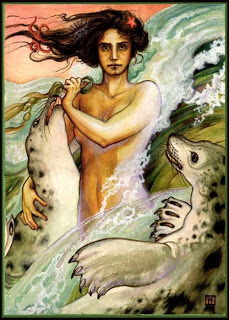
At the start of the novel, Merry is in the midst of a sexual relationship with Roane, one of the seal people. Because a fisherman had found his sealskin and burned it, Roane can no longer return to his seal form. Though the two share sex, they don't share secrets: "Roane couldn't breech my shields, but he knew they were there. He knew that even in that moment of release, I held back. If he'd been human, he would have asked why, but he wasn't human, and he didn't ask, just like I never questioned him about the call of the waves" (29). Sex is separate from emotional intimacy for Merry and Roane, a  separation that in most romance novels would be seen as a deep fault (usually in the hero-as-rake figure, but occasionally in a female self-punishing slut heroine), something that needs to be corrected in order for true love to flourish. But Hamilton does not suggest that sex for sex's sake, sex without sharing deep emotional intimacy, is a problem.

Hamilton also questions another basic tenet of romance novels: that of the one true love. The sexual predator whom Merry's detective agency is pursuing uses the lure of romance's one true love, particularly the lure of the reformed rake, to reel in unsuspecting victims:

    I looked up at him. "Are you buying [a house] with an eye for the future? Munchkins and the family thing?"
     He raised my hand to his lips. "With the right woman anything's possible."
     Lord and Lady, but he knew just how much carrot to dangle in front of most women. Imply that you could be the woman to tame him, make him settle down. Most women love that. I knew better. Men don't settle down because of the right woman. They settle down because they are finally ready for it. Whatever woman they're dating when they get ready is the one they settle down with, not necessarily the best one or the prettiest, just the one who happened to be on hand when the time got to be right. Unromantic, but still true. (42-43)

Merry's pragmatic attitude does not change over the course of the novel, nor is it significantly challenged by any other character in the book. Polyandry is considered the norm for those of the Unseelie Court, at least until one marries; even then, marital sexual continence is not valued for itself, but for its reflection of one's honesty: "The sidhe don't worry about fornication, but once you get married, give your word that you will be faithful, then you must be faithful. No fey will tolerate an oath breaker. If your word is worthless, then so are you" (41). Merry's attitude toward sex is part fey, part human, but as far as premarital relations go, the fey side seems to win out: "I like sex, my queen, and I have no designs upon monogamy," Merry tells her aunt when the Queen makes her a political offer that rests upon Merry's choice of sexual partners.

Merry has, in Kennedy's words, a "magic cooter": sex with Merry can heal the wounded male. Kennedy is bothered by Merry's power to heal through sex, feeling that it "sends a message when Merry has so little self esteem and values her body so little. In fact, I worry about the disconnected way that Merry uses her body—as if it were just a tool to share around for the greater good." Merry never struck me as lacking in the self-esteem department, or careless of her own body; must having multiple sexual partners always equate to a disregard for one's own body? I myself found Merry's sexual healing powers both interesting and amusing; they seem to make explicit the implicit assumption of many romance novels, that sex with one's true love grants one, in the words of Smart Bitches Candy Tan and Sarah Wendell, a "Magic Hoo Hoo," a vagina that, through sex, is able to "heal all ills, psychic and sexual" (Beyond Heaving Bosoms 38). But Merry's sexual healing inverts the traditional romance trope. Said "Magic Hoo Hoo" typically serves to bind the romance hero to the heroine. But when Roane regains his sealskin after having sex with newly-empowered Merry, it allows him to leave her: "He was in the ocean with his new skin. He hadn't left me unprotected, but he had left me. Maybe it should have hurt my feelings, but it didn't. I'd given back Roane his first love, the sea" (87).

One of many fan-created visions of a powerful Merry
Kennedy suggests that Merry is a victim because she is forced into having sex, rather than choosing her own sexual partners. But Merry herself agrees to the Queen's bargain, and chooses which of the Queens' Guards will become part of her retinue, and which will never see her bed. And Merry gains a boon from the Queen in return. It is true, the Queen does physically coerce Merry at the very end of their negotiations, but not because Merry has refused to have sex; instead, Merry objects to the Queen's control over when Merry will begin to implement her side of the bargain. It struck me as a breath of fresh air, having a fantasy novel feature not just one, but two women, one in power, another just coming into her own, fighting and negotiating to gain the upper political hand. So very different from the typical power struggle between two men, fighting over a woman, or the romantic struggles between a man and a woman, using sex to gain or manifest power over one another...


Merry and her harem
Finally, Hamilton also offers her heterosexual female readers another, far more rare pleasure: the pleasure of the male harem fantasy. While the words "harem," "seraglio," "serail," and "zenana" have historically referred only to groups of women focused on serving the sexual needs of a man, in the realm of fantasy (written as well as daydreamed), a harem can function just as well when the sexes of its members are flipped. And being the head of a harem by its very definition means being able to choose one's sexual partner.


It also suggests a role as protector; the head of a harem is responsible for keeping its members safe. Even though her fey guards return to the human world with her as bodyguards, Merry takes her own role as protector quite seriously. As she explains on the book's final page, "I don't want the throne if I have to climb over the bodies of my friends and lovers to get it. I don't want anything that badly—I never did. I always thought love was more important than power, but sometimes you can't have love without the power to keep it safe. I pray for the safety of those I care about. Maybe what I'm really praying for is power, enough power to protect them. So be it" (435). At heart, most fantasy novels are about power: its use and abuse, whether a hero or heroine defeats a villain who has allowed power to corrupt, or embraces his or her own power it in order to shape a better world. I'm looking forward to reading the next books in the Merry Gentry series, and seeing if, and how, Merry chooses to use her power, and if she does so for feminist goals.


A Kiss of Shadows
Ballantine, 2000


Photo/Illustration credits:
Unseelie Court: IMVU
Selkie: Merlyn's Musings
Merry Gentry power and seduction: Fair Cruelty at Deviantart
Merry and her harem: Aurora30 at Deviantart


Next time on RNFF:
Merida's Makeover

Tuesday, March 19, 2013

Repairing the Romance, Repairing the Nations: Melina Marchetta's QUINTANA OF CHARYN

Though men have been responsible for starting and carrying out the majority of wars our planet has experienced*, women are often invited to play an integral role in picking up the pieces after war has ended. Epic fantasy, typically constructed around world-changing battles between good and evil rather than the less overtly heroic work to rebuild countries and societies inevitably damaged by them, has, unsurprisingly, traditionally featured more men than women, even when its primary audience has been young adult readers. Yet with the publication last year of Kristen Cashore's Bitterblue, and this month, Melina Marchetta's Quintana of Charyn, young adult fantasy has begun to explore what happens after the evil has been defeated. In particular, both authors ask readers to recognize that mending the physical destruction caused by war is likely to be far easier than repairing the emotional trauma war inevitably inflicts on both sides of a conflict.

As I've already written about Cashore's novel on Goodreads, I'd like to focus on Marchetta's in this post. Quintana is the third book in the Lumatere Chronicles; much like Tolkien's The Two Towers and The Return of the King, Marchetta's Quintana is less a sequel than a continuation of an ongoing story. If you're a fantasy fan and you haven't yet read the first two books, Finnikin of the Rock and Froi of the Exiles, I'd highly recommend them.

In Quintana, relations between former warring nations Lumatere and Charyn look to be on the verge of disintegration. Yet the book does not focus on diplomacy and political maneuvering; instead, it explores the difficult relationships of five related romantic couples, each of whose members are either leaders or allies of, or high-level advisors to, the two countries. Their romantic difficulties, and the work each couple must do to solve them, suggest in miniature what the two enemy nations must accomplish before they can move beyond their brutally antagonistic history and forward into a peaceful, generative future.

Five couples. Queen Isaboe of Lumatere and her consort, Finnikin of the Rock. Provincaro De Lancey and Gods' blessed priestling Arjuro. King's advisor Gargarin and King's whore Lirah.  Lucien of the Mont and Phaedra of Alonso. Queen Quintana of Charyn and Froi the Exile. Two from the elder generation that helped begin the conflict, three from the younger, which has had to live with the trauma of its aftermath. Four heterosexual couples, one homosexual. One couple both from Lumatere; two couples who are both from Charyn side; and two couples that each contain a member from each nation. One couple, apparently rock-solid at the end of Froi, suddenly erupts into anger and doubt; they must learn how to move beyond the fear of being lied to, of being betrayed, in order to help one another grieve a tragic loss. One couple, long-separated due to weakness and betrayal, must believe that people can change for the better. One couple, finally reunited after years of separation, must accept the limits their situation places on their love, for the good of both their child and their country. One couple must forgive the harm each has done the other out of prejudice and hate. And one couple must accept enforced separation, not only once, but multiple times, waiting until others who love them have laid the groundwork necessary to ensure that their joining will not cause irreparable harm.

And all, because they play in the realms of power, must acknowledge that the demands of the polis will often come before the demands of the personal: "In the games of queens and kings, we leave our dreams at the door and we make do with what we have. Sometimes if we're fortunate, we still manage to have a good life," Isaboe tells Froi. But the sacrifices never mean that the love is without meaning:

     [Phaedra] made a sound of regret. "We come second, you and I... Our allegiance is always to our kingdoms. Without that allegiance, our people would fall.
     She placed her head back against his chest, and he felt her tears. "This is not our time."
     "But that will never mean I love you less," he said. (310)


To keep faith with that love, to make peace with one another, and peace between their countries, all ten characters must learn to "look on the side of wonder" (180).  Rather than viewing the world through smog-tinted glasses, only seeing the disastrous and the damaged, both lovers and peacemakers must live life "drown[ing] in hope rather than wallow[ing] in despair" (324). Only then can lovers, and nations, begin the difficult, feminist work of cooperation and compromise required to pick up the pieces after the fighting is done.


Big thanks to AQ for sending me an ARC -- 25 years, and we're still friends!


* Primarily because throughout history, men have held the leadership positions in most countries. Women rulers have begun their fair share of wars, when they've had the chance (Cleopatra; Elizabeth I; Victoria I), although they often seem to be on the side of those rebelling against invaders or oppressors (Boadicea; Lakshmibai of Jhansi; Zenobia).


Candlewick, 2013.


Next time on RNFF
RNFF goes on vacation:
See you back on Friday, March 29th

Tuesday, November 6, 2012

Feminism, YA style: E. Lockhart's RUBY OLIVER series

Romance novels are often regarded as fantasies, stories that tell about love not as it is, but as we wish it would be. In the world of young adult fiction, though, with its strong tradition of literary realism, love stories often feature a far more rocky road to the HEA (Happily Ever After) than do many other sub-genres of romance, if they arrive there at all. If an author can provide a wealth of laughter to help cushion a reader's ride on said rocky road, he or she is likely to find an eager audience. And if on top of that, a writer in our so-called "post-feminist" age adds a healthy dollop of feminist consciousness-raising to her tale, then she just might find herself a featured author on Romance Novels for Feminists. As does E. Lockhart, author of four feminist books about wisecracking neurotic adolescent Ruby Oliver and her travails through the pitfalls and pleasures of teen romance.

Lockhart's quartet, beginning with 2005's The Boyfriend List: 15 Guys, 11 Shrink Appointments, 4 Ceramic Frogs and Me, Ruby Oliver and concluding with Real Live Boyfriends: Yes, Boyfriends, Plural. If My Life Weren't Complicated, I Wouldn't be Ruby Oliver (2010), is chock-a-block full of "of course this is the way it is" feminism, as well as recognition of the ways in which feminism's goals are still, frustratingly, out of reach.

Each reader will have her/his favorite feminist moments. In the spirit of Ruby, who loves to make lists, I've jotted a few of mine below.

1. Ruby's lists of romance patterns from movies and books that hardly ever occur in real life: 

From Ruby's list of break-up then love films
Another thing that happens in the movies: They all have these dramatic crises where everything looks bleak and you think the couple will never, ever get back together. But then they realize they can't live without each other, and in the end they live happily ever after. (BL 65)

I thought maybe heartbreak would make me lose my appetite, like it always does to heroines of books, and then I could waste away tragically to nothing and Jackson would see me and I'd be pale and haunted-looking, and he'd realize that he never should have hurt me like that. But no. It turned out my stomach has no idea of what's going on in my heart and I could eat just like normal, if only there was normal food in my house). (BL 151)

Movies where the heroine meets a guy who is funny and cute and kisses her—but then she never lays eyes on him again: none. (BB 146)

2. Ruby's hilariously trenchant comments on the limiting construction of masculinity her culture (the well-to-do kids who attend Seattle's Tate Academy) offers:

If you're trying to talk to a boy in front of his friends, don't mention anything too girly. Like mermaids. Or kittens. If you do, he is apt to act like a complete wanker and cause severe injury to your self-esteem. Beware.

And after she and her friend Meghan get a boy to recruit others to bake for their bake sale:
     
A bit more secure in their masculinity than Tate boys...
     "This is going to change the whole social order at Tate," I said to Meghan as we left the B&O in the rain.
     "It'll get us out of this state of Noboyfriend, if that's what you mean," she answered, unlocking the doors and climbing into the Jeep.
     "No, I mean it'll change the antiquated sex roles that go on during bake sales," I said.
     "Speak English."
     "You know. Every year, girls bake. Boys eat. It's like the nineteenth century."
    "I guess."
     "That's why I never liked CHuBS [the bake sale club] that much in the first place. It was all girls in the kitchen. In fact, I bet you no boy has contributed to CHuBS, ever. And like Wallace said in American H and P last year, if you change one part of the pattern in a social system, the rest will have to shift in accordance." (TMofB 83)
  

3. In this book, it's the jerks who sling anti-feminist comments, not the heroes:

     "Ooh," I said, all innocent. "Can I see? Let me look!"
     "I don't know," said Darcy.
     "Please," I coaxed, scotting in next to him and leaning over flirtatiously. "Just for a sec. I love pictures."
     He pulled them into a stack and handed them over. As soon as I got them, I yanked the Nora pictures [ones featuring her friend topless] from the bottom of the pile, dropped the others on the floor and ripped the ones of Nora into tiny pieces.
     "Oliver!" barked Darcy. "What'd you go and do that for?"
     "You have to ask?"
     "Don't go all feminist on me," he muttered. "Geez."
     "I wouldn't need to be feminist if you weren't such a pig." (BB 82)


4. And especially, the way Ruby points to how difficult it is to reconcile what we know (from what feminism has taught us), what we even believe, with how we feel: 

Ruby thinking about Spring Fling:

The second mentally deranged thing about the situation was that I was waiting for someone to ask me. Obviously, this is the twenty-first century, and as I'd told Nora, girls can ask guys out. We should ask them out. There is no reason to sit around being passive and hoping to that someone will ask you to a dance when you can easily invite the person you want to go with. How are women going to become president and win Oscars for directing if we sit on our butts waiting for things to happen?
     I know this. I believe it. But I still wanted someone to ask me to the dance. Yes, like it was 1952. Yes, like Gloria Steinem never existed. Yes, idiotically, yes. (TMofB 188)


What I'd like to spend the bulk of this post on, though, is a feminist message that may not be so obvious on a first reading of Lockhart's series: the message that girls play as much a role in the suppression of other girls as does "the patriarchy."

In the opening book of the series, Ruby has recently been dumped by her boyfriend of six months, Jackson Clarke. Three days after dumping her, Jackson begins dating Ruby's best friend since kindergarten, Kim. Because she is so invested in being the nice girl demanded by contemporary femininity, Kim begs Ruby, "Don't be mad" before she drops the news of her new romance on Ruby. Though unbeknownst to Ruby, Jackson has been talking to Kim for a long time about his troubles with her, Kim has kept to the letter of the "Rules for Dating in a Small School" their quartet of friends has worked out and written down in their self-authored The Boy Book: A Study of Habits and Behaviors, Plus Techniques for Taming Them:

Rule 4: Never, ever kiss someone else's official boyfriend.
Rule 5: If your friend already said she likes a boy, don't you go liking him too. She's got dibs.
Rule 6: That is—unless you're certain it is 'truly meant to be.' Because if it's meant to be, it's meant to be, and who are we to stand in the way of true love, just because Tate is so stupidly small? (BB 16)

Kim invokes rule 6: "I'd never do this to you, except the thing with you was never working out anyway—and I think Jackson and me are meant to be" (BL 131), and continues to beg "Please don't be mad." Kim can thus position herself as acting "nice," as following the rules, while suppressing the knowledge that her behavior is hurting Ruby.

But when Kim can't attend the big upcoming Spring Fling dance, Jackson asks Ruby to go with him—"as friends." Ruby decides to say yes, realizing only later that she didn't consider how it would affect Kim, or Angelo, the son of her mother's friend whom her mother had fixed her up with to go to the dance: she was "only thinking about how Jackson still had some feelings for me, would love me again in my silver dress, and how we would stand in the moonlight, looking over the railing at the light playing across the dark water" (BL 156). Yes, even though she can see the false romance patterns movies put forth, she still finds herself sucked in by them, as well as by her lingering feelings for Jackson.

Crusing alone in the moonlight is safer...
But standing is not all Ruby gets up to with Jackson in the moonlight. And though Jackson is more than a willing participant in their Spring Fling smooch, somehow he comes out without a scratch. The resulting spin is that Ruby is the slut, the boyfriend stealer, the friend-betrayer. Jackson is the "faithful saint who was only doing a favor taking a poor, rejected four-eyed ex to the dance when she had no other date" (BL 168).

Ruby becomes a metaphorical leper in the Tate universe; she loses not only Kim, but also her other two best friends, both of whom take Kim's side. Ruby even agrees, at first, with Kim's interpretation, and begins experiencing panic attacks. Only after several months of therapy can she acknowledge her own anger at Kim, and admit that "I just didn't think she had been nice at all, really" (BL 153).

Very few books for teenagers demonstrate so clearly the damage that socializing girls to be "nice" can cause, not just to themselves, but to other young women. Getting along with one another at all costs, even at the cost of deluding themselves when they act in a way that isn't nice at all, becomes a defensive skill for girls raised under patriarchy's dictates. Learning to recognize when a girl, (your friend, or even more difficult, you, yourself) is hiding behind the "oh, I didn't intend to hurt you, please don't be mad at me" line to protect herself from knowing how much pain she has brought to others is a truly difficult skill. But a vital one in a society in which girls are supposed to hide their anger and jealousy behind a facade of niceness.

For Ruby, it takes three more books' worth of therapy, losing and gaining new friends, and figuring out just what she wants from a boyfriend before she truly gets it. Only then can she see which boy in the Tate universe might be generous enough to recognize, as she has, that "people are complicated and make mistakes" (TMofB 231). And that when they make mistakes, and hurt you, you shouldn't hide behind niceness; you need to tell them that you're mad. And then, if you love them, you also need to forgive. 

With Ruby's help, it just might not take readers quite so long...


P.S.  For readers in the U.S.: Don't forget to vote today!


E. Lockhart, The Boyfriend List: 15 Guys, 11 Shrink Appointments, 4 Ceramic Frogs, and Me, Ruby Oliver (Delacorte, 2005)

The Boy Book: A Study of Habits and Behaviors, Plus Techniques for Taming Them (Delacorte, 2006)


The Treasure Map of Boys: Noel, Jackson, Finn, Hutch, Gideon—and me, Ruby Oliver (Delacorte, 2009)


Real Live Boyfriends: Yes. Boyfriends Plural. If My Life Weren't Complicated, I Wouldn't Be Ruby Oliver (Delacorte, 2010)


Photo/Illustration credits:
Say Anything: IMDb
Men at Bake Sale: Flickr CarrieApple
Gloria Steinem: WDYDWYD
Moonlight cruise: Pasatter's nature favorite pictures
Be Nice: Seth Drury


Next time on RNFF: Free to be a Feminist