Showing posts with label HEA. Show all posts

Tuesday, March 20, 2018

What type of HEA do You Prefer: Accomodation or Collaboration?

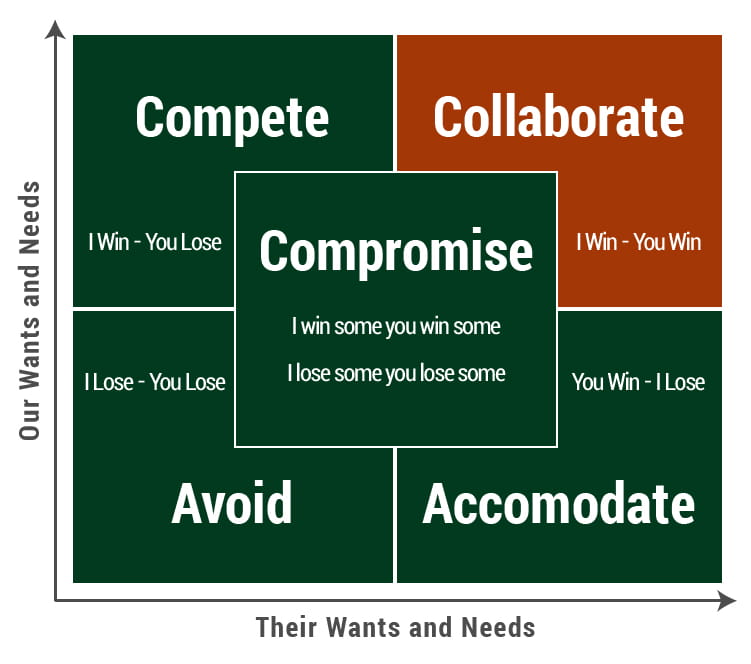
At the March meeting of the New England Chapter of Romance Writers of America, attorney Alisha Bloom gave a presentation on different negotiating strategies, and how romance writers might draw on these strategies in construction their characters and conflicts. Drawing on the Thomas-Kilmann Conflict Mode Instrument, Bloom listed these five common negotiating styles:

• Avoiding
• Accomodating
• Compromising
• Competing
• Collaborating

These styles all sounded familiar to me, and I could easily assign each to different people in my life (and to different characters in romance novels). What was new was the underlying relationship Thomas and Kilmann posit between these five styles. They do not appear on a linear continuum, but rather along a dual axis, one the degree to which the outcome of a dispute matters, the other the degree to which the relationship matters. Or, in other words, how much do your wants and needs matter, and how much do you care about the wants and needs of the person or group with whom you are negotiating? (The Thomas-Killman instrument actually posits these axes as personality issues, with one axis = degree of assertiveness, the other = degree of cooperativeness).


People and characters who choose an Avoidance style of negotiating typically cluster close to the zero point on both of these axes: they don't care that much about the outcome, nor do they care that much about the relationship between themselves and the person or group with whom they are negotiating. Those who use a  Compete strategy cluster on the high end of the "care more about their own wants and needs" axis, but low on the "care about the wants and needs of the other" axis. And those who use an Accomodate strategy cluster around the point diagonally opposite that of the competitors: high on the "care for the needs of others" and low on the "care for own needs."

One might think that a "Compromise" strategy would be the goal in a successful negotiation. But in the examples Bloom provided from romance novels (all recently published), the protagonists moved not toward compromise (splitting things evenly, so each side wins a bit and loses a bit), a cluster at the midpoint of both axes, but towards the "Collaborate" strategy: a strategy that cares highly about both the needs of the self and the needs of the other.

Bloom asked us if we thought that this was a general goal of romance: to move characters through the arc of caring either too much or not enough for self, or too much or not enough for others, towards not compromise, which is a "split everything fifty fifty" type of negotiating, but towards collaboration: a strategy which seeks new ways to meet both sides' needs. "Expanding the pie" is one way to put it, but in terms of romance writing, Bloom described the character movement as one in which the romantic protagonists move towards valuing both their own and the other's goals and desires, and seek ways to have both sides' needs met.

A lively discussion followed Bloom's presentation.  I pointed out that unlike the 21st century romance novels that Bloom had used as examples in her presentation (Julie James' Practice Makes Perfect, one example), in which Collaboration proved to be the end goal, Old Skool romances generally held up the "accomodation" style as the heart of a true HEA. Older romances, which value the "taming" the the alpha hero, a taming that causes him to not only admit his feelings of love for the heroine, but also to recognize the value of emotional work typically carried out by the female half of the population, require their heroes not to compromise or to collaborate, but instead to "accomodate": to give up their own needs or desires (because they are misguided and harmful) and to replace those needs and desires with those of their heroines.

Some agreed that in more modern romances, "Collaboration" appeared far more often than "Accomodation." And some stated that they preferred this type of HEA to one that "tames" the hero, one that makes him fall at the feet of the heroine. "I want the protagonists to work together, to value each other and their goals equally," said one member.

But others expressed a continued preference for the "Accomodation" HEA over the "Collaboration" one.  "I will give up anything and everything for you, that's what I want to hear from the hero at the end of the romance" one person noted. "That's what makes me feel." Another noted, "This is a fantasy, not real life. In real life, you compromise. But the fantasy of romance is that your hero will do what you as a woman want. He'll come home and do the dishes."


The conversation made me wonder: how many romance readers prefer "collaborative" HEA's, and how many prefer "accomodation" HEA's? Is this a generational thing? Or does it depend more on one's own real-life expectations about and experiences of gendered behavior? My partner already does do the dishes (at least on weekdays; on the weekends he cooks, and I pick up the dishcloth), so my fantasy is not about finding a guy who will do that. If your partner doesn't, and neither of you expect that he will, are you more likely to wish for an accomodation HEA?

Would love to hear your own preferences, readers, as well as your thoughts on using a negotiating strategy model to think about romance novel endings.


Photo credits:
Negotiation styles chart: Negotiation Experts
Compromise: Redbubble
Win Win: Thought Exchange

Friday, May 20, 2016

Happily Ever After: Catherine Roach's thoughts on the endings of romance novels

The third, and last, in my series of posts on Catherine M. Roach's Happily Ever After: The Romance Story in Popular Culture focuses, fittingly, on the endings of romance novels (see posts #1 and #2 here and here). "In romance, the ending is crucial," Roach notes in the introduction of her book's final chapter (165). That that ending be a happy one has become not just a given, but one of the key parts of the definition of the genre as a whole. Romance authors whom Roach interviewed "view the ending as a contract they have with their readers: No matter how wounded the characters are by plot conflicts in a book's middle, all will be well by the end" (166). What is the larger cultural meaning of the romance novel's HEA, or "happily ever after"?

Roach's answer is two-fold:

(1) People have faith in love. The romance story functions similarly to a religious belief system that offers guidance on the end goal of how to live a good and worthy life

(2) The romance story is a reparation fantasy of the end of patriarchy. In this fantasy, the romance hero stands in for patriarchy itself in a vision wherein gender unfairness is repaired and all works out. (167)

I'm completely on board with claim #1. Romance, at least for many women, has become "the Highest Good," a replacement for (or, perhaps a supplement to?) Christianity, a religion that has been in steady decline in the West and the North since the 18th century (see chart at right). Traditional romance novels certainly demonstrate a "faith in the healing power of love" (169). And even romances that eschew the romantic love heals lovers paradigm do share with their less progressive counterparts an "underlying conviction" in "the power of love to make the world a better place" (169). In almost all romance novels, to love romantically is to want to strive to be a better person, a kinder person, a person who does good, rather than harm, both within the romantic relationship and without, in the greater world. 

Claim #2, though, feels more iffy to me. To make her argument, Roach uses/revises the theoretical model constructed by literary critic Leslie Fielder in his famous essay "Come Back to the Raft Ag'in, Huck Honey!" As Roach notes, Fielder's essay is

essentially about the literature of white male America as a homosocial reparation fantasy for racism. In this fantasy, the predations of racism are repaired through an interracial buddy story, a narrative of a white male and a colored male who share friendship and brotherly love. The story is offered with remorse and affection on the part of whites and read with pleasure by them, partly because the friendship offered by the characters of color implies forgiveness and absolution for white people's acts and attitudes of racism. (177)

Roach takes Fielder's model and turns it on its head, suggesting that the central fantasy of romance novels is offered not by the oppressors, but by the oppressed; not by the racists, but by the women who have been subject to patriarchy's sexism. Instead of a friendship and brotherly love of the oppressed, romance offers the emotional and sexual love of the oppressor: the "myth of the male beloved." In Roach's interpretation, the mythical male beloved figure, "the alpha male, the patriarch—loves with tenderness, devotion, and sensitivity, even while maintaining his alpha ways" (177). But not really. Because, Roach asserts, "the core appeal of romance fiction is this fantasy of the end of patriarchy in which the alpha male hero is revealed as the submissive"—submissive to the female, and submissive to a more feminine conception of gender relations, a conception based on love and connection (178, emphasis added).

When I was drafting the previous sentence, I initially added "not on dominance and oppression" to its end. But then I began to wonder: doesn't the idea of male "submission" by necessity imply female "dominance"? Can the hero be "submissive" by agreeing to a relationship that refuses a "dominant/submissive" binary? And if there is no refusal of a dominant/submissive binary, is there any real challenge to patriarchy?

This idea of alpha male submission echoes the arguments of many of the romance writers who contributed essays to Jayne Ann Krentz's 1992 essay collection, Dangerous Men and Adventurous Women. These writers argued that romance's appeal lies in the way it inverts traditional gendered power relations:

Why is this ending so satisfying? Not only because love has triumphed, but because he has capitulated and she has won. He's willing, finally and at the very last minute and after much resistance, to do anything to keep her with him. This is the ultimate fantasy, the quintessential escapist fare. (Doreen Owens Malik, "Mad, Bad, and Dangerous to Know: The Hero as Challenge," 76)

He is the mightiest of the mighty, the strongest of the strong. But, because he has been tamed by our heroine, because she exerts such a powerful emotional stranglehold over him, his almost superhuman physical strength is now hers to command (Susan Elizabeth Phillips, "The Romance and the Empowerment of Women," 58).

The hero must be part villain or else he won't be much of a challenge for a strong woman. The heroine must put herself at risk with him if the story is to achieve the level of excitement and the particular sense of danger that only a classic romance can provide.
     And the flat truth is that you don't get much of a challenge for a heroine from a sensitive, understanding, right-thinking "modern" man who is part therapist, part best friend, and thoroughly tamed from the start. (Jayne Ann Krentz, "Trying to Tame the Romance," 108-109).


In the minds of many of the contributors to Dangerous Men and Adventurous Women, for a heroine to "win," a hero must lose: he must "capitulate," he must be "tamed." And in the books of many romance writers, such a vision of female winners and male losers still remains.

But many 21st century romance novels do not rely on this dominance/submission model. Instead, they push for "equality" between the hero and heroine, a relationship in which power is shared (and in the sexual realm, often played with), rather than wrested from the male by the female. I'm not certain how Roach's idea that romance is "a reparation fantasy of the end of patriarchy" applies to them.

Even if we limit her argument to just those novels in which gender relations are constructed as a win/lose, rather than a struggle toward equality and parity, I wonder just how reparation "ends" patriarchy? Roach takes the concept of "reparative reading" from Eve Kosofsky Sedgwick, a type of reading in opposition to "paranoid reading," critical interpretation focused on uncovering "the violence hidden in texts and culture," concerned about "oppression and false consciousness," and working to "leverage the power of exposing injustice to bring about positive change" (178). In contrast, reparative reading is less about suspicion, and more about love: "The desire of the reparative impulse is to repair an object of relationship—say, the readers' relationship to the hero or heroine—that will then have resources to offer the self" (178).

What resources does romance offer the (female) self? Roach argues that "Women readers 'extract sustenance' from romance novels in the imaginative play of repairing the alpha male and of restoring gender relations" (179).  This "repairing" of the alpha male "is one in which the domineering or uncaring patriarch becomes the good man" (182). A romance must still feature an alpha man, Roach suggests, because "if it is still a man's world out there, then for a woman to have a good man at her side is a good thing. A woman is safer from danger and has more resources to draw on, to the extent that she is in a committed relationship with, and thus protected and aided by, the good man" (182). This seems to contradict Roach's assertion that within the romance, patriarchy has "ended." The "good man" hero may no longer be sexist by book's end, but he is still enmeshed within, and benefits from, patriarchy, because patriarchy is a system, not an individual relationship. Both within and outside the book, patriarchy remains, no matter how "good" one's man becomes.

In discussing J. R. Ward's 2005 Dark Lover, Roach seems to comes to a similar conclusion: "The reader fantasy here is that patriarchy ends, yet patriarchy continues. In this end, you have the alpha-king for your own, since you have conquered him on the battlefield of love and taught him how to love" (187). There seems to be a vital "and" missing here: "and, because patriarchy continues, he still can behave with impunity like an alpha-hole to everyone else, and still reap the benefits of male power and privilege."

So yes, the traditional romance novel, invested in a binary conception of romantic power relations, does invoke a fantasy of female empowerment. But while gender unfairness may be repaired on the level of the individual couple, through the alpha male's "submission" to his beloved female, patriarchy as a whole has hardly been "ended." Because patriarchy isn't just about relations between an individual man and woman; it is "the predominance of men in positions of power and influence in society, with culture values and norms favouring men" (OED online). The fantasy, then, for a woman reader of traditional alpha male romance seems less about imagining the end of the system of patriarchy, and more about dreaming of becoming its unlikely beneficiary.

Or perhaps I am just too much of a "paranoid reader" to appreciate Roach's argument?

I hope you all have a chance to take a look at Roach's intelligent, provocative book, and talking about (and debating) its fascinating theories.


Photo credits:


Catherine M. Roach
Happily Ever After
The Romance Story in Popular Culture
Indiana University Press, 2016

Tuesday, October 20, 2015

Pot of Gold at the Beginning of the Rainbow? Rebecca Rogers Maher's ROLLING IN THE DEEP

A romance novel, much like a fairy tale, typically ends with a reward: a new job, perhaps; a stronger relationship with friends and family, quite often; and, of course, a committed romantic partner. The reward, otherwise known as HEA, or happily ever after, is such an integral part of the genre that it is one of the two elements in RWA's definition of romance.

What happens, though, when the reward comes at the start, rather than the end, of the romance? What comes after the reward? After what many would consider a "Happily Ever After"?

In the case of Rebecca Rogers Maher's latest contemporary, Rolling in the Deep, the reward in question is one millions and millions of Americans attempt to win every week: the lottery. More specifically, in the case of Holly Ward and Ray Lopez, co-workers at a Cogmans store (think Wal-Mart or whatever big box chain department store owns the working class market in your area), the four hundred and twenty-five million dollar jackpot in the New York state's latest Powerball lottery. Holly doesn't ever invest her hard-earned Cogmans pay buying the most infinitesimal chance at a wildly improbably dream: "Yeah. Let's definitely play the lottery. Because that's not rigged at all. We'll totally win" (Kindle Loc 120). But new coworker Ray, whom she'd find sexy and appealing if only she weren't as tired "as a hamster in a wheel" from working a demoralizing, dead-end job in order to care for her son, attempts to cheer her up when he catches her in a down moment by proposing they go in together on ticket, and Holly ends up handing over a dollar. A dollar really isn't too much to spend "for the sake of a little dreaming," is it?

Dream turns into reality, though, when number after number read out by the eager young woman in a red pantsuit on the television screen matches the the numbers on the ticket Ray purchased. Suddenly, less than a quarter of the way through their story, Ray and Holly find themselves in the middle of something that's supposed to be a fairy tale.

But for Ray and Holly, winning the jackpot often feels more like a nightmare. Because neither Holly nor Ray can set aside the existential question that comes not only to those who experience tragedy, but also to those who are the beneficiaries of a completely unmerited windfall: "Why me?"

Up until now, Holly's life has been a battle. She'd been a good student, but growing up white and poor in Poughkeepsie, Holly's schooling hadn't been strong enough to get her in anywhere but the local community college. She'd attended there for two years, waitressing to pay her way through, and planned to transfer to a more competitive, higher-ranking college, one whose diploma would allow her access to a decent-paying job. But then her mother, who worked cleaning bathrooms at Vassar, died from a heart attack, and a handsome but manipulative man conned his way into her life. Only after several years of suffering his criticisms and verbal abuse did Holly find the courage to divorce him, gaining partial custody of her son, a pittance of a child support payment, and a job at Cogmans. "What kind of loser works at Cogmans? What kind of mother would let her child see her like that?" her still abusive ex taunts whenever she drops her son off at his fancy new house (he's remarried, a wealthy woman this time around). Often, Holly can't help but wonder herself.

Mexican-Italian Ray had a far stronger family life, growing up surrounded by the Queens community that frequented the diner where his mother waitressed. Ray dreamed of working in a diner of his own, but his mother, who could have returned to Mexico after her husband died, remained in New York, determined that her two boys would have a better life than she had. Before her recent death, she made Ray promise to pursue something better for himself: to attend the Culinary Institute and earn a job in "quality" restaurant. But cooking in a diner hasn't given him the experience he needs to even apply to the elite school. Moving closer to the Institute, he's working one job at a restaurant, gaining the requisite experience at a "real" restaurant, and working a second job at Cogmans to make ends meet. But "up here in the country," Ray feels isolated, unmoored. Holly is the only one who offered a friendly "hello," who asked him if he needed help, who captures his attention with her sadness, and her dignity, and her calm. No wonder he's been nursing a giant crush on her for weeks. And that he's thrilled that she agreed to go in with him on the lottery ticket.

But now that they've actually hit the jackpot, neither Holly nor Ray is really feeling like the hero of the fairy tale everyone tells them they're in. The attention, the decisions, the invasion of privacy, and above all, winner's (rather than survivor's) guilt, all weigh them down. As Holly tells her friend Beth:

"I keep waiting for it to start to feel good. To be, you know, exciting, like you said. I keep thinking tomorrow I'll wake up and it'll sink in, and I'll celebrate . . . . It's just that you know . . . think of all the millions of people who paid for a Powerball ticket . . . And they lost, and I won. Why? It's  not . . . it's not fair. I feel like I don't deserve it, no more than anyone else did. So why me?" (852-62)

And as Ray thinks as he's walking into a party for himself and Holly given by his ex-Cogmans co-workers:

     I can leave.
     But the woman with the cart next to me can't. She can't afford to shop anywhere else. All my coworkers, waiting for me in the break room with a cake to celebrate my lottery win—they can't leave. They need this job, just like I did a few days ago.
     I don't know what I'm supposed to do with that. (968)

In their desperation to flee, if only for a a few stolen moments, from the overwhelming changes about to crash atop them like a tsunami, Ray and Holly make their escape—via sex. With one another. And soon the newspaper headlines aren't only about striking it rich: "Local Powerball Winners Hit It Big in More Ways Than One" (1911). Will Ray and Holly's romance wither under the pressure, before it even has a chance to bloom?

Maher's story isn't interested in allowing readers to vicariously live out their dreams of untold riches by watching empty placeholder characters spend and spree on their behalves. But nor is it a cautionary tale, warning readers not to wish for the sun for they'll only get burned. Instead, it is a thoughtful attempt to understand what it means to be happy, and to what extent wealth can contribute to the pursuit of same. For make no mistake, having money means having power, and being poor often equates to being powerless, as Maher's class-conscious romance makes all-too-painfully clear.

But it also suggests that other things—love for family; respect for self; a desire for community; the need to give back—can remain constants, even in the face of tragedy.

And even in the face of the proverbial pot of gold.


ARC provided by NetGalley in exchange for an honest review.


Rolling in the Deep
Loveswept, 2015