Showing posts with label fantasy. Show all posts

Friday, September 21, 2018

Feminism and the Beast: Juliet Marillier's HEART'S BLOOD

Feminism has long had a hate relationship with the fairy tale "Beauty and the Beast." From the animal bridegroom folktale, which Frenchwoman Suzanne de Villeneuve drew on for the first written version of "La Belle et La BĂȘte" in 1740, to the most recent film version of B&B by Disney, feminist literary and cultural critics have often written about the not-so-hidden messages, messages encourage girls and women to stay with and even love "beastly" (i.e. abusive) men, that seem inherent in this trope.

Which is why it is such a pleasure to read contemporary novels or stories penned by authors who draw on the trope, but do so with a clear aim of subverting its sexism. My favorite short story of this type has long been Angela Carter's "The Tiger's Bride," from her 1979 collection The Bloody Chamber and Other Adult Tales, in which it is the beauty who embraces the beastly rather than the beast who is transformed into a beauty. And I've enjoyed novel-length B&B and animal bridegroom novel retellings, too, both for young adults (Robin McKinley's Beauty [1978]; S. Jae Jones' Wintersong [2017]) and for adult romance readers (Mary Balogh's Lord Carew's Bride [1995]; Elizabeth Hoyt's To Beguile a Beast [2009]), novels that draw into question some of the central assumptions of the more sexist versions of the B&B trope.

My new favorite, though, might just be Juliet Marillier's 2009 retelling, Heart's Blood.

Set in a 12th century Ireland rife with magic, Marillier's novel opens with heroine Caitrin fleeing toward the beast's home not to save a father, but instead out of grief for one. Berach, a scribe, taught his daughter Caitrin his trade, and the two spent many an hour working together, bent over quill and scroll. But after Berach's sudden death, Caitrin falls into a deep depression, during which distant cousins come and claim her home. Showing a kind face to the town, but an abusive one to Caitrin, Cillian and his mother Ita insult and physically abuse Caitrin until she has internalized all their aspersions:

You're nothing, her dream voice reminded her. You're nobody. Your father shouldn't have filled your head with wild ideas and impossible aspirations.... Bel glad you have responsible kinsfolk to take care of you, Caitrin. It's not as if you've demonstrated an ability to look after yourself since your father died. (12).

When Cillian insists that he and Caitrin wed, however, Caitrin knows she can remain no longer in her once safe home. And so she flees, with only a change of clothes and a small box containing the tools of her trade. And the hopes that she can somehow find her way back to the "old Caitrin, the confident, serene one," rather than the person she has become since her father's death, the person who could not find the power or the will to speak up in the face of Cillian and Ita's abuse (62).

The folk of a far-western settlement Caitrin lands in warn her against accepting the post as scribe at the castle of their local chieftain—"I can't think of one good thing to say about the man, crooked, miserable parasite that he is" (10). But Caitrin, fearful of a pursuing Cillian, won't let herself belief that their stories of a 100-year curse, a horrible lord, a dog large enough to eat a fully grown ram in a single bite, and tiny beings that whispered in traveler's ears and led the off the path are anything more than fearful exaggeration. Caitrin is not coerced into going to the beast's lair to save her father, as in most Beauty and the Beast retellings; she accepts a job willingly, a job which she hopes will help her find herself.

When Caitrin arrives at Whistling Tor, it is to discover that each and every story is true—at least, in its own way. Anluan, the young chieftain, limps, has the use of only one arm, and has a strangely unsymmetrical face. Caitrin's first sight of Anluan clearly places him in the "Beast" role: "There was an odd beauty in his isolation and his sadness, like that of a forlorn prince ensorcelled by a wicked enchantress, or a traveler lost forever in a world far from home." But Caitrin immediately chastises herself for placing him in such a traditional role: "I must stop being so fanciful. Less than a day here, and already I was inventing wild stories about the folk of the house. This was no enchanted prince, just an ill-tempered chieftain with no manners" (45).

Anluan has tragic reasons for his temper, his physical disabilities, and for his lack of social graces, reasons which are gradually revealed to Caitrin over the course of her weeks at the Tor. And though Anluan often falls prey to abrupt bouts of verbal anger, he never acts violently or harms the handful of faithful retainers who remain. What he does lack is hope—the hope that things might change, the hope that the dark cloud under which he has been living might ever abate. And hope is the one thing of which Caitrin will not let go. It is not physical beastliness, then, but despair, which it will be Caitrin's task to banish—not just from Anluan, but from herself.

Caitrin's job at Whistling Tor is to transcribe the documents of Anluan's ancestor Nechtan, searching for a spell which Nechtan apparently could never find. Not a spell to summon dark power, but rather to disperse it: to send the whispering denizens of the forest, the dark legacy Nechtan's willingness to dabble in black sorcery in order to gain power over his rivals, back from whence they were unnaturally summoned. Many of Nechtan's notes are in Latin, a language which Anluan's father did not have the chance to teach him before he took his life when Anluan was only nine, the most recent of a string of early deaths among the chieftain's ancestors.

The task must be completed by the end of summer, Anluan insists, without ever telling Caitrin why. But when rumors of invading Normans begin to swirl, and acts of hurtful vandalism begin to plague the Tor, the search grows ever more urgent. Caitrin is free to leave at any time; she is no prisoner. And she certainly doesn't long to return home, at least, not to a family that no longer exists. But after receiving a threatening emissary from a Norman lord, Anluan insists on sending Caitrin away. Because he doesn't love her? Or because he loves her too much?

(Spoiler: "At last I begin to understand why my father acted as I did. To lose you is to spill my heat's blood. I do not know if I can bear the pain" [315].)

Again, unlike the traditional B&B story, Caitrin's time "home" is not about proving how bad home really is when compared to the luxury of "away." Rather, it is about conquering her particular monster, banishing those who made her feel less than her true self, and remaking her once destroyed family. A task she undertakes not on her own, but with the help of allies she meets during her journey home.

Community and hope, rather than isolation, doubt, and despair, are what Caitrin needs in order to reclaim her birthright—and then, to claim her place by Anluan's side while he faces his own worst fears.


What are your favorite Beauty and the Beast retellings?


Photo credits:
Castle: Geni
Bleeding heart: Moonbeam 13, Deviant Art


Heart's Blood
Tor, 2009

Tuesday, July 3, 2018

Romancing Female Ambition: Claire Legrand's FURYBORN

The danger of ambition is a theme at the heart of many a high fantasy novel. Even if one's ambition stems from the desire to do good, fantasy novels generally warn that political ambition often engenders a far more dangerous desire, a desire for power itself. And as French politician and philosopher deLemartine argued, "absolute power corrupts the best natures"; or, as English Lord Acton wrote, "Power tends to corrupt, and absolute power corrupts absolutely. Great me are almost always bad men."

And if the striver in question happens to be of the female persuasion? Well, then the warnings grow even more pointed. As Robin Romm notes in the Introduction to her essay collection Double Bind: Women on Ambition, "striving and achieving [have] to be approached delicately or you risk the negative judgment of others." Twenty-first century American women are socialized to be soft, feminine, but are simultaneously urged to "go for it," a paradox Romm describes as "the double bind of the gender, success paired eternally with scrutiny and retreat."

That is what intrigued me about the first volume in Claire Legrande's YA fantasy novel, Furyborn: its portrayal of not one, but two deeply ambitious women. After an opening scene in which a queen gives birth and then gives up her baby to prevent her from falling into the hands of a malevolent angel, Furyborn forks into two separate strands, one set in the near past, the other a thousand years into the future. The first tells how the queen of the first scene, Rielle, came to be "allied with angels and helped them kill thousands of humans. This queen who had murdered her husband" (Kindle Loc 91). The second tells of a the rise of an assassin who is asked to become a rebel against the oppressive Empire, a woman whose questionable morals make her seem just as unfit for the role of savior as was/is Rielle.

Eighteen-year-old Rielle, only daughter of  Lord Commander Dardenne, chief of the king's guards, chafes against the restricted life her father condemns her to after the uncontrolled power of her magic lead to the death of her mother. As she protests to her teacher, Tal, the Grand Magister of the Pyre, the head of those who bend fire to their magical will, "If Father had his way, I'd stay locked up for the rest of my life with my nose buried in a book or on my knees in prayer, whipping myself every time I had a stray angry thought" (Kindle Loc 380). Rielle wants more than a life stuck in a cloister: she wants to participate in the Boon Chase; she wants her childhood friend Audric, now Prince Audric the Lightbringer, the mot powerful sunspinner in centuries, to love her and not their friend Ludivine; most of all, she wants to show everyone just how powerful her magic is. For unlike every other elemental who had ever lived, Rielle needs no physical object to access her power, and her magic is not limited to one element. No, Rielle can control them all.

During an assassination attempt on Prince Audric, Rielle uses her powers to save her friend, despite her father's warnings never to reveal them. And Audric becomes convinced that his old friend is one of the Light Queen of prophecy, a human woman who will rescue them all from the angels who once oppressed humankind and who threaten again:

The Gate will fall. The angels will return and bring ruin to the world. You will know this time by the rise of two human Queens—one of blood, and one of light. One with power to save the world. One with the power to destroy it. Two Queens will rise. They will carry the power of the Seven. They will carry your fate in their hands. Two Queens will rise. (1649)

Rielle is not your usual fantasy heroine, not an empty placeholder for the reader nor a troubled, misunderstood, but deeply good at heart girl. No, as Prince Audric's mother recognizes, Rielle is "Cunning. Willful, and lovely. It's a volatile combination. It unnerves me" (3400). Rielle, with her naked ambition, is meant to unnerve the reader, too. Indeed, she unnerves herself: "Even while my mother burned, I was glad to feel the power simmering at my fingers... Even though you belong to Ludivine... I want you for my own. I want... I want. I crave. I hunger" (4285). Is she the Sun Queen, the one who will save humankind? Or is she the Blood Queen, who will destroy all?

If Rielle seems a questionable savior, what are we to make of the other heroine of Furyborn? We first meet assassin Eliana Ferracora as she helps round up a group of rebels, fighting against the Empire that rose in the ashes of Rielle's betrayal of humankind. Eighteen-year-old Eliana is tempted to let the rebel children of  group go, but resists: "children couldn't keep their mouths shut. And if anyone ever found out that the Dread of Orline, Lord Arkelion's pet huntress, had let traitors run free..." (648). Instead, Eliana watches as the eldest boy is beheaded.

Eliana's partner and lover Harkan wishes she were different: "Harkan paused, that sad, tired look on his face that made her hackles rise because she  knew he hoped it would change her, one of these days. Make her better. Make her good again. She lifted an eyebrow. Sorry, Harkan. Good girls don't live long" (643). Calculating, skilled, and deadly, Eliana focuses on the here and now, on keeping her mother and brother safe, and herself alive. Her ambition may be narrower than Rielle's, but it still burns bright. Though people in Eliana's time call Rielle the evil Blood Queen, it's difficult to believe that Eliana is more suited to the role of Sun Queen than is/was Rielle.

Eliana knows that any day now, she'll be recruited as a member of Invictus, a company of assassins that travels the world and carries out the Emperor's bidding. For she's not just skilled; she also seemed to have an ability no one else in her world has:

The problem was, she liked showing off. If she was going to be a freak with a miraculous body that no fall could kill, then she might as well ave fun with it. If she was busy having fun, then she didn't have time to wonder why her body could do what it did. And what it meant. (552)

But after her mother mysteriously disappears, The Wolf, a famed captain of the Red Crown rebels, bargains for Eliana's help in infiltrating the palace in exchange for his help in finding her missing parent. Coldly weighing both the costs and the benefits, Eliana agrees, looking out all the while for how to shimmy free of any acts, or any personal connections, not promoting her own safety or that of her mother and brother. She even accepts poor Harkan's self-sacrifice, leaving him behind in order to save herself and her brother.

One of the other rebel leaders tries to convince Eliana that "Revolutions mean nothing if their soldiers forget to care for the people they're fighting to save," but Eliana has more than her share of doubts (2609). Somehow familiar with the trajectory of the typical fantasy romance, she knows that she's supposed to be transformed by her time with the rebels, especially by her admiration for The Wolf, known to her now as Simon, a man who has endured much during his battles against the oppressive Empire. "People like us don't fight for our own hope... We fight for everyone else's," Simon nobly avers, but wily Eliana uses his own hope in her redemption to deceive him (2964).

At the end of this first installment, both Rielle's and Eliana's worlds are on the verge of war: Rielle's against the resurgent angels, Eliana's against the invading Undying Empire. Can either war be prevented? Will either young woman be Sun Queen? Or will both fall into the temptations of blood?

Or might the stark binaries of the prophecy be pushed aside, the opposition between sun and blood,  self-focused ambition and other-directed empathy, shown to be equally necessary in order to defeat true evil?

I'm gnawing on my fingernails, waiting to see what the next two volumes in the trilogy have to say about women and ambition and power.


Art credits:
Elemental magic symbols: Zenkora Wiki
Ambition: Girltalkhq


Furyborn: The Empirium Triology, Book 1
Sourcebooks, 2018

Friday, August 11, 2017

Kick-Ass Heroism and Female Self-Determination: Ilona Andrews' HIDDEN LEGACY series

I'm a longtime fan of Ilona Andrews' Kate Daniels Atlanta-set urban fantasy books, but I'd been annoyed by book #6 in the series, 2013's Magic Rises. Rises relies on an old, often sexist romance novel trope—the big lie to one's partner, for that partner's own good, of course—a trope that almost always strikes me as contrived and anti-feminist. Had Kate and Curran's relationship run its course, I wondered?

So I was chuffed when Andrews (the husband and wife team of Ilona and Andrew Gordon) began a new urban fantasy series in 2014. Since Hidden Legacy would be set in a different fantasy world than Kate Daniels' part-magic, part-mechanical Atlanta, and would depict the beginning of a new romantic relationship, it would give the authors a chance to start afresh, rather than trying to spin new/old drama from Kate and Curran's already established relationship.

After I read Burn for Me, I found a lot to like about the world Andrews had created in Hidden Legacy. As the book's opening explains, "In 1863, in a world much like our own, European scientists discovered the Osiris serum, a concoction which brought out one's magic talents" (Kindle Loc 45). Those who took the serum manifested magic in quite different ways, but gaining any godlike power was worth it to the governments and the rich who vied to buy the serum. But, as is the way with many newly discovered medicines, the Osiris serum had some pretty nasty side-effects, and the serum was soon banned. But the magic awakened by the serum did not just effect the one who had taken it; it also affected their children, and their children's children. And soon magical families began to form into Houses, creating a society that runs parallel to unmagical human society, with its own laws, institutions, and power struggles.

Burn's narrator, twenty-five-year-old Texas native Nevada Baylor, isn't a part of an established magic House. But its clear that there's some Osiris-taking ancestors in her family tree. Nevada has some powers—she can tell when someone is telling the truth, and when someone is lying—but she's never studied magic, never been taught much about it, and doesn't know the full extent of her own magical skills. She's kept them hidden, not wanting to be forced into becoming a human lie detector for the government or for some powerful House or corporation. This makes Nevada an interesting contrast to Kate Daniels, who has been raised knowing her lineage and the awesome power that she has inherited because of it, and has been training her entire life to fulfill her destiny. Nevada is genetically poised to become a kick-ass magic heroine, but at the start of her series, she's not yet a superpower, not a dominant player in the larger magical world.

Also unlike Kate Daniels, who is a loner at start of her series, Burn's Nevada Baylor is deeply ensconced in family. She lives in a converted warehouse with her two sisters, her two male cousins, her mother, and her grandmother; the elder members of the family all work in some capacity for the detective agency founded by Nevada's father. But now that Mr. Baylor has died, it is Nevada, the oldest of the younger generation, who takes charge of the day-to-day running of the Baylor Investigative Agency. The agency isn't in the greatest financial position, though, and Nevada feels responsible for keeping her multigenerational family afloat. Again, in interesting contrast to Kate, Nevada isn't estranged from her family, but is driven largely by her need to protect and sustain it. Can one be a kick-ass feminist heroine and still be deeply committed to family? I was curious to see how Andrews addressed this often contentious issue.

By book's end, however, I wasn't convinced that I could write about Burn for Me on RNFF. Because the magic-user to whom Nevada is reluctantly attracted appears to be a more than questionable as a feminist romantic lead. The reputation of Connor Rogan, the head of House Rogan, decidedly precedes him. A few of his nicknames: "Mad Rogan," The Butcher of Merida," "Huracan." During a conflict in Mexico (fighting began after magically potent mineral deposits were discovered in Belize and Mexico invaded), Rogan, a Prime (the top level of magic-wielder) used his telekinetic powers on behalf of the U.S. government to destroy entire cities.

A recluse since leaving the army four years ago, Rogan and Nevada's paths cross when Nevada's agency is hired to track down a man linked to Rogan's cousin. And Nevada's interactions with the guy don't suggest that his values and hers will mesh very well. Meet cute as a kidnapping? Ah, not so much:

     "So instead of talking to me, asking for my credentials, or doing any of those things a normal person would do, you decided to assault me and chain me in your basement?"
     He shrugged, a slow, deliberate movement. "It seemed like the most expedient way to obtain the information. And let's be honest, you weren't exactly harmed. I even took you home.
     "You dumped me on my doorstep. According to my mother, I looked half dead."
     "Your mother exaggerates. A third dead at most."
     I stared at him. Wow. Just wow. (1954)

Even though Nevada finds Rogan crazy sexy, and wonders if there is anything left of the innocent boy he once was (caught on a video before his first foray into government-sanctioned city destruction), she's not convinced that the adult Rogan takes anybody's interests to heart except his own. She's definitely not in favor of working for him when he offers to hire her company:

     "You are incredibly powerful, and you have a blatant disregard for laws and moral constraints. I'm guessing that you don't think anything you ever do is wrong.That makes you very dangerous and a huge liability in mu line of work. You will break laws and kill to get what you want, and if I manage to survive, I'll be left with the fallout. So the answer is no." (2037)

She's also pretty unhappy about his lack of compunction against killing those who threaten him:

     "You killed Peaches."
     "Of course I killed him."
     I opened my mouth and closed it.
     "Okay," Mad Rogan said. "This is distracting you, and I need you to function, so let's fix this. Which part of what happened is upsetting?"
     I opened my mouth again and closed it again without saying anything. Peaches would've attacked us, possibly killed us, so what Mad Rogan did was justified. It was the sheer sudden brutality of it. It was thew way he did it, without any hesitation. One moment Peaches was there, and then he vanished. No trace of him remained. He was crushed out of existence. He was . . . dead.
     "Let me help," he said. "You've been taught all your life that killing another person is wrong, and that belief persists even in the face of facts. Not only would Peaches have killed us given the chance, but this way I only have to kill one person rather than kill half a dozen of his followers. I saved several lives, but your conditioning tells you that I've done the wrong thing. I didn't. He started it. I finished it."
     "It's not that. I was getting ready to shoot him in the head." But when you shot someone, there was a slight chance they might live. There would be a body. what he did was so complete and sudden that I needed a couple of moments to come to terms with it.
     "Then what is it?"
     "It's the. . ." I struggled for words. "Splat."
     Mad Rogan glanced at me, his eyes puzzled. "Splat."
     "Yes."
     "I had briefly considered impaling him with one of those steel poles from the roof, but I decided it would be too graphic for you. Would that have been preferable?"
     My mind conjured up Peaches with a steel pole sticking out his stomach. "No."
     "I really would like to know," he said with genuine curiosity. "The next time I kill someone, I'd like to do it in a way that doesn't freak you out."
     "How about you don't kill a anybody for a little bit?"
     "I can't make that promise."
     Small talk with the dragon. How are you? Eaten any adventurers lately? Sure, I just had one this morning. Look, I still got his femur stuck in my teeth. Is that upsetting to you? (2544)

By the end of Burn for Me, Nevada, doesn't have to kill, but has to rescue Rogan from his own power, a princess kissing a mad sleeping beauty back from the edge of magical overkill. But when Rogan comes calling post-apocalypse aversion, Nevada simply can't reconcile herself to the ease with which Rogan can destroy others, his apparent lack of empathy for other human beings. And the way that he can put her own family members in the line of fire, if that will help him accomplish his goals. Even if it turns out said family members agreed to be used: "I can't be with you, no matter how crazy you make me, because you have no empathy, Rogan. I'm not talking about magic. I'm talking about the human ability to sympathize." (5481). Nevada fears Rogan might be a psychopath, or a sociopath, and given his actions in the book, readers can't help but worry she might be right. So when Nevada sends Rogan on his way at book's end, how can readers do anything but cheer?

Did Andrews get push-back against this depiction of the "heroic" Rogan? Or did they have his rehabilitation in mind from the start? Because book #2, White Hot, spends much of its time proving Nevada wrong, or at least complicating her (and our) interpretation of Rogan's psychology. Turns out he does have feelings, does experience empathy, as the murder of several of his employees at the start of White Hot demonstrates: "There was an awful finality in his voice. I hadn't thought he cared. I'd thought he viewed his people as tolls and took care of them because tools had to be kept in good repair, but this sounded like genuine grief" (White Kindle Loc 765). He evokes loyalty from his people, but is in turn loyal to them, rather than just using them. He does have family he cares for (offstage, but still); he does play by some rules, just rules that are different from the ones Nevada has been used to. And his wartime experiences (which Nevada hears about from one of Rogan's doctors, and which she experiences through some sharing of his dreams) transformed him from a young, cocky, idealistic man, one who was kept carefully protected in "bubble of patriotism" from seeing the destruction his powers had caused, into a man who sees the world in black and white, enemies and allies, and who will do almost anything to not feel helpless.

And, perhaps most importantly for romance readers, he's willing to break one very important rule: wanting Nevada, even though the rules of House society say he should only court and marry a woman whose genetic background will ensure his children will have Prime magic power like his own. Not a sociopath, or a psychopath, but a man messed up by his wartime experiences, a man whose empathy is there to be found, deep under the surface.

But I still couldn't find my way to writing about White Hot, either. Because Rogan has the ĂŒber-protective instinct characteristic of "alpha" romance heroes, a protective instinct that doesn't sit well with Nevada, nor with a reader who values a female protagonist's ability to determine her own life choices. Rogan buys her mortgage without telling her, to keep her safe from a foe who has been searching for her family for years. He tries to keep her from engaging in job-related encounters that may endanger her life. He even puts his jacket on her when she shivers. "What will it cost me? You keep chipping away at my independence every time you try to 'take care' of me, so I'd rather know the price in advance," Nevada challenges Rogan as she brushes his jacket away (3471). It's not that Nevada doesn't appreciate his way of caring. It's that this way of caring endangers her own sense of self: "You do things for me, even when I specifically ask you not to, because you feel you know better. I'm desperately fighting for my independence and boundaries, because otherwise there will be no me left. There will be just you and I'll become an accessory" (3476). By book's end, Nevada takes a risk and starts a romantic relationship with Rogan, risking both that he will be able to move beyond black and white, and that he will allow her the autonomy she needs: "the only way I'll ever respect his wishes is if he respects mine," she tells Rogan's friend and doctor (5293).

It was only by the end of book three, Wildfire, that I felt able to embrace the series wholeheartedly. Because the relationship arc of book three shows Rogan's gradual acceptance of Nevada's need for self-determination. Aptly, two potential romantic rivals show up on the scene, largely to underscore the this message: Rogan's former fiancée, Rynda, who always turns to others more powerful to keep her safe; and a fellow truthseeker Prime, Garen Shaffer, who wants to marry Nevada so that their kids will inherit their truthseeker genes and power. Rogan and Nevada get into some arguments when Rogan's protective impulses lead him to help Rynda even when she doesn't really need it, a pretty obvious counterpoint to Nevada's self-sufficiency. In contrast, Garen tries to woo Nevada by recognizing how hard she's worked to keep her family safe, and warning her that her life with Rogan will threaten that safety:

He'll put you in danger assuming you can handle it, and he'll fail to notice the moment you can't. I would do everything in my power to keep you from being put into a dangerous situation in the first place, because that's what a husband is supposed to do. (Wildfire Kindle Loc 4250).

Given the conflicts in book #2, it's pretty safe to assume that Garen's courtship isn't likely to prosper. And that Rogan's encouraging Nevada to embrace her power, and take her rightful place in the Magical world by officially filing her family for House status and outing herself as a Prime, is.

Andrews' web site says that Wildfire is "the thrilling conclusion" to the Hidden Legacy series. But the book's epilogue suggests that the real baddies are still lurking, biding their time until they can take Nevada and Connor, and the rest of civilized magical society, down. I for one am looking forward to seeing how Nevada and her family navigate House life and mores, and have my fingers crossed that other romantic pairings (for Nevada's siblings and cousins) might be in the offing in future books. Pairings that will also grapple with the negative implications of the all-too-common overprotective male hero in contemporary urban fantasy romances.


Tuesday, March 22, 2016

Running the Rings: Kate Elliott's COURT OF FIVES

Theorists of high fantasy often point to the conservatism of many of the genre's most popular and well-known works. In an interview in the International Socialism Journal, author China Mieville describes the nature of this conservatism:

If you look at stereotypical "epic" or "high" fantasy, you're talking about a genre set in magical worlds with some pretty vile ideas. They tend to be based on feudalism lite: the idea, for example, that if there's a problem with the ruler of the kingdom it's because he's a bad king, as opposed to a king. If the peasants are visible, they're likely to be good simple folk rather than downtrodden wretches (except if it's a bad kingdom...). Strong men protect curvaceous women. Superheroic protagonists stamp their will on history like characters in Nietzschean wet dreams, but at the same time things are determined by fate rather than social agency. Social threats are pathological, invading from outside rather than being born from within. Morality is absolute, with characters—and often whole races—lining up to fall into pigeonholes with "good" and "evil" written on them.

It's not fantasy itself that is inherently conservative, though, Mieville cautions. Build on a different model than Tolkein, or base your moral insights on a different intellectual framework—say, the insights of postcolonial theory—and you're just as likely to create works that critique, rather than embrace, "feudalism lite."

Such as the work of World Fantasy Award finalist Kate Elliott.

Though her past books were written for adults, her new Court of Fives series is for the YA market. It's first book, Court of Fives, is set not in a feudal society, but in a colonized one. Our first-person protagonist, Jessamy, and her three sisters are oddities in the society of Efea: though their lighter-skinned father, Captain Esladas, emigrated north from Saro, and is thus a member of the Patron, or ruling class that conquered Efea 100 years earlier, their darker-skinned mother, Kiya, is a "Commoner," or native Efean. Though they are biracial, Jes and her sisters have been raised following Saroese customs, and are allowed little freedom of thought or of movement through the royal city where they live. But since their strict father is a military officer, he's often away from home, and Jes has taken advantage of his absence to sneak out to train for the Fives, "an intricate, multilevel athletic competition that offers a chance for glory to the kingdom's best contenders" (flap copy). Think a giant obstacle course, but with five separate sections, each with mythological resonance.

It's bad luck that Jes's wandering father arrives home just on the eve of her first competition at the City Fives Court, invited to watch the competition in celebration of his recent military victories. It's even worse luck that her father's patron, Lord Ottonor, dies soon after the games. For now her father is faced with two equally untenable choices: fall into penury due to his debts to Ottonor, or accept the patronage of Lord Gargaron, who demands Esladas throw over his socially unacceptable "concubine" and her offspring and marry a Patron woman instead. And give over Jes to him to be trained in his palace five court "stable."

Jes, who has always had her eyes determinedly fixed on her five court training, cannot regret her father's decision for her own sake. Especially when it reunites her with Kalliarkos, the young man against whom she raced in her first competition, a Patron princeling whose kindness (if not his competitive prowess) sparks her admiration. But she can certainly blame her father for her sisters' and mother's sake. Especially when she discovers what her father's new patron really meant when he promised that his stewards would "take make provision for the women so you can travel to the frontier with peace of heart and a calm spirit ready to do battle" (136).

Efea's colonial society is a fiercely patriarchal one, as well as a racist and classist one. Though Jes understood this as far as it related to her own personal situation, she'd never before had the sickening realities of the lives of the less privileged forced in her face—until her family is torn apart. Kalliarkos, in contrast, knows far more about the corruption and cruelty of the ruling class than Jes does, and he finds it sickening. He may be willing (with a little prodding) to help Jes rescue her mother and sisters, but he wants no part in the court intrigues that animate his Uncle Gargaron and his grandmother. He has no desire to become a soldier, as his uncle wishes; he knows he'll really be just a pawn, a figurehead, the person to be trotted out to appease the masses but with no say in how they are treated. Instead, he, like Jes, is determined make a name for himself by running the Fives, becoming his own man, charting his own course. But he will be forced to take up a military life—unless he can somehow emerge the victor at the next Royal Fives Court.

Jes is a planner, a schemer, a fighter, the child who "should have been my son," as her newly promoted General father tells her (271). She may have come to care for Kal, but she is as little able to turn her back on the struggle for power, as he wishes to do, as she is to participate in it solely for personal and familial gain, as do Kal's relatives. And so, at the novel's climax, Jes is faced with her own set of two equally untenable choices, just as her father was before her.

Thus the black and white/good vs. evil set up in the beginning of the novel becomes far more nuanced, far less easy to navigate. And the stereotypical gender roles inhabited by Jes's sisters and mother—flightly flirty privileged girl; quiet disabled scholar; self-sacrificing wife—all grow more complicated, too, as Jes's view not only of the world around her, but the world inside her own home, grows more acute.

Will Jes's heroics on the Fives court lead her to become involved in a far larger game—the overthrow of corrupt colonial power? If so, will the change consist of throwing out a "bad" king (and queen) only to replace them with purportedly "good" ones? Or will the political change prove as radical as Elliott's questioning of gender roles is?

I'll be anxiously awaiting Poisoned Blade, the second book in the series, which is due to hit the shelves this August, to find out.


Photo credits:
Woman Climbing: John Lund


Court of Fives
Little, Brown, 2015

Tuesday, February 2, 2016

Heather Rose Jones' DAUGHTER OF MYSTERY

Is Heather Rose Jones' Daughter of Mystery a lesbian romance? A work of historical fiction? A fantasy? An adventure story? A tale of court intrigue? After finishing the book earlier today, I'm not quite sure what genre to place it in. What I am certain, though, is that I closed the book with a distinct sense of feminist satisfaction.

Set in a Ruritania-like kingdom in the second decade of the 19th century, Daughter of Mystery is told through alternating third-person pov chapters of its two protagonists. Twenty-year-old Margerit Sovitre never imagined her sophisticated, wealthy, and distant godfather, Baron Saveze, would leave her much of anything after his death. But to her shock, his will proclaims Margerit heir to all his properties, holdings, goods, and monies excepting those linked to the title. Margerit's inheritance earns her not only the enmity of the new baron, who believes her new fortune rightly his own, but also the grudging protection of the old baron's armin, or bodyguard, a young woman known only by the name of Barbara.

Purchased as a young child by the baron, Barbara knows little of her own parentage. What she does know is that the baron arranged for her to trained as an armin despite her gender, and that her patron promised her she'd be a free woman after his death. To be listed as one of the "possessions" given to his new heir drives Barbara nearly mad. Margerit is equally appalled, and offers to free Barbara from her servitude. But the terms of the baron's will, as well as the refusal of Margerit's guardian uncle to allow her to give away any of her inheritance, tie the two young women together until both come of age.

Now just imagine one of those duelists as a woman...
Thus unfolds a wary dance of power and attraction between the two young women, one highly skilled in martial arts but without any financial or social power of her own; the other exploring her very real but still constrained financial power, but owing her safety to armin. Barbara and Margerit's slow-developing relationship takes place against the backdrop of court intrigue: the fictional country of Alpennia (situated, like Anthony Hope's Ruritania, in the midst of existing European countries without displacing any of them), like the elder Baron Saveze, is also in search of its next heir. Will the ruling Counsel declare the prince's underaged son, child of his second (and French) wife, the heir apparent? Or will his grandson, child of his eldest daughter by his first wife, but raised in Austria, be given the crown?

Margerit, enthralled by the chance to continue her academic studies at university, cares as much about state politics as she does about finding a potential mate, her purported reason for traveling to Rotenek, Alpennia's capital city. But Barbara, accustomed to the intrigues of the court from her years serving the baron, knows how dangerous it is to ignore the hidden messages behind seemingly kindly advances. And with the new Baron Saveze as deeply committed to helping the young princess and her son as he is to his plan for revenging himself against both Margerit and Barbara, can either young woman afford to turn her back on the duties of society, even if both would prefer a quiet life of scholarship?

Daughter of Mystery is decidedly short on sexy times. But it contains myriad other pleasures. Unsurprisingly, given the author's PhD. in Linguistics, the language used for the names, places, and ranks of Alpennia feels strikingly realistic, a compelling mixture of sounds that evoke French, Swiss, and Italian, with hints of German and Slovak: Margerit, Nikule, Giseltrut; Rotenek, Chalanz, Turinz; Maisetra, Mefro, Mesner. Even though I knew that the book was a work of fiction, its language sounded so right that I found myself wondering many times if it had been set in an actual European country that had somehow slipped my mind.

The English language used to relate the story of two Alpennian women is just as compelling as its invented one. After reading just the book's second paragraph, I knew I was in the hands of a gifted wordsmith:

     If the baron were less rich or less powerful, he would have been called an Eccentric, but Alpennian society didn't use that word of a man like the baron. As he was the only person sitting to dinner, and as it was neither one of his eccentricities to explain his plans to the lower servants nor to presume such exalted rank as to speak in the royal plural, the target of this remark appeared to be the motionless figure standing precisely one step behind and to the right of his chair. (Kindle Loc 61).

World-building and plotting are also strengths in Jones' writing. Careful readers will pick up on the clues dropped throughout the story about Barbara's parentage, but most will likely be surprised by the way Barbara's antecedents are interwoven with the current-day political wrangling about who will inherit Alpennia's crown. The book's fantasy elements (Alpennia is a land in which Thaumaturgy is not just an imaginary skill in a role-playing game, but an actual field of study, one pursued by Margerit and her fellow university students) make complete sense within the world Jones has created.

But what I enjoyed most was the gradual friendship, emotional connection, and at last, openly declared love that grew between experienced but vulnerable Barbara and unworldly but determined Margerit. Some claim that romances with same sex couples do not have to cope with the distressingly unequal power relations common to heterosexual relationships under patriarchy. Jones' story suggests, however, that differing levels of power are always being negotiated between potential romantic partners: social power, economic power, cultural capital, educational attainments and in-born gifts. The ability to come to terms with each other's greater (or lesser) power, even more than ability to fight the baron intent on their harm, is what makes Jones' heroines so utterly appealing, both as feminist role models and as romantic heroines.


Photo credits:
Prisoner of Zenda (1922): Movie Morlocks
Grey Thaumaturgy card: Patrick O'Duffy blog


Heather Rose Jones
Alpennia #1
Bella Books, 2014

Tuesday, November 10, 2015

A Fantasy Heroine with no Superpowers? Meljean Brook's THE KRAKEN KING

I've been a big fan of Meljean Brook's Iron Seas series, especially of Heart of Steel (#2) and Riveted (#3). But when I heard that the fourth book in the series, The Kraken King, was to be published in serial form, I decided to hold off until the entire book was available. A fan of Victorian literature yes; a fan of Victorian-style publication, sometimes; a fan of paying $1.99 per part for an 8-part serial, thank you, no.

The publication date for serial-as-book came and went, though, and somehow I never pulled The Kraken King to the top of my TBR ebook pile. Only after my teen daughter began plowing through every fantasy romance book could recommend to her this past summer, including Meljean Brook's Iron Seas titles, did I remember that I myself hadn't yet read the latest addition to the series.

I'm sorry now that I waited so long to dive in. For while this steampunk fantasy is named after its hero, the real star of the show is its writer-heroine, Geraldine Gunther-Baptiste, otherwise known as Zenobia Fox. Despite penning popular serials about the adventures of treasure-hunter Archimedes Fox, Zenobia has long been a stay-at-home, content to remain in the shadows. First, to keep out of the way of an abusive father; then, to put off would-be suitors after they discover her relation to the actual Archimedes, a wealthy treasure-seeker; and, then, as depicted in Heart of Steel, to seem as innocuous as possible while enduring several kidnapping plots designed to bring her brother down. While her brother "flung himself at every peril," Zenobia is content "to observe it from a safe distance" (9).

Unlike Zenobia, the heroines of Brook's previous Iron Seas books had all been empowered, kick-ass warriors, fighting side by side with their equally kick-ass future mates. How would Zenobia, whose greatest superpower is her ability to wield a pen, survive, never mind prove herself heroine material, I wondered?

The opening of The Kraken King has Zenobia taking a small step out of the shadows, leaving home and hearth to set off halfway across the world with a childhood friend who is traveling to the Red City in Australia (in the alternate history Iron Seas world, Europe has been overrun by zombies; the "Golden Horde" [i.e. the Mongols] control much of the world through despotism and nanotechnology; and Australia has been partially colonized by Nippon [aka Japan]). Though in the wake of multiple kidnappings, Zenobia has hired two bodyguards (just in case), nothing of much event has occurred during the journey—just as she expected.

Until, that is, they reach the western coast of Australia, and their airship is attacked by unidentified marauders. Current manuscript and store of gold in hand, Zenobia jumps from the doomed airship—and is pulled from the ocean by a man straight out of the most fantastic adventure story. Ariq, the Noyan or leader of Krakentown, a Mongol settlement on the Australian coast, is larger, stronger, and physically more powerful than anyone that Zenobia has ever met. Known as the Kraken King (because once he gets something or someone in his grip, he never lets go), Ariq had once been a major player in the rebellion against the Mongol ruler. But when the rebel leaders began fighting with themselves over who would take power once the Khagan fell, Ariq felt the need to distance himself not just from their infighting, but from the rebellion as well.

Sounds like the perfect set-up for a he-man rescues imperiled woman storyline, no? But in Brook's capable hands, Zenobia isn't forced to magically transform into a warrior-woman fighter or to reconcile herself to playing the damsel in the typical damsel-in-distress storyline. How?

In part, because Brooks uses an alternating point of view narrative, a narrative that shows us Zenobia through Ariq's perceptive eyes. Ariq falls for Zenobia almost the moment he first sees her—but not from unmotivated "insta-lust." As Brook's describes it, "he remembered her expression when she'd jumped from the falling balloon. Serenity. Acceptance. As if her entire life had been leading to that moment and she faced it without fear" (30). Fighters, Ariq knows, are not the only ones who are brave. And when he begins talking with the woman he's pulled from the sea, and discovers that she also has a sense of humor as well as a quick, agile mind, he's even more drawn to Zenobia. Her unremarkable face, her unremarkable hair—none of it matters, not after he first looks into "her eyes like jade stones lit by an inner flame.... There was nothing unremarkable behind those green eyes—and this woman might have the power to lay waste to him. But if she did, he didn't want to fight it" (37). Throughout the story, Ariq interprets Zenobia for us, showing us how our expectations of heroine-ism might be blinding us to the kind of heroine that Zenobia is.


Also in part because Zenobia does undergo a transformation over the course of the novel, though it takes place internally, rather than externally. All her life, Zenobia has waited—waited for her abusive father to leave on another trip; waited for her suitors to tire of her; waited for Archimedes to bring the ransom and rescue her from her kidnappers. But when Zenobia is captured by a former ally of the Kraken King's, an ally who now wants to use her to manipulate Ariq, Zenobia is no longer content to be a pawn in others' machinations. She knows that Ariq, or her bodyguards, or her brother will eventually come to save her, and that it might make more sense to wait, now, too.

But she couldn't bear to wait. She couldn't bear to let Ghazan Bator determine the course of her life. She couldn't bear to let anyone decide who she would be or what she would do. Not anymore. And the thought of staying here on this ironship with a man who would use her to frighten her friends and threaten thousands of others? Who would wield her like a whip on Ariq's back? She'd rather burn the ship down and sink with it.
     Yet far better to escape—even if she died trying. And if this meant her death, maybe the effort would be all for nothing.
     But if she lived, that effort would mean everything. (303)

Zenobia does not train to be a fighter, nor does she magically gain new skills that enable her to overcome stronger foes. But she does discover the power of refusing to be driven against her will, a power that she will have to draw on throughout the second half of the novel in order to survive.

And finally, because Brook brings Zenobia to the realization that courage does not mean a lack of fear. In fact, fear is at the very heart of courage—the courage to fight against tyranny, yes, but also the courage to accept love.


The Kraken King
Berkley, 2014

Tuesday, June 2, 2015

Adventures in Equality: Jenn Bennett's GRIM SHADOWS

In both adventure fiction and in romance, pacing plays a key role. Adventure is all about the quick—one breathtaking danger immediately followed by another, and another, and another, no time to think or feel, only to react. Romance, in contrast, seems more about the slow—a gradual building of feeling for the other, with sexual tension all the more delicious the more it is delayed. It takes a deft authorial hand to combine such diametrically opposed genres. Add in the requirement that an action-oriented romance to also be invested in portraying a relationship of equals, and it's probably not that surprising that reviews of adventure romances have been few and far between on RNFF.

In Grim Shadows, author Jenn Bennett performs an impressive juggling act, successfully combining not only adventure and romance, but fantasy and historical fiction as well. The second book in her Roaring Twenties series, Grim Shadows gives us an Indiana Jones-type hero with a romantic partner far more memorable than any of the heroines with whom Indy was ever paired.

San Francisco's de Young Museum
Bennett's story opens with with our protagonist, archeologist Lowe Magnusson, in immediate danger. On his way back home to San Francisco from a successful dig, Lowe realizes that two men are far more interested in him, and the priceless artifact he smuggled out of Egypt, than they should be. So distracted by their pursuit is Lowe that he temporarily forgets that he's supposed to be meeting the daughter of a curator at the de Young Museum to whom he's hoping to sell his contraband artifact. Hadley Bacall, as cool and logical as Lowe is spontaneous and imaginative, interrupts Lowe's attempts to sweet-talk himself onto a different train to remind him of his promise. And before you can say "boo," the two seemingly opposites are bantering, bickering, and then fleeing together from two thugs with revolvers.

Between Lowe's inventive lies and Hadley's helpful Mori (spirits who react to Hadley's anger and fear by attacking whatever is causing them), the two manage to evade their pursuers and hop a train to SF. Irreverent Lowe and intelligent Hadley immediately start debating decisions and qualifications, a debate that inevitable leads to gender:
   
     "Is this what you do? Lie your way out of every situation you encounter?"
     "I prefer to think of it as inventing a character. Acting."
     "Acting.... Why wasn't the truth good enough?"
     "You mean, I should have told him that I'm an archeologist who found a piece of a mythical artifact purported to open a door to the land of the dead—and two hired thugs were shooting at us to get it, so we jumped the train like hobos?"
    "You, sir, aren't an archeologist. You're an entrepreneur."
     "I have a degree."
     "And I have two."
     He casually kicked up his feet on the seat next to her, one ankle crossing its mate. "But no fieldwork."
     "Not for lack of wanting, but kudos for making me feel small."
     His face pinched as if she'd slapped him. But only for a moment before blankness settled over his features. He stretched his neck, loosening muscles. "You said you wanted honesty." With his head lolling on the seat back, he rested his hands on his chest and closed his eyes. "If you'd like me to tiptoe around your feminine feelings, I'm happy to do so."
     "I want to be treated like a man."
     He glanced at her from under squinting eyelids, one brow cocked.
     "I mean to say, I want to be given the same directness you'd offer a trusted colleague. I am your equal. Speak frankly to me, or not at all." (20-21)


To Hadley's surprise, Lowe gives her demand due consideration, and acknowledges her right to be treated as an equal. But in his own insouciant way, first by inviting her to call him by his first name, then by taunting her, a taunt that takes a surprising turn:

     "You know, now that I'm thinking about it," he said with his eyes still closed, "if we were trusted male colleagues on a first-name basis with each other, I'd probably be bragging about how I just got a peek at a bea-u-ti-ful ass and nice pair of legs, and what a shame it was that the strange woman who curates mummified corpses in the antiquities wing of the de Young Museum dresses like an old maid."
     The nerve.
     "And I'd tell you that she dresses that way so that the men she works with treat her with respect, not as the privileged daughter of Archibald Bacall."
     His voice softened. "Then I'd tell her that she shouldn't change herself to please anyone, and her coworkers are probably overeducated Stanford graduates with no real-world field experience, so who the hell cares what they think, anyway?"
     "I'm a Stanford graduate." (21-22)

Djed pillar, often referred to as the
backbone of Osiris: the model for
Lowe's amulet
Are Lowe's hints about being open to treating Hadley as an equal just another of his lies? Or does Lowe really admire Hadley for more than her bea-u-ti-ful ass and her father's money? Given that RNFF is featuring Grim Shadows, the answer is probably not surprising. But as this is as much an adventure novel as a romance, the pleasure is in the process as much as it is in the answer.

When Hadley's father reveals to Lowe that there are four other parts to the amulet he found, parts which Dr. Bacall once had but which his now-dead wife hid from him, Lowe agrees to undertake another search. A search in which he cannot make much headway without Hadley's help. Help that becomes more and more important as Lowe and Hadley begin to fall for one another between bouts of searching and fighting off mystical creatures who are also pursuing the amulet. And as they begin to realize that Hadley's father is searching for the amulet not out of academic interest, but out of fears for both himself and his Mori-cursed daughter.

The Art of Manliness blog claims that "Nothing speaks to the heart of man like a good tale of adventure." With Grim Shadows, Jenn Bennet proves that adventure speaks to the heart of woman, too, especially a woman who can find a romantic partner who admires her for her brains and bravery as well as for her beauty.


Photo credits:
de Young Museum 1920s: de Young Museum
Djed pillar: British Museum


Grim Shadows: A Roaring Twenties Novel
Berkley, 2014

Tuesday, December 16, 2014

Film and Novel Feminism: Diana Wynne Jones' HOWL'S MOVING CASTLE

This past weekend, my daughter and I took some time-out from December's rush to have a mom-kid movie night. Our film of choice? The 2005 animated Howl's Moving Castle, adapted by Hayao Miyazaki from the 1986 novel by British fantasist Diana Wynne Jones. Miyazaki is a filmmaker of great imagination, one who does not feel bound to stick slavishly to his original source material when crafting an adaptation. Interestingly, though, in spite of their differences, both Miyazaki's film and Diana Wynne Jones's novel have been called "feminist" by various writers and critics. As I watched the film, I found myself thinking about the differences between it and Jones' novel, and wondering how those differences impacted the feminist messages of each.  Such wondering gave me the perfect excuse to indulge in a comfort re-read of Wynne Jones' novel.

In the film version of Howl, Sophie Hatter's problem at story's start is her lack of self-esteem. Unlike her mother or her sister Lettie, or the other girls in the hat shop where she works, Sophie is not that attractive. Plain, shy, and gray, Sophie is more upset than charmed when two handsome but large and looming male soldiers attempt to flirt with her in the town's streets. "Do something for yourself for once, will you?" sister Lettie calls to her as Sophie gradually edges away from the busy pastry shop where Lettie works, pointing to Sophie's penchant for self-sacrifice and linking it to her lack of self-esteem.

For Sophie of the novel, looks are not at issue; both she and her two sisters "grew up very pretty indeed" (1). Rather, her problem lies in her belief that story has the power to shape destiny. "In the land of Ingary," the novel opens, "where such things as seven-league books and cloaks of invisibility really exist, it is quite a misfortune to be born the eldest of three. Everyone knows you are the one who will fail first, and worst, if the three of you set out to seek your fortunes" (1). Though the book's second paragraph hints that stories are not infallible (though the birth of Sophie's second sister "ought to have made Sophie and Lettie into Ugly Sisters," it had not), Sophie herself misses the hint. "She had read a great deal, and very soon realized how little chance she had of an interesting future. It was a disappointment to her, but she was still happy enough, looking after her sisters and grooming Martha [the youngest sister] to seek her fortune when the time came" (1). For the reader, the humor lies both in imagining a world where fairy tale tropes determine one's future, and in laughing at a character who buys into the convention, even when the evidence to disprove it is as close as the nose on her face.

With its focus on storytelling rather than feminine self-confidence, the book's opening may appear to be less feminist than the film's. But DWJ is a sneaky writer, with a lot of hidden agendas up her sleeve. Even while we're encouraged to chuckle at Sophie, we're also invited to think more deeply about the ways that story—in the form of social and gender conventions—can and do shape us, often despite our own better judgment. About which, more below.

The bulk of both versions take place after the Witch of the Waste comes to Sophie's hat shop and, for reasons only hinted at, lays a curse on her, a curse that makes her appear to be an old woman rather than a seventeen-year-old adolescent. Before moving to that section of the story, though, I want to discuss two significant differences between film and book that occur before Sophie's transformation. Sophie of the book is wont to talk to the hats as she trims them, spinning stories about their own futures: "You have mysterious allure"; "You are going to have to marry money!" "You have a heart of gold and someone in a high position will see it and fall in love with you" (7). Though the narrator does not come out and say it directly, astute readers will quickly pick up on the fact that Sophie's predictions turn out to be true for the women who buy and wear her hats. While Sophie believes that story has the power to shape her life, in fact it is Sophie who has the power to tell stories that shape the lives of others. But it is a power of which she, unlike the reader, is woefully unaware. Because she is so invested in the stories her society tells her?

A fearful Sophie being rescued by a handsome stranger
Unlike book Sophie, film Sophie has no latent magical powers. And film Sophie's first meeting with her future love interest, the purportedly evil Wizard Howl, is significantly different from book Sophie's. In the film, a slim, blond man rescues Sophie from the importuning of the above-mentioned flirty soldiers, claiming her as his "sweetheart" and using magic to send the soldiers marching away. We're immediately distracted from this "rescue" by the arrival of a new threat ("Don't be alarmed, but I'm being followed" the man tells Sophie as inky snaky blob creatures ooze out of the walls around them), but a rescue it is all the same. Though the girls of the town spread rumors about how Howl eats girls' hearts, they're clearly enchanted rather than threatened by the prospect, a course that Sophie is invited to follow. Some men may be threats, the film suggests, but this man (who we later discover is the wizard Howl) is not. "That's my girl," he tells her when he leaves her on Lettie's balcony, clearly the adult to Sophie's frightened child.

In the novel, though, it is not soldiers, but "a young man in a fantastical blue-and-silver costume" who spots Sophie and accosts her on the crowded street (9). Book Sophie's response to the man (who, again, turns out to be Howl) is similar to movie Sophie's response to the soldiers: "Sophie shrank into a shop doorway and tried to hide" (9). But the novel casts Sophie's response, not Howl's actions, as abnormal:

Crowds of young men swaggered beerily to and fro, trailing cloaks and long sleeves and stamping buckled boots they would never have dreamed of wearing on a working day, calling loud remarks and accosting girls. The girls strolled in fine pairs, ready to be accosted. It was perfectly normal for May Day, but Sophie was scared of that too. (9)

At the costumed man's pitying look, Sophie realizes that she's overreacting, and feels ashamed. Sophie's fear of aggressive masculinity, which in the film is justified by Howl's rescue, here is cast as part and parcel of her problem. Could that problem be less about believing in the stories her society tells, and more about using those stories to hide from her own fears? Does film Sophie lack self-confidence, while book Sophie fears her own powers? Including her own power to attract the opposite sex?

The Witch of the Waste's curse on Sophie "compels [Sophie] to seek her fortune" in both book and film. What fortune does she find? What is her quest? In the book, Sophie's transformation from maiden to crone allows her to free herself from many of her fears. A trapped dog frightens her, but "The way I am now, it's scarcely worth worrying about," she tells herself, and goes about freeing the canine with her sewing scissors (20). "Still, I don't think wolves will eat me. I must be far too dry and tough. That's one comfort," she thinks later in her trek (22). And finally, when she encounters Howl's moving castle on the moorland, one more comfort: "Wizard Howl is not likely to want my soul for his collection. He only takes young girls" (23). And thus old Sophie risks knocking on the castle door.

In contrast, film Sophie wanders rather helplessly on the moors, and relies on the help of a turnip-headed scarecrow, who gives her a cane, finds her a place to stay, and urges her to enter the moving castle in spite of her doubts and fears. Old Sophie initially has far more agency in the novel than in the film.

Once inside the castle, though, both book and film Sophie find themselves talking back to Wizard Howl. "What a nosy/outspoken/unruly old woman you are," Howl teases book Sophie, responding to her nosy, outspoken, unruly words and behavior. Far from the shy "mouse" he named her at their first meeting, old Sophie isn't afraid to speak her mind, or to act on her own behalf, in her own self-interest. Without having to worry about romance, about attraction and sex, book Sophie feels safe enacting an identity far different than the shy, mousy girl she's been playing for most of her life.

Film Sophie is initially a bit more cautious, a bit more tentative. But her anger at being suspected of being in league with the Witch of the Waste spurs her to throw off her caution: "I'm sick of being treated like some timid little old lady," she cries while attacking the dirty castle in a domestic cleaning spree. Both book and film Sophie invert the typical quest pattern of leaving the domestic to go and seek adventure. Instead, Sophie goes to seek adventure and finds herself hard at work in the domestic sphere.
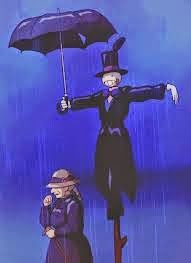
Film Sophie crying over
 her lack of beauty
Film Sophie's personal quest turns out to be accepting her own beauty. In the novel, the uproariously comic scene in which Howl cries in despair after Sophie mixes up his potions while cleaning the bathroom, leading him to inadvertently dye his hair red, serves as another sign of his character: vain, self-centered, and entertainingly dramatic. But in the film, the scene serves to reveal Sophie's deep pain over her lack of looks. "I see no point in living if I can't be beautiful," Howl melodramatically despairs, to which Sophie responds, "Fine. So you think you've got it bad? I've never once been beautiful in my entire life!" Fleeing the castle, Sophie ends up outside, crying on the moor.

Interestingly, Sophie's curse seems to fade at this moment; the film pictures her as a young woman again. And throughout the rest of the film, at moments when Howl pays attention to her—remaking the castle to give her her own room, resetting the magical door to open upon a beautiful flower-covered plain, giving her presents—Sophie looks younger. The Witch of the Waste may have initially laid the curse of age on Sophie, but the film suggests that it is Sophie's lack of self-confidence that keeps it in place.

Significantly, film Sophie remains old even after the Witch of the Waste is stripped of her powers by the evil wizard Madame Suliman. Only after Sophie takes action to save Howl (by moving the castle) does she throw off her old-woman disguise for good.

At the climax of the film, after Sophie has figured out how to save Howl from the curse he has been under, Howl awakens and exclaims, "Wow. Sophie, your hair looks just like starlight. It's beautiful." Sophie's response—"You think so? So do I."—indicates that Sophie has finally accepted herself, finally believes in herself. Embracing feminine self-confidence is certainly a feminist message. But having beauty function as a proxy for self-confidence, rather than any sense of achievement, is troubling at best. And that Sophie regains her youth by acting to save another, rather than acting to save herself or to achieve her own goals, reinforces messages that women are meant to meet others' desires rather than their own.

In contrast, the climax of the book occurs when Miss Angorian, a woman whom the love-em-and-leave-em Howl has been courting, is captured by the Witch of the Waste. Sophie feels she's the one who put Miss Angorian in danger because she felt jealous of Howl's attentions to her, and immediately sets off to rescue the woman. Saving another woman, a woman endangered because of her jealousy, rather than saving a man with whom she is in love, sends quite a different message about Sophie's agency.

But Wynne Jones' message gets even more complicated. Because after she and Howl join forces to defeat the Witch of the Waste, it turns out that Miss Angorian is not as innocent as she initially appeared. And Sophie must act again, this time to rescue Howl. But also to rescue herself, from being too femininely nice, so nice that she's allowed others—her stepmother, Miss Angorian, even Howl—to take advantage of her.

New York Times film reviewer A. O. Scott may be right that Miyazaki's film "resonate[s] with... determined, somewhat romantic feminism," and that its Sophie "joins an impressive sisterhood of Miyazaki heroines, whose version of girl power presents a potent alternative to the mini-machismo that dominates American juvenile entertainment." But given a choice, I'd take Diana Wynne Jones' version of feminism every time.