Friday, August 10, 2018

Who's Talking About Diversity in Romance?


A reposting today of two romance & diversity-related announcements. First, this announcement from the Bawdy Bookworms about the start of their "Diverse Romance Press List," a database intended to "help connect diverse authors and the media/librarians" by sending out a monthly email with "a link to a database of diverse romances that will be released in the next 3 months." For more info, check out the full announcement here.

(And if you're specifically interested in romances by women of color, check out Rebekah Weatherspoon's Women of Color in Romance on Tumblr, and Facebook, and Twitter, which has been doing similar work since 2015).


Second, a report from Romance Writers of America on the Diversity Summit held during July 2018's national conference, which can be found here. I found the report of 2000 romance readers on their reading preferences and habits, compiled by NPD Book for RWA, particularly telling (the full report is available only to RWA members, but some of the highlights are summarized here). The take-away? The reading habits of younger readers are far different than those of older readers, so if authors and publishers want to keep the industry growing, it is vital to appeal to this more racially and sexually diverse, more male, and more social media-engaged group.


Here's to keeping the diversity conversations going...

Friday, August 3, 2018

Romancing the Spectrum: Katharine Ashe's THE PRINCE, Helen Hoang's THE KISS QUOTIENT, Talia Hibbert's A GIRL LIKE HER

I've read quite a few strong romance novels that featured heroes with the social difficulties, language impairments, and repetitive behaviors that characterize those with Autism Spectrum Disorder (ASD). But finding books with heroines with ASD has been far more difficult. Not just because the disorder is more commonly diagnosed in men than in women, I'm guessing, but because of many romance readers' preference for "nice" or "perfect" female leads.

Which was why it was such a pleasure to come across not just one, but three romances this past month featuring women falling in love while navigating their worlds as people with ASD.

Katharine Ashe's The Prince (book 4 in her Devil's Duke series) is set in 1825 England, long before the terms "autism" or "autism spectrum disorder" came into medical usage. A "small madness," is the term Ashe's heroine, twenty-year-old Elizabeth (Libby) Shaw and her father use to talk of her set of "peculiarity": repetitive daily routines; an eidetic memory; a lack of a social filter; and a single-minded desire to follow her father and become a physician, in a time when women were not allowed to apprentice as surgeons. Libby's so intent on her goal that when her father travels to London, leaving her behind in Edinburgh, she dons men's clothing and takes on a male identity in order study anatomy and chemistry, and to gain a mentorship at the city's Royal Infirmary.

There's not much of a plot in The Prince beyond Libby's medical studies and her growing romantic relationship with painter Ibrahim Kent (a bit about corpse-stealing comes in late in the novel). And don't ask how the two come to be sharing a house; you have to accept some plot contrivances whenever you pick up an Ashe historical. But the interactions between intelligent, direct Libby and secretive, wounded Kent (or Ziyaeddin, as he was called before he was exiled from his Middle Eastern country [one invented by Ashe]) are a real pleasure. As a painter, "it had always been his curse to see what others did not"; part of Ziyaeddin's seeing is recognizing the beauty in the not just unconventional but outright odd Libby:

He considered himself her protector. He wished to keep her safe, yet so differently from the manner in which her friends and father always had. They always wanted to protect her from the morass of her own thoughts and desires. He wished to protect her for herself, so that she could pursue her dreams. (185)

In turn, Libby uses her growing medical skills not to keep her "protector" close to her side, but instead to help him realize his own long-thwarted dreams.

My favorite lines:

"I finished bleeding two days ago."
     The kisses ceased.
     He rose onto his elbow to look down at her. "What are you saying?"
     "That I shan't get with child from this.... Women do not typically speak of such matters to men, of course," she said, "unless the man is a physician, and even then infrequently. But I should think this a very useful thing for lovers to discuss." (319)

Indeed.


The Prince
(Devil's Duke #4)
Avon, 2018


Unlike Katharine Ashe, new author Helen Hoang uses humor to draw in readers to her story of a 21st century woman struggling to incorporate romance into her tightly structured life. But readers are never invited to laugh at Stella Lane, the protagonist of The Kiss Quotient. Instead, the humor comes from the gap between Stella's way of looking at the world and the ways her family and her co-workers see it. Take the book's opening lines, spoken by Stella's mother: "I know you hate surprises, Stella. In the interests of communicating our expectations and providing you a reasonable timeline, you should know we're ready for grandchildren." I'm still smiling at that one, even after reading it for probably the fifth time now.

Stella, a (presumably white) Silicon Valley native, knows she has Asperger's, or what is now termed ASD, and is quite self-aware about her own differences. She hates uninvited touches; she likes to do things in a certain order, at a specific time each day; she tends to either be indifferent or obsessed in her interests; she can't help but say exactly what she's thinking, without any reference to the impact it might have on others. Stella knows her social awkwardness and singleminded focus on her job (as an econometrician for an online-shopping behemoth) will make it difficult for her to even find a boyfriend, never mind stay with a guy long enough to raise a child together. As Stella thinks to herself, "The problem was she couldn't keep a man for the life of her" (3).

After a conversation with a rude coworker, Stella has an "ah-ha" moment: "Maybe sex was just another interpersonal thing she needed to exert extra efforts on—like casual conversation, eye contact, and etiquette" (8). And so she comes up with a logical, rational plan: she'll hire an "escort" to teach her how to be better at sex, so she'll be better able not just to enjoy the deed, but to attract a "regular" man.

But Stella isn't counting on the emotions that often come along with sex—especially sex with a man as kind, and as gorgeous, as Michael Phan. Biracial Michael (Norwegian father, Vietnamese mother) trained to be a fashion designer, but returned from NYC to help his mother after she was diagnosed with cancer. And since he's always enjoyed women and sex, working as an escort in addition to his day job as a tailor at his mother's dry cleaning store to earn the money to pay her medical bills wasn't a big deal. But he's starting to get a bit bored with it all—until he's hired by Stella.

Because—feelings. Unexpected feelings. Surprisingly moving feelings. And not just on rational Stella's side, either. As he gradually introduces her into participatory, mutually pleasurable sex, seemingly easygoing Michael keeps getting taken aback by Stella's unwitting display of kindness and caretaking, things he's never experienced before from other women who have paid him to have sex.

Self-acceptance is the underlying message here, not just for Stella but also for Michael, who is burdened with his own insecurities and guilt. But it comes with a large helping of kindly laughter, as well as deep insight into the challenges of being an odd duck in a world that would prefer to everyone to quack to the same beat.


The Kiss Quotient
Jove/Berkley
2018


Perhaps my favorite of the three books is Talia Hibbert's A Girl Like Her, the first book in her small-town Ravenswood series. The book's cover features a hunky white hero, but the real draw here is the heroine, prickly Ruth Kabbah, whose mother emigrated to England from Sierra Leone. Unlike Stella, Ruth isn't worried about people knowing about her autism; soon after hot Evan Miller introduces himself as her new neighbor, Ruth tells him, "Before you ask, there's nothing wrong with my brain.... I'm autistic." Like both Stella and Libby, Ruth lacks social filters; she's obsessed (with comic books ); and her brain doesn't quite work the same as most other peoples'. As she thinks to herself during a difficult lunch with her neurotypical sister, "it's not you or anything you've done, it's me and this fucked-up tongue that won't obey and this fractured mind that won't think" (308).

But Hibbert's story is not about self-acceptance. Or at least, not acceptance of a disability. It's about coming to terms with past bad mistakes, mistakes that any woman could have made. Mistakes involving a boy, and the strong emotions of adolescence, and not having enough experience to see the difference between healthy and unhealthy desire. Ruth's become a pariah in the small town of Ravenswood, and not because of her ASD; she's crossed the town's golden boy, Daniel Burne—who also happens to be Evan's boss.

But Evan's an adult, and a newcomer to Ravenswood; he can see what the others, too caught up in Daniel's smiles and reputation, cannot: "This man had never been told no, and never thought he would be. Those were the men you had to watch" (187). Even though Daniel's all charm and Ruth is all prickles, it is Ruth who draws his attention, Ruth whom he wants to befriend.

And Ruth whom he wants to sleep with, a prospect that has Ruth, wary from her bad past with Daniel, not quite knowing how to respond:

     "You can't say yes?" His fingers stopped.
     "I can't say yes. I can't say no, either."
     He swallowed. Hard. "You're not afraid of me. Are you?"
     "No." She'd never been less afraid of a man in her life. "I just. . ." She took a deep, shuddering breath. "I can't give you permission to fuck me over."
     He smiled slightly. "That's not exactly what I want to do."
     "But you will," she said sharply. Was this really what she thought?
     Yes.
     "You will, and when you do, at least I'll know I never gave you permission." (1876)

It takes Ruth some time to understand just how different Evan is from Daniel. His words—"It's just, I want to do things with you. Not to you. There's a difference" (1892)—aren't enough. He has to show her, not just tell her, that he's worthy of her trust. That's something that can only build over time. But the reward for Ruth, and for the reader, is well worth the wait.

Favorite line:
"Feelings weren't as straightforward and binary as he'd once assumed; around Ruth, he could feel fifty things at once."


A Girl Like Her
Ravenswood Book #1
Nixon House, 2018

Friday, July 20, 2018

In the Aftermath of Manipulative Men: Lucy Parker's MAKING UP and Molly O'Keefe's THE TYCOON

When my alarm went off this morning, it tore me from the midst of a very unpleasant dream. My spouse and I had bought half of a two-family house, but it turned out that we didn't in fact actually own the house; we'd only paid for the right to live there, something my spouse knew about but never told me. Thinking I'd just protest, and knowing in his own mind that it was "for my own good," he decided to manipulate me by keeping the relevant information hidden from me. I was so very, very angry in that dream, even though a part of my brain knew my spouse would never ever do such a thing to me.

Can you guess what romance novel I was reading the night before I had this dream?

Fifty Shades Freed.

Why was I reading the third installment of E. L. James' BDSM/romance series? Because next week, I'll be taking part in a Facebook Live event next week at the Boston Public Library, a discussion with radio host Cassie Crossley and Harvard literature professor Susan Weaver Schopf about the changing face of romance from the 19th to the 21st century. The books we'll be talking about all appear on PBS's The Great American Read's "100 most-beloved books" list, which includes James' 50 Shades books.

I'll have more to say about that event in a future post. Today, though, I'm writing about how my 50 Shades-inspired dream made me think less about the differences between 19th and 21st century romances, and more about the differences between contemporary romances—particularly when it comes to the celebration of—or warnings against—the manipulative lover/hero figure.

Two recent books by RNFF favorites inspired this post: Lucy Parker's Making Up, the third book in her London Celebrities series; and Molly O'Keefe's The Tycoon, the first book in a multi-author series about the siblings of a wealthy, dysfunctional Texas family. Both authors take markedly different approaches to the manipulative lover/hero figure than does James, approaches that ask romance readers to question the genre's longstanding embrace of the hero who lies or misleads a heroine, purportedly because he loves her and thinks its for her "own good."

Parker's approach is to recast the manipulative male lover as villain rather than hero. In Pretty Face, the previous book in The London Celebrities series, secondary character Trix was in the midst of a bad romance, one in which she hadn't yet realized she was being majorly gaslighted by Dan, her seemingly charming boyfriend. Towards the end of that book, Trix finally recognized that Dan was manipulative and verbally abusive, and told him where to get off, a major moment of female empowerment.

But now, as the heroine of her own story, pink-haired white Brit Trix is recognizing that a single moment of empowerment does not an empowered woman make. "Telling him exactly what she thought of him had been cathartic, and closed the chapter of him being physically present in her life," Trix thinks to herself (Kindle Loc 578). But despite kicking Dan to the curb more than a year ago, Trix doesn't "just spring back to being the person she'd been before, as if he'd been a temporary blip" (578). Her sense of herself, and her confidence in her own judgment, has taken a major beating, as she tells best friend Lily:

"It's about me, and the fact I could ever have thought I was in love with someone like that in the first place." She'd let him strip so much away before she'd realised what he was doing. Weak. It made her feel weak, even thinking about it. And she'd never, ever thought that about herself before him.She'd never seen herself that way. (591)

Trix, who has always loved performing, finds herself struggling to take on a new role in her show,  a role that she'd once coveted. And having another man from her past, one who dealt her a less damaging but still painful blow to her amor propre while she was in high school, abruptly join the show, isn't helping matters in the least. Or is it?

As a fellow worker in the London theater scene, black Brit makeup artist Leo Magasiva keeps making "a surprise appearance every ten pages or so in the picture book" of Trix's life (212). Sprite-like Trix revels in dishing out the snappy insults and quick comebacks to the "mountain of a man" that is Leo. But even as their bickering shifts from anger to attraction, Trix's wariness and self-doubt make it difficult for her to believe in her own abilities on the stage—or her judgment off it.

Parker makes it clear that recovering from a relationship with a selfish manipulator takes more than just insight and a cathartic rejection scene. It even takes more than having a friend tell you hundreds of times that it's not your fault (as Trix recognizes, it's "easier to listen to them than it was to believe them" [588]). Recovering from a manipulative lover takes days, months, even years, rebuilding new trust in one's own abilities and especially in one's ability to judge others.


Making Up
London Celebrities #2
Carina Press 2018


Where Parker makes the manipulative male lover the villain, O'Keefe tries a sneakier tactic to call the Christian Grey-type hero into question. Appealing directly to readers who typically go for the alphahole hero, she packages her novel as a story that appears to celebrate him. But throughout her bad-boy-redemption romance are subtle hints about how problematic it is that women in general, and her heroine in particular, are encouraged to leave themselves in the hands of a "loving" man. And although she gives her bad-boy hero a reason for why he acts as manipulatively as he does, O'Keefe never suggests that his manipulative behavior is acceptable, nor does she force her heroine to compromise her own sense of self in order to appease her manipulative lover.

The ad copy for The Tycoon makes it sound as if it will play out like a typical dark romance, with a disempowered white woman at the mercy of an obsessed, manipulative bastard of a brooding (also white) hero:

Five years ago, Clayton Rorick loved me. Or so I thought. Turned out he only wanted to get his hands on my daddy's company, Heartbroken, I ran away with nothing but the clothes on my back. Like a twisted Cinderella. When my father dies, leaving my sisters in a desperate situation, it's up to me to help them. I'll have to beg the man who broke my heart to save us. But Clayton hasn't forgotten me and what he wants in exchange for his help is. . . my body, my heart and my soul.

With such expectations in place, it's a bit of a shock to read the opening lines of Veronica King's story:

No one had ever told me about orgasms.
     Like, I had a sense, from movies or whatever. But no one ever gave me the complete picture. How they were tricky. How you had to be patient and vulnerable. Naked in a lot of ways—more than just, you know, actually naked. No one told me that they were a little frightening, that feeling of chugging up the incline of a roller coaster. Of something powerful and scary being just over the edge of a cliff.
     Really, what no one told me was how freaking consuming they were. . . .
     All I could think about was sex (41)

It's twenty-two-year-old Veronica King's innocence about sex—about its power, its pleasure, its orgasms—that leads her to accept the proposal of an employee of her father's, a man who has spent more time giving her orgasms (8 to be exact) than telling her anything about himself. And it is this innocence that leads to Veronica's disillusion when she overhears her fiancĂ© Clayton and her father arguing over just what payment Clayton will be receiving in exchange for taking Veronica off Mr. King's hands.

Fast forward five years later, and Veronica isn't just pining away for a manipulative lover lost. She's taken his engagement gift, an expensive diamond, and hocked it to support herself and to help her start a business with a distinctly empowering goal. As she explains to the reader:

You know what no one ever tells girls about?
     Money.
     No one ever tells women to have their own money and know what to do with it. How to protect it and take care of it. How to make a fire out of it that will keep a woman warm and safe her whole life. No one ever tells a newly single woman how much she'll need to take care of her household after her husband dies or runs off with someone else. Or how to pay for the kids' college and her husband's spousal support, if that's how it shakes out. (335)
   

Tired of feeling like "women were lambs to the slaughter in so many ways," Veronica has opened a business focusing on helping women learn to manage their own financial lives: Her Safety Net Accounting and Investments. Veronica herself is in fine financial shape; discovering that her heel of a father has disinherited all of his daughters in favor of her one-time fiancé is annoying, but not crippling, either emotionally or monetarily. O'Keefe even has Veronica reject the typical romance novel jerk-hero redemption move, yelling at Clayton after he forces a man who had been coming on to her at her father's funeral from the premises:

     "You do't get to do this, Clayton," I said.
     "I just want to be sure you're okay."
     "No! You don't get to be the hero. You can kick out all the jerks and look as concerned as you can force yourself to look, and you're still not the hero." (701)


In a more conventional dark romance, the heroine would be forced into an abject position, desperately needing the very man who earlier betrayed her: as the ad copy says, "When my father dies, leaving my sisters in a desperate situation, it's up to me to help them. I'll have to beg the man who broke my heart to save us." But Veronica doesn't need saving, and she certainly doesn't beg. And Clayton doesn't force her or demand that she do anything. He offers; she negotiates; and to Veronica's surprise, he compromises: "I'd expected him to be bossy and cruel and demanding. Not... giving. Reasonable. Or fair" (1416). O'Keefe here points to what every woman should demand from a spouse: reasonableness, fairness, compromising. To not lie. To be willing to compromise. And to apologize when you make a mistake, and hurt the other. Not a cardboard hero, to protect and rescue, but a life partner.

And then O'Keefe suddenly switches point of view, allowing us inside Clayton's mind, showing us the details of his life that he kept from Veronica during their engagement. Showing the reader that he, too, has been a victim in many ways. The bad boy hero typically has a tortured background, a background that often serves as an excuse for past and present arrogant, controlling behavior.

But O'Keefe doesn't allow the hurts inflicted on Clayton to excuse his hurt he inflicted on Veronica. Clayton chose not to stand up against Veronica's father; he chose to lie to her while he was courting her. And now he has to accept his own central role in pulling their relationship apart, and apologize for it, if they are to start over again. The villain of the piece becomes not a hero, not a savior, but instead a flawed human being: "Clayton isn't a bad guy. He's just bad at being good. I don't think anyone ever showed him how" (2963).

Readers drawn to The Tycoon expecting the thrill of a manipulative, controlling hero brought to his knees by his love for a seemingly abject woman will find quite a different model in the second-chance relationship that Veronica and Clayton create. A model less about the thrill of submitting to a controlling lover, or making that controlling lover ultimately submit to you, and more about a feminist vision of a mutually respectful, and mutually beneficial relationship. With, of course, lots of hot sex in the bargain.

I'll be curious to see if future books in this series, written by other authors, will follow more conventional bad-boy romance tropes, or will provide the same feminist bait-and-switch that O'Keefe does in The Tycoon.


The Tycoon
The King Family #1
indie-published, 2018

Tuesday, July 10, 2018

"The First Man To Give Me One": The Assumptions About Female Orgasm in Romance

How do heterosexual women reach orgasm during sex? From reading many a romance novel, one could easily conclude that orgasm is not something a woman need actively strive for at all. Instead, orgasm is often described and portrayed, as something a romance heroine receives from her male lover.

In Old Skool romance, with its typically virginal protagonists, the usual sign that a hero was the right partner for a heroine was the fact that he could sexually excite her when no other man could or had. In the 1970s and 80s, good romance heroines did not ever get turned on, at least not until they met their one true love.

We assume that the sexual experiences of real women are far different today than they were in the 70s and 80s. But in fact, the average age of first sex has gone up a tad since its low of just below 17 in the mid 70s, to a bit closer to 18 in 1989, and then back down a bit to about 17 today (see info from the Guttmacher Institute). So perhaps it's just that social acceptance of premarital sex has finally caught up to social practice of same.


In romance novels, what does this social acceptance look like? Well, heterosexual romances in 2018 features far fewer virginal heroines than they did in the 70s and 80s (although they still do exist, and in both female and male types). But despite heterosexual romance novel heroines' increasing sexual experience, many a romance novel still links the discovery of a heroine's true love with the simultaneous discovery of a partner who can bring her to orgasm. Let's call it "The First Man to Give Me One" trope.

Take this example from the compulsively readable Harlequin author Maisey Yates. In Untamed Cowboy, book #2 in the Gold Valley series, Yates' veterinarian heroine, Kaylee, embarks on a sexual relationship with best friend Bennet. Kaylee's made herself orgasm before, but "She had never come with a man before. She just could never get herself all the way into it. Could never stop feeling self-conscious. About where to put her hands, about whether or not he was enjoying it. About whether or not she was enjoying it enough" (Kindle Loc 2067). For Kaylee, thinking about sex is a problem, one that interferes with her ability to relax enough to reach sexual climax.

But with Bennet, who is not only her business partner and closest friend, but also the man she's been nursing a secret crush on for years, it's far different:

Then he pressed it [his finger] between her slick folds, rubbing her slowly, methodically. Before pushing inside of her completely.
     She broke. And he swallowed her cry of pleasure as her internal muscles pulsed around his fingers as he gave in to the deepest, most intense orgasm she had ever had in her entire life. The only one she had ever had in front of another person.
     And it was Bennet. Bennet was the one who had seen it. Bennet was the one who had caused it." (2091).

The narrative here puts Bennet in the role of actor ("pushing inside her completely"), Kaylee as reactor ("She broke"). Kaylee's internal dialogue echoes this narrative positioning: "Bennet was the one who had caused it." A woman has an orgasm not because she strives for it, reaches for it, but because she responds to the actions of her male partner.

Kaylee echoes this same language around female orgasm later, in the midst of a fight with Bennet:

"Thank you. Thank you for the orgasm. It was awesome. I'm putting it in my diary. Because you are the first man to ever give me one."
     Well, crap.
     She hadn't meant to confess that. And right about now you wud be able to hear the tinest piec eof straw fall onto the concrete barn floor. Because Bennet had fallen utterly silent, his mouth dropped open in an expression of shock.
     "What?" he asked. . . .  "No man. None of them. None of those douchebags I watched you date."
     She crossed her arms and shook her head, defiant. "Nope."
     "Well, that's just . . . I'm torn between wanting to beat them up and wanting to take a damned victory lap."
     "This is not really more charming than any of the other crap you pulled earlier."
     "I'm the first one to give you an orgasm?" he asked as if he hand't heard her previous statement.
     "Yes," she said, "don't let it go to your head."
     "It's not my head it's going to."
     "Bennet!" . . . .
     "It's just hard for me to believe."
     "That there's something wrong with my body.
     He shook his head emphatically. "It's not you, Kaylee. Hell, no. It was them." (Kindle Loc 2433)

In Yates' construction, female orgasm is something a man "gives" to his partner. A bad male sexual partner will fail to give the gift ("Hell, no. It was them"), while the right male sexual partner will always bestow it. Responsibility for an orgasm thus lies completely with the male partner, not with the female ("It's not you"). Even though earlier Kaylee admitted to herself that her own self-consciousness stood in her way, Yates' novel tells its readers that self-consciousness will inevitably vanish in the face of the right male partner, clearing the way for the gift to be received. In such a construction, a woman plays no real role in achieving climax with a partner, beyond picking the right man; all responsibility for female orgasmic pleasure lies with her male partner.

Is male climax with a female partner portrayed in the same way? Yes, Bennet is just as blown away by his own climax (in a later scene) as Kaylee is by hers in this one. But the language Yates uses to describe orgasm from Bennet's point of view does not cast it as something that Kaylee does to him or gives to him; Bennet still remains the active party, even as he loses control:

     Pleasure gathered at the base of his spine, electric and undeniable. It was like fire building inside of him. One that was going to rage out of control at any moment. One that might consume him completely. That need again. That thing he had known would be a raging, destructive thing. And it was. It was. But he was ready to jump feetfirst into it.
     He lost his hold on his control, letting go completely, igniting and bringing Kaylee along with him.
     If they were going to burn, at least they were burning together.
     They clung to each other, his orgasm taking them over completely, a feral growl on his lips as he let it all go completely. (2803)

Bennet's orgasm is all about his choice to lose control. "He was ready to jump feetfirst into it"; even though he "lost his hold," he still is the one who is "letting go completely." It is not Kaylee who gives him the gift of orgasm; in fact, it is Bennet who "brings Kaylee along with him." Female orgasm is a gift from the right male to the right female, but male orgasm is an active male choice.

What's at stake when female heterosexual orgasms are constructed as a gift from a man to a woman, while male orgasms are portrayed as an active choice a man makes all by himself? Here are just a few downsides:

• It ignores the fact that many women never not reach orgasm during p in v sex at all, and that those women who do often need additional clitoral stimulation to achieve it. According to a 2017 study of 1478 women in the Archives of Sexual Behavior, 51%-60% of respondents reported reaching orgasm via intercourse plus clitoral stimulation, while only 21-30% reported reaching orgasm without such assistance. Needless to say, such "assistance" can come from either partner. But if a woman believes that she is the passive recipient of the gift of orgasm, she's far less likely to take matters into her own hands, or to ask her partner to take them into his.

• It plays into the linkage between the ideal male romantic partner and the ideal female sexual experience. Good sex usually takes time to develop; more women report reaching orgasm with a familiar partner than with a new or casual one, no matter how weak or strong their romantic feelings are for each other at the start of their relationship.

• It puts men in the drivers' seat when it comes to sex and female sexual pleasure. If you're waiting for a guy to give you an orgasm, you might be waiting a good long while.

• It suggests that women are not responsible for their own sexual pleasure, which can make women reluctant to ask for what they want, or suggest to their partners that they do something different than they are currently doing.

• Just because sex for men is the cycle from arousal to ejaculation doesn't mean that climax has to be the end goal for a woman. Multiple orgasms, or no orgasms, can be just as good an option for a woman than the one orgasm per sexual act common to the male.

• And as one of my favorite lines from one of my favorite web sex education web sites, Scarleteen, reminds us: "Don't forget: the vagina, all by itself, is an active muscle. It grips what is around it: it doesn't just hang out and whistle Dixie while things happen to it." Check out the rest of this post, which busts the myth that males are active, females are passive during sex.


How often do the romance novels you read portray female orgasms as a gift from a male to a female? How often do they portray sex as an active experience for both partners?

Tuesday, July 3, 2018

Romancing Female Ambition: Claire Legrand's FURYBORN

The danger of ambition is a theme at the heart of many a high fantasy novel. Even if one's ambition stems from the desire to do good, fantasy novels generally warn that political ambition often engenders a far more dangerous desire, a desire for power itself. And as French politician and philosopher deLemartine argued, "absolute power corrupts the best natures"; or, as English Lord Acton wrote, "Power tends to corrupt, and absolute power corrupts absolutely. Great me are almost always bad men."

And if the striver in question happens to be of the female persuasion? Well, then the warnings grow even more pointed. As Robin Romm notes in the Introduction to her essay collection Double Bind: Women on Ambition, "striving and achieving [have] to be approached delicately or you risk the negative judgment of others." Twenty-first century American women are socialized to be soft, feminine, but are simultaneously urged to "go for it," a paradox Romm describes as "the double bind of the gender, success paired eternally with scrutiny and retreat."

That is what intrigued me about the first volume in Claire Legrande's YA fantasy novel, Furyborn: its portrayal of not one, but two deeply ambitious women. After an opening scene in which a queen gives birth and then gives up her baby to prevent her from falling into the hands of a malevolent angel, Furyborn forks into two separate strands, one set in the near past, the other a thousand years into the future. The first tells how the queen of the first scene, Rielle, came to be "allied with angels and helped them kill thousands of humans. This queen who had murdered her husband" (Kindle Loc 91). The second tells of a the rise of an assassin who is asked to become a rebel against the oppressive Empire, a woman whose questionable morals make her seem just as unfit for the role of savior as was/is Rielle.

Eighteen-year-old Rielle, only daughter of  Lord Commander Dardenne, chief of the king's guards, chafes against the restricted life her father condemns her to after the uncontrolled power of her magic lead to the death of her mother. As she protests to her teacher, Tal, the Grand Magister of the Pyre, the head of those who bend fire to their magical will, "If Father had his way, I'd stay locked up for the rest of my life with my nose buried in a book or on my knees in prayer, whipping myself every time I had a stray angry thought" (Kindle Loc 380). Rielle wants more than a life stuck in a cloister: she wants to participate in the Boon Chase; she wants her childhood friend Audric, now Prince Audric the Lightbringer, the mot powerful sunspinner in centuries, to love her and not their friend Ludivine; most of all, she wants to show everyone just how powerful her magic is. For unlike every other elemental who had ever lived, Rielle needs no physical object to access her power, and her magic is not limited to one element. No, Rielle can control them all.

During an assassination attempt on Prince Audric, Rielle uses her powers to save her friend, despite her father's warnings never to reveal them. And Audric becomes convinced that his old friend is one of the Light Queen of prophecy, a human woman who will rescue them all from the angels who once oppressed humankind and who threaten again:

The Gate will fall. The angels will return and bring ruin to the world. You will know this time by the rise of two human Queens—one of blood, and one of light. One with power to save the world. One with the power to destroy it. Two Queens will rise. They will carry the power of the Seven. They will carry your fate in their hands. Two Queens will rise. (1649)

Rielle is not your usual fantasy heroine, not an empty placeholder for the reader nor a troubled, misunderstood, but deeply good at heart girl. No, as Prince Audric's mother recognizes, Rielle is "Cunning. Willful, and lovely. It's a volatile combination. It unnerves me" (3400). Rielle, with her naked ambition, is meant to unnerve the reader, too. Indeed, she unnerves herself: "Even while my mother burned, I was glad to feel the power simmering at my fingers... Even though you belong to Ludivine... I want you for my own. I want... I want. I crave. I hunger" (4285). Is she the Sun Queen, the one who will save humankind? Or is she the Blood Queen, who will destroy all?

If Rielle seems a questionable savior, what are we to make of the other heroine of Furyborn? We first meet assassin Eliana Ferracora as she helps round up a group of rebels, fighting against the Empire that rose in the ashes of Rielle's betrayal of humankind. Eighteen-year-old Eliana is tempted to let the rebel children of  group go, but resists: "children couldn't keep their mouths shut. And if anyone ever found out that the Dread of Orline, Lord Arkelion's pet huntress, had let traitors run free..." (648). Instead, Eliana watches as the eldest boy is beheaded.

Eliana's partner and lover Harkan wishes she were different: "Harkan paused, that sad, tired look on his face that made her hackles rise because she  knew he hoped it would change her, one of these days. Make her better. Make her good again. She lifted an eyebrow. Sorry, Harkan. Good girls don't live long" (643). Calculating, skilled, and deadly, Eliana focuses on the here and now, on keeping her mother and brother safe, and herself alive. Her ambition may be narrower than Rielle's, but it still burns bright. Though people in Eliana's time call Rielle the evil Blood Queen, it's difficult to believe that Eliana is more suited to the role of Sun Queen than is/was Rielle.

Eliana knows that any day now, she'll be recruited as a member of Invictus, a company of assassins that travels the world and carries out the Emperor's bidding. For she's not just skilled; she also seemed to have an ability no one else in her world has:

The problem was, she liked showing off. If she was going to be a freak with a miraculous body that no fall could kill, then she might as well ave fun with it. If she was busy having fun, then she didn't have time to wonder why her body could do what it did. And what it meant. (552)

But after her mother mysteriously disappears, The Wolf, a famed captain of the Red Crown rebels, bargains for Eliana's help in infiltrating the palace in exchange for his help in finding her missing parent. Coldly weighing both the costs and the benefits, Eliana agrees, looking out all the while for how to shimmy free of any acts, or any personal connections, not promoting her own safety or that of her mother and brother. She even accepts poor Harkan's self-sacrifice, leaving him behind in order to save herself and her brother.

One of the other rebel leaders tries to convince Eliana that "Revolutions mean nothing if their soldiers forget to care for the people they're fighting to save," but Eliana has more than her share of doubts (2609). Somehow familiar with the trajectory of the typical fantasy romance, she knows that she's supposed to be transformed by her time with the rebels, especially by her admiration for The Wolf, known to her now as Simon, a man who has endured much during his battles against the oppressive Empire. "People like us don't fight for our own hope... We fight for everyone else's," Simon nobly avers, but wily Eliana uses his own hope in her redemption to deceive him (2964).

At the end of this first installment, both Rielle's and Eliana's worlds are on the verge of war: Rielle's against the resurgent angels, Eliana's against the invading Undying Empire. Can either war be prevented? Will either young woman be Sun Queen? Or will both fall into the temptations of blood?

Or might the stark binaries of the prophecy be pushed aside, the opposition between sun and blood,  self-focused ambition and other-directed empathy, shown to be equally necessary in order to defeat true evil?

I'm gnawing on my fingernails, waiting to see what the next two volumes in the trilogy have to say about women and ambition and power.


Art credits:
Elemental magic symbols: Zenkora Wiki
Ambition: Girltalkhq


Furyborn: The Empirium Triology, Book 1
Sourcebooks, 2018

Friday, June 15, 2018

Popular Romance in the Classroom: Guest Post by Jennifer Wofford


Please join me in welcoming to RNFF Dr. Jennifer Wofford, a professor as well as a romance author, as she describes her recent experience of teaching first year college students through the "Category Romance Project."


My name is Jennifer Wofford. I teach writing and popular romance at Ithaca College in Ithaca NY. I also write historical romance under the name Giulia Torre. Along with Catherine Roach, I self-identify as an Aca-Fan, an academic who is also a fan of what she studies. I study romance while wholly immersed in it—reading, writing, teaching, and advocating for its importance and complexity on all fronts.

In the fall of 2017, in my first-year college writing seminar Reading Popular Romance, I piloted the "Category Romance Project," a classroom-based, large-group student research project that explored "vintage" category romances (20 years or older) from a social science perspective.

I proposed Reading Popular Romance as a social science course with the sponsorship of IC's Writing Department. Ever since the publication of Janice Radway's Reading the Romance (1984), scholars have been using social science to analyze the genre. Social science was the most exciting thing to happen to my relationship to text since I read my first Bantam Loveswept romance in 1984.

I was introduced to social science methods by Brian Street through the field of New Literacy Studies. NLS takes an "ideological approach" to the study of literacy—to reading, to writing, and to text in all its forms and contexts. Through language we create, acknowledge, and most often presume mythologies and master narratives that in turn guide and make sense of our actions.

Community of Inquiry model
Because of what I learned from NLS, my approach to teaching is a theoretical framework called "Community of Inquiry," or CoI. Learning is social, and therefore relies on participation in a community. The CoI model turns the classroom into a site of literacy research. I've found that this approach gives students the skills for recognizing their own identity filters, for designing research questions that in turn create strong claims, for creating compelling arguments and finding something to say, and ultimately for developing their own authentic voices. Simply, students write better papers when they use the CoI approach.


STEP ONE: FIND A SHARED LANGUAGE

My first step in creating a community of inquiry around a classroom research project is shaking out students' funds of knowledge, getting everyone's cards on the table. During sessions designed to focus on students' transition-to-college issues, we discussed issues related to race, gender, sexuality, and mental health. Student panels and speakers trained in conducting such conversations came to the classroom to tell us their stories, so students had a way of talking about real world issues and their own identities without having to use themselves as examples.

Also during these sessions, I asked students to bring in examples of popular love songs as well as  their favorite romantic movies. Songs and movies are an easy way to get students talking about romance. They can also serve as good ice breakers: students feel a teacher is a bit more approachable after seeing her dance to Tina Turner during the first week of class.

These initial conversations about romance and about identity served as points of reference throughout the remainder of the course. For example, in one section of my course, 9 out of 16 students self-identified to the group as having been diagnosed with anxiety or depression or as having suicidal thoughts. Reading Alexis Hall's Glitterland in the context of these students' experiences was far different than in sections where students did not identify so closely with the mental health challenges of Ash Winters, Glitterland's protagonist.


STEP TWO: INTRODUCE CONCEPTS IN POPULAR ROMANCE

While students recognized and shared their own knowledge about romance, I also introduced new concepts that weren't already a part of their own systems. Students learned the difference between romantic and popular romance and romanticism, as well as the definition of "trope" (and key examples from genre romance). Weekly lectures gave students the language of Romancelandia, as well as some of the tools by which they could analyze individual romances and the romance genre as a whole. In addition, we discussed theoretical concepts, such as Lyotard's notion of "master narrative," a story that explains society and cultural norms while at the same time legitimizing the status quo. Master narratives make it difficult to understand reality in any other way than the "dominant" narrative. Popular culture often uses counter-narratives to make make alternative narratives visible. One of the more well-known master narratives in the United States if the history of Columbus "discovering" America. The word "discovery—and the master narrative it implies—wasn't challenged until relatively recently. We discuss the ways that the HEA (Happily Ever After) of romance is a master narrative.


STEP THREE: INTRODUCE THE CATEGORY ROMANCE

Quite simply, I tried to explain the category romance to this generation of students. My students had a hard time conceptualizing the category romance, even when faced with a large pile of examples. I explained that category lines represent subgenres in mainstream romance publishing, and that these sub-genres have rules about authors' use of tropes, archetypes, and plot lines, rules that readers come to expect and use to guide their reading choices.

There seemed to be nothing like the category romance in their world.

Showing students covers of books with the same trope helped.


STEP FOUR: INTRODUCE SOCIAL SCIENCE METHODS

As an entrance into the analysis of texts by way of social science methodology, we read Lily King's Euphoria (2014), a work of fiction inspired by the story of anthropologist Margaret Mead. Set in 1930s New Guinea, Euphoria tells of a love triangle between three anthropologists in the field, each of whom is struggling with varying degrees of failure to "see" beyond their own limited perspectives. The novel represents the social life of text in various forms. The female protagonist writes field ethnographies. All three scientists hunker down over a colleague's monologue draft mailed to them from back home. The antagonist searches for an artifact that will prove a primitive culture had a written language.

After students finished reading Euphoria, I learned that they originally thought the book was a romance. But this book has one of the most heartbreaking and haunting endings in my memory. As un unanticipated teaching moment, students got to experience the phenomenon of reader expectation (and the dashing of same) in commercial romance.

In addition to reading Euphoria, students read brief, introductory articles in the fields of New Literary Studies and social linguistics. Social science is a valuable process of alienation, or de-familiarization. One activity proved particularly effective in demonstrating this process of alienation. I asked students to draw a sentence from an NLS article, and we browsed the results, looking for patterns. They realized that we're ruled by rectangles—paper (everyone drew on lined paper), tablets, screens, desk tops, even the very room that we were in. Standardization is a master narrative. It's invisible, and we think it's valuable (cost-efficient, replicable, consistent) without even questioning what gets lost when we sit, write, and think inside boxes.

By reading about anthropologists at work, a fiction focused on a central love story, through the lens of social science, students become attuned to looking at rather than through the water in which we swim.


STEP FIVE:  DEFINE THE DATA SET

So what exactly was our data set? We started with three category lines:

• Harlequin Presents
• Harlequin Romance
• Bantam Loveswept


Perilous stack of vintage category romances
(buttressed with a Heyer and a Woodiwiss)
Why these lines? For me, they are my everyday. I own them in the hundreds. I'm familiar with the plot structure, archetypes, and authors. And I love the covers. Not only because cover illustration is a lost art, but because covers are a clear visual representation of how the mainstream West allowed love, intimacy, sex, and gender to be represented over time. Covers were indeed a favorite topic for students.

We restricted our reading to books at least 20 years or older.

Were there problems with this data set? You betcha.

Vintage category romances are white, there are no two ways about it. But the utter absence of characters of color is, in and of itself, a wake-up call. It's a way to understand the full scope and impact of whitewashing, as well as the privilege of reading while white.

This data set is also unarguably heternormative. These books tell the story of heterosexual romance. In the very first book in the Loveswept line—Heaven's Price by Sandra Brown—the heroine's first long-term romantic partner was gay, which provided the logical reason for her still being a virgin. But that's as queer as these books get.

After butting up against these limits, we decided to expand the data set. I assigned questions that charged students to research on diversity and diverse voices in popular romance. They returned with blog posts on the closure of the Kimani line and segregation in romance publishing, as well as information on Bold Strokes Publishing and women writing romance with queer male characters. This diversity research provided some of the most interesting discussions in the course, and many students ended up choosing final paper topics on issues related to their diversity explorations. Each student expanded their own data set, but the limitations of the larger set remained intact. To a significant degree, it was the limitations of the set that taught students the most, both about research and about master narratives in romance. That said, when I teach this class next year, the data set will at the very least include early books from Harlequin's Kimani and Arabesque lines, as well as a canon-busting assignment to expand the classroom library.


STEP SIX: SOLICIT RESEARCH QUESTIONS

When presented with hundreds of gorgeous, but designed-to-be-ephemeral books, students were mesmerized and astounded, sometimes even shocked. They started reading the back covers and inside blurbs, and then began to reach them aloud to one another. It was a very natural process for them to start to ask questions about what they were reading.


All questions were shared among students and between sections. An important element of the course is to share questions so that students can also share findings. But it has the added benefit of giving students an understanding of what makes a good question.

Through the simple act of considering what they would have to do to answer their question, students learned an important lesson: some questions are unanswerable, given the constraints of both our data set and of the time allotted to the project.


STEP SEVEN: DEFINE CODES

In anthropology, coding is used to chunk and classify concepts in the social scientist's ethnography: the field notes and rich description of her subject. Coding feels a lot like textual analysis. When coding is applied to literary texts, it functions to highlight the text's cultural dimensions. I created a starter list of codes—single words or short phrases to signal a theme or topic or question—and shared them with the class. These codes directly represented their specific questions. As new questions emerged, students were charged with creating and sharing new codes.

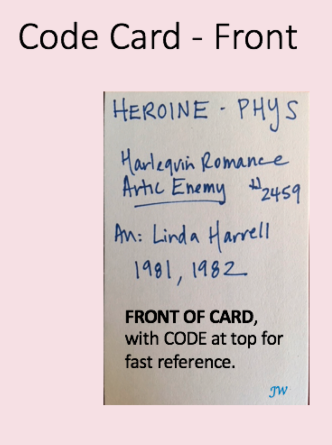
Students were then assigned code cards. Each student had to produce 10 cards to satisfy the larger category romance project assignment. I gave them time in class to read and search for codes in our data set books, and they also were allowed to use my books outside of class. Students also drew on the massive online library at the Romancewiki, as well as other online sources, such as Goodreads, AbeBooks, Amazon, and publishers' web sites.

As students turned in completed code cards, I scanned them front and back, and uploaded them to our online course site, saving them with titles that reflected the codes. As more cards were submitted, I continued to scan and upload. Students then had access to all other students' research on the codes or associated codes that provided responses to their chosen research question.

#metoo was very much in the headlines during the time we were working on this project, so students were encouraged by world events and by events happening on college campuses to ask questions about rape culture and consent, and their connection to romance reading.


CONCLUSIONS

In their final projects, students wrote on virginity, consent, race and ethnicity, sexism, and cover art. Some of the essays were outstanding; others were standard first-year fare. But students all walked away having grappled with important and complicated issues. Old school category romances are an on-ramp to complicated discussions of power: segregation in publishing; what it means for readers of color to be forced to read only of white characters; the prevalence of rape culture and "forced seduction," and the ways that popular romance reflects and reproduces that culture.

Happily Ever After is a master narrative, and I see this as one of the grand takeaways of this course. What happens to our personal narratives if partnership at the end of a story is removed? If it's not a (or the only) desired ending at all?

One of my students said during class one day, "Sometimes I think you hate these books, and sometimes I think you love them." YES. Her comment raises an important question: how can we acknowledge the historical moment in which these stories were written and respect their authors, while at the same time use them as examples of what not to do today?

The romance plot forces us to navigate ambiguity and complexity, to articulate this feeling of bothatonce (or many things at once). One thing is not ambiguous: popular romance is definitely female and almost universally denigrated. By studying popular romance in the college classroom, both scholars and students have the opportunity to develop language that acknowledges criticism but allows for imperfection, for our own sometimes conflicted ideas about the genre and ourselves as readers of it. Such study unambiguously asserts the importance of genre romance both as a body of writing and as one example of a communal representation of the female imagination.


Readers, if you had the chance to take a class on popular romance, would you? What research questions would you want to explore?


Note: This post is based on a talk given by Dr. Wofford at Bowling Green State University's Browne Popular Culture Library, at the Researching the Romance conference.

Tuesday, June 5, 2018

Prima Donna romance: Lynn Turner's PAS DE DEUX and Katherine Locke's DISTRICT BALLET COMPANY series

prima donna:

• (1745) the leading female singer in an opera company; a female opera singer of great skill and renown
• (1834) a person who has the highest standing or who takes a leading role in a particular community or field; ALSO
• a self-important or temperamental person


When I looked up the phrase prima donna in the Oxford English dictionary, I wasn't surprised by the first definition I found. The words are, after all, a pretty literal translation from the Italian: prima = first; donna = lady. And I've spent quite a few hours accompanying my spouse on many trips to the opera, listening to prima donnas from Teresa Stradas to Elina Garanca on both stage and screen.

What did surprise me was the way the gendered nature of the term disappeared as it shifted from the world of opera to take on a more figurative connotation, pointing to a person with excellence in any field. And especially as the figurative connotation narrows to encompass not a person's standing, but the negative judgments with which successful people, especially successful women in the arts, are often labeled. There's more than a hint of sexism in label prima donna, I think. It functions to contain and control female success by labeling it as problematic, as too much: too self-important, too emotional, too erratic, too neurotic, too difficult. Diva, princess drama queen, prima donna: these and similar labels seem aimed at undercutting female power, or the power of a man who behaves in a stereotypically female manner. It reassure the world that while a particular woman (or feminized man) may be great, her/his greatness is not untainted, as a cisgendered man's would be.

Given the general romance reader's preference for nice heroines, the prima donna figure is not all that common in the genre. Which was why I took such pleasure in reading not one, but two hetero romances that featured strong-willed, deeply emotional artists, both of them world-renowned ballet dancers. And rather than insist that the prima donna stereotype was wrong—that these women were not self-important, not temperamental—both books instead celebrate, rather than denigrate their female heroines, precisely for the characteristics for which the prima donna label tells us we should condemn them. Both Mina Allende of Lynn Turner's Pas de Deux (2018) and Katherine Locke's three District Ballet series books (Turning Pointe, Second Position, and Finding Center, all 2015) have talent, ambition, drive, and the emotions (and emotional baggage) that often goes hand in hand with an artistic temperament. And both authors make readers love them, precisely for these qualities.

For the past ten years, since the age of seventeen, French-Tunisian-American Mina Allende has been dancing with the Paris Opera Ballet company. But the recent death of her best friend and fellow ballet dancer Étienne has left her wanting something different, something more. Mina is tired of the all-white world of the ballet, especially being continually turned down for her dream role:  Odette in Swan Lake. "DĂ©solĂ©," she's always told, "You're just not the right fit" (Kindle Loc 3593). Not because she's not good enough to dance the part, but because even today, the ballet world cannot imagine a black woman dancing the part of Swan Queen.

Ashley Murphy, photographed by Nathan Sayers
So when brash American choreographer Zach Cohen invites her to co-star with him in his new Broadway musical Lady in Red, a decidedly modern take on the classic story La Dame aux CamĂ©lias, Mina jumps at the chance. So many ballet choreographers are "obsessed with this antiquated notion of uniformity," a uniformity which her skin color breaks. But on her first rehearsal of Zach's New York show, Mina is surrounded by "an array of skin tones and body types in the room, something she hardly ever saw in her world." The embrace of variety, rather than insistence on uniformity, gives her back a bit of the feeling of being alive she lost after losing Étienne (493).

Mina just might be able to make something new, something special, in New York—if only she and Zach Cohen can stop butting heads. For Zach, like Mina, needs to be in control. Even though he was adopted by a working-class, loving Latinx family as a teen, and has left much of his anger and fears of abandonment behind, he can't quite ever erase the impact of his years living as a "nomad" in the foster care system. And he deals with his emotions by exercising authority over not only himself, but also his show. The show of which Mina is the star.

There's a bit of a suspense plot toward novel's end here, but the main pleasure of Pas de Deux is the "let's put on a show" storyline: the ups and downs that Mina and Zach experience, first as dance partners, then as lovers as they gradually allow themselves to slip free of their self-imposed restraints and give into the attraction they've felt for one another almost since the moment they met. Channelling their emotions into sex, and gradually, into love, doesn't dilute their chemistry onstage. Nor does sharing the vulnerabilities of their pasts, or the complex steps each has danced between privilege and disadvantage, between opportunity and prejudice, as they've forged their way to fame in their respective careers. Emotions run high for both Mina and Zach, but it is those very emotions that allow them to create art that moves audiences to leap to their feet in joy.


I picked Katherine Locke's Second Position, the first full-length novel in her District Ballet Company three-story series, back in January, after reading a tweet from the author saying that the book fit the bill for those looking for a demisexual romance with a non-alpha male protagonist. But the book isn't really focused on demisexuality; it's more about the long, arduous process of accepting loss and recovering from trauma. The second-chance love story between Alyona Miller and Zedekiah Harrow actually takes place over the course of two full-length novels—Second Position and Finding Center—with the story of their initial friendship and falling in love in the prequel novella, Turning Pointe. I didn't know this at the time, though, so I began with Second Position, which begins four years after the events of Turning Pointe. Since this is a second-chance romance, and references many of the events covered in Aly and Zed's earlier time together, I don't think it's vital that you begin with the novella.

Too much emotion has always been a problem for prima ballerina Aly. In particular, anxiety has been her nemesis. As her best friend Zed describes it, "Without tea and without ballet shoes on, [Aly] is restless and anxious and something just short of a disaster waiting to happen" (Kindle Loc 336). During her teen years, her friendship with Zed helped keep her balanced, helped keep her anxiety at bay. But after a devastating car accident costs Zed a leg and them both the baby their new-fledged sexual relationship has inadvertently created, Aly flees. And Zed does not have the wherewithal to chase after her.

Now, four years later, Aly might just be the poster girl for temperamental prima donna-hood. The youngest principle dancer in the Philadelphia Ballet, she's been forced to take a leave of absence after having a major melt-down during rehearsal, brought on by stress, anxiety, and the weight of unresolved trauma. And that one public incident is only the tip of the iceberg: Panic attacks. Fainting. Rages.

Aly hardly expects to run into Zed in a coffee shop in D.C., where she's been living with her mom and spending intense hours working with a therapist to help get a handle on both her anxiety and her disordered eating. While Aly's on a downward spiral, Zed is finally clawing his way up. The years since he last saw Aly were just as difficult as hers: debilitating depression, alcoholism, and suicidal thoughts. He's got a job now, teaching high school drama, attends AA meetings, and calls his AA sponsor when times are tough. But he, too, is still mourning.

In romance novels, love is supposed to conquer all. But neither Aly nor Zed had the ability to cope with the multiple traumas life dealt them during their teen years, something they try to come to terms with when they meet four years later:

     "You squeezed my hand. I thought we'd be okay.".....
     I whisper, "So why weren't we?"
     "I—" she begins and swallows. Her eyes fill with tears. She looks like she can't breathe either. "I know. I couldn't—I just—I wanted everything to go away. I couldn't do it. I'm a coward. I'm so sorry."
     I want to reach over the table and cradle her face in my hands. Those goddamn eyes. I need to look away.... I shift in the booth, my feet  moving and bumping against Aly's. I can only feel one of them, a reminder that some things lost that day were tangible.
     She lost, too. I wanted to share that grief with her, for something that we never wanted but had been ready to handle. But the car rolled, and hit a fence,, crushing my leg and shaking her so badly she started to bleed.... I mourned my leg, my career, our kid, and her. She mourned a life—and me, maybe—alone. I can't undo that and I don't want to try. I need to say something.
     "I'm sorry, Aly. I should have—everything just felt so—it got bad." (352)

Many a writer would take such a scenario and make melodramatic hay of it. But Locke crafts a story that relies on character development rather than sensational plot for its draw, delving deeply into the psyches of two damaged people who only gradually come to terms with all they've lost. Neither heals the other; each needs other people, people with far more experience in coming out the other side of trauma than either of them has. Locke spends time depicting these often painful emotional interactions—between Aly and her therapist, Aly and her mother, Zed and his friends, Zed and his AA compatriots—showing how their own work in coming to understand both their self-destructive patterns and the things that bring them joy help them bring far stronger selves to the task of rebuilding a relationship they had thought long lost.


Photo credits:
Ashley Murphy: Pointe magazine
Prima donna t-shirt: Zazzle


Pas de Deux
indie published
2018


Second Position
District Ballet Company #1
Carina 2015