Showing posts with label interracial romance. Show all posts

Tuesday, September 11, 2018

Working Romance: Talia Hibbert's UNTOUCHABLE and Lola Keeley's THE MUSIC AND THE MIRROR

RNFF is back from a summer hiatus, and is thinking about romance in the workplace. I just read a contemporary romance that I had major problems in the way it addressed (or waved its hands at, instead of addressing) issues of power and consent in a employer/employee setting. Or in this case, a college professor/undergraduate student relationship. No matter than the professor was actually a graduate student just on the verge of defending her dissertation, and the student was a professional athlete going back to school to earn the final credits for his bachelor's degree after leaving college to go pro years earlier. The two are instantly drawn to one another even before their first class together, and soon start socializing outside of class, and then burning up the sheets between classes. Neither one thinks of solutions to the forbidden romance: transferring to a different section; dropping the class altogether; informing a supervisor about the relationship, and asking for a different grad student or professor to grade the student's work. They just keep sleeping together, and dismiss the idea that there is anything problematic about the situation. Did the author think that because the woman was the person in power, and the man in the subordinate position, that the situation wasn't worth fretting about? If so, she might want to check out this recent New York Times article about a female professor who has been reprimanded for harassing a male student.

Even if the #metoo and #TimesUp movements have made workplace romances less common (a February 2018 CareerBuilders' survey cites the figure at 36%, down from 41% in 2017 and 40% in 2008), a sizable number of Americans still meet romantic partners at the office. Can romance novels depict such romances, but in a way that takes into account the concerns raised by #metoo and #TimesUp?

In Talia Hibbert's Untouchable, the workplace setting isn't an office, but a home. Thirty year old Hannah Kabbah always dreamed of a job working with children. But a conviction for maliciously damaging the car of her sister's secret (and abusive) boyfriend scuttled those plans long ago. But after running into former schoolmate Nate Davis and his two kids, all of whom are desperately in need of a nanny, Hannah gets a second chance to do what she loves. Only complication: her adolescent crush on Nate is turning into a mature, adult longing for the former angry bad boy turned into really kind guy. And Nate's pretty drawn to grumpy, direct Hannah, too ("The earth hadn't moved, when her skin had brushed his. The stars hadn't aligned, and his heart hadn't pounded its way right out of his chest. It only felt that way" [Kindle Loc 1162]).

But Nate is Hannah's employer, something he is aware of almost every time he finds himself thinking sexy thoughts about the quirky, curvy woman who is taking care of his children:

...but for some reason she held back her irritation. No; not some reason. She held it back because they weren't at school, and she wasn't just some girl he watched with interest from afar. She was his employee, and she was cautious around him. He had power over her, and she remembered that, even if he didn't." (1745)

The situation is triply complicated, both by the fact that Hannah is of African descent, while Nate is of European, and that Hannah suffers from biological depression, while Nate has long since recovered from the situational depression he experienced after the death of his wife years earlier. But after months of keeping their polite distance, interspersed with vivid moments of heart-stopping attraction, Nate can't keep his feelings to himself any longer (especially because his standoffishness is apparently hurting Hannah's feelings):

"Because I'm not that kind of guy! I don't lust after women who work for me! I don't spend hours thinking about women I can't have and shouldn't want. I don't take advantage of people—I don't even think about it. But I can't stop thinking of you. And dreaming of you, and wishing I could touch you, and tryin to make you smile—and you want to tell me it'll blow over? Do you know how many times in the last few years I've wished I could want someone like this? I didn't think I could! And now it's you, and I shouldn't, and I—fuck!" (2563)


After Nate's confession, Nate and Hannah have to openly discuss what they will do about their mutual attraction. And how they will negotiate the power dynamics inherent in an employer who is sleeping with his employee. And how they will explain the situation to Hannah's family and friends, all of whom are quite protective of the woman who declares to all that she can well-protect herself, thank you very much. And ultimately, both realize that the only way forward is to make a choice: to be an employer and employee, OR to be a couple. There is no both/and possible here, not if their romantic relationship is to have a chance of being an equitable one.


Lola Keeley's debut novel, The Music and the Mirror, approaches the workplace romance from a different angle altogether. The workplace in question here is even more un-office-like than in Untouchable: a professional ballet company. Twenty-one-year-old dancer Anna Gale is in awe of everything and everyone at the Metropolitan Performing Arts Center—especially the company's legendary artistic director, Victoria Ford. Victoria's dancing inspired a far younger Anna to devote her own life to ballet, and Anna has long nursed a crush on the greatest ballerina in modern history. Having the chance to work professionally with her idol is almost more than Anna can believe.

Victoria (a white woman, like Anna), is the only woman in the world to work as the artistic director of a major ballet company, a job that requires her to be tougher than old leather. She's in almost constant pain due to her career-ending injury, something else Victoria will never allow anyone else to see. No, Victoria is all Ice Queen. Which Anna finds out when her cell phone rings, interrupting her very first rehearsal:

"The charity case. Of course. Just another millennial who thinks the centuries-long history of ballet owes them any career they bother to pick up for themselves. This is what happens when people fawn over your first tutu and tell you that you're special, Anya." (193)

But despite her "corny-as-Kansas exterior," Anna contains a "glint of steel" (892). Victoria may think she can humiliate her, but Anna is used to dancing for her career, which "feels a whole lot like dancing for her life." Rather than stumble through a difficult routine that Victoria dictates she demonstrate before she is dismissed from the company, Anna blocks out the audience and makes the steps hers as soon as she starts to move.

Which impresses the hell out of Victoria, though Victoria would be the last one to admit it. What she does do, though, is even more shocking—she offers Anna a principal role in one of the season's upcoming ballets. It could be seen as the move of a boss seeking to influence an employee to impart sexual favors—if roles at the company were not so clearly given because of talent, rather than favoritism. Other dancers protest at Anna's sudden promotion, but none can gainsay Victoria's decision after watching Anna dance. Or after seeing how hard Victoria makes Anna practice, extra private lessons on top of her regular work with the rest of the corps. What looks to be nearly abuse to the average person is a reason for determination and pride in a professional ballet dancer: "Something in the way Victoria's never happy and never quite lets up makes Anna feel like she can dance right through the floorboards if she has to" (1119). And makes the crush Anna's still nursing on almost-forty Victoria even more potent—and even more hopeless.

It's been twelve years since Victoria's dancing career ended, but her ambition is as fierce as ever. She's always believed that ambition leaves no room for the feelings for others ("Perhaps Victoria shouldn't invest much time in this girl who'll stab Anna in the back for her shot, but it's not a failing, not where Victoria is concerned. She respects a fell shark at work. It's just Anna who mistakes them all for dolphins" [3825]). But somehow she finds herself drawn to Anna in spite of their differences. Anna manages to combine breathtaking talent with a sunny, and bone-kind, temperament, all wrapped up in direct, blunt way of speaking that is far different than the deferential way in which most of the rest of the company treats Victoria. And slowly, so very slowly, the girl who looks like the sun pulls the ice queen into her orbit of her trust and care.

Anna worries that being Victoria's romantic partner means keeping their relationship a secret. But Victoria surprises her:

     "You, the one who likes to assume things, are assuming you're m dirty little secret?"
     Anna nods. What else could she possibly think?
     .....
     "Well," [Victoria] considers out loud. "Fuck that."
     "Ex-excuse me?" Thank God Anna has finished her coffee, or it would be all over Victoria's immaculate brushed-linen bedding.
     "Oh yes, it's quite the sapphic scandal." Victoria rolls her eyes. "Do you know how many men in my position have fucked their way to greatness? Claiming an exceptional dancer as their muse and riding her talent to fame or their own? Not," she clarifies, "that it's what I intend with you."
     "You're already way more renowned," Anna points out.
     "Well, of course I am. All I mean is that no one ever judged those men and their muses. Often the fights were more dramatic than the performances, but it never stopped them. Why the hell else are we in the arts, if not to shrug off that pedestrian bullshit?" (5077)

Rather than reject their relationship, or hide it, Victoria and Anna own it. They don't go around announcing it to everyone in the company. But they don't hide it either, especially after Anna experiences an injury during practice. And the company's members are soon speculating about their "official start date," for the betting pool they've all been running about when the two would finally take the plunge. No one, it seems, is as surprised by this romantic development as are Anna and Victoria. And no one worries that Anna is taking advantage of Victoria, or Victoria of Anna. They all work too hard, and too much under each others' eyes, for any sexual favoritism or misconduct to be tolerated. Neither is fucking her way to greatness; each is talented enough in her own self, ambitious enough for her own self, for their romantic relationship to be regarded as problematic, by themselves or by their peers.

Added bonuses: cool gender flipping of ballet roles; the celebration rather than denigration of female ambition; and a climax that takes an unusual, but deeply satisfying turn. Not to mention a compelling present-tense narration with tons of detail about the world of professional ballet. I'm no balletomane myself, but I'd say that The Music and the Mirror is one of the best romances I've read all year.


Photo credits:
heart/keyboard: Sharp Heels
Nanny t-shirt: T-Public
Ballerina in black tutu: Photo by Jamie Mink on Unsplash
Ballet slippers: Photo by Donald Giannatti on Unsplash


Untouchable
(Ravenswood #2)
Nixon House, 2018


The Music & the Mirror
Ylva Publishing, 2018

Tuesday, May 8, 2018

The Promise and Limitations of Hope: Courtney Milan's AFTER THE WEDDING


Where there's life, there's hope.
The darkest hours are just before the dawn.
Look on the bright side.
Every cloud has a silver lining.


I'm a person who tends to bristle rather than take comfort when someone offers an time-worn aphorism as a way to deal with a difficult or painful situation. A cup half-empty, rather than a cup half-fill kind of girl, that's me. Be realistic, don't hope for the impossible, and you'll be far better off than deluding yourself with overly easy platitudes.

I would have thought, then, that a romance about two people with irrepressible hope as the cornerstone of their characters would not have held much appeal. Yet such is the skill of Courtney Milan that she makes such characters not just understandable, but immensely sympathetic and appealing, even to one prone to undervaluing the Hufflepuffs of the world.

Readers of Once Upon a Marquess, the first book in Milan's Victorian Worth Saga series (2015), might recall Camilla Worth, the heroine of After the Wedding, as the missing sister of the Worth family, siblings whose fortunes and prospects dwindled after their father, an earl, was declared a traitor. At twelve, Camilla accepted the offer of a uncle to come and live with him, leaving her family behind in poverty for the chance to return to a life of privilege, complete with "gowns, lemon tarts, and a come out" (Kindle Loc 636). But the kindly uncle proved not to be so kindly, shunting the overly talkative girl off to some cousins, who shunted her off in turn to another relative, and then on to someone whom she barely even knew. Now, at twenty, Camilla feels herself fortunate to be employed as a maidservant for a rector, who only offered to take her in because he feared for her mortal soul after she dismissed from another household for kissing a footman. That the godly rector gets a full-day's work from Camilla but only pays her half-wages of course has nothing to do with his offer to help her reform her soul.

In spite of eight years of rejection, though, Camilla can't keep herself from hoping for something better, something more: someone to choose her, to love her. Rector Miles wants Camilla to feel her sinfulness, to feel debased and downtrodden; then she'd be easier to control. But somehow, in spite of everything, Camilla knows "she was the kind of person who, when dragged into hell, would hatch a plan to win the devil over with a well-cultivated garden of flame and sulfur. It wouldn't matter if it was impossible. She would still try. She just would" (1199).

Adrian Hunter's life hasn't been a bed of roses, either, although his family and financial situations are far more secure than Camilla's. His mother was the daughter of a duke, but was disowned when she married an abolitionist of African descent and moved to the United States. Adrian lost three of his four elder brothers to the American Civil War; as the youngest, he was sent to England to stay with an uncle, to keep him far from the conflict. Though that uncle was his mother's favorite sibling, he's also an English cleric; while Bishop Denmore is unerringly kind to his nephew in private, he will not acknowledge him as a relative in public, fearing for his reputation. Instead, Adrian must pretend to be his page, and then, when he grows older, his part-time amanuensis. Even goodhearted Adrian chafes at the pretense, but his promise to his mother that he'd do all in his power to change his uncle's mind, and "bring him round to the cause" leads him to swallow his pride and bear it (333). As does his uncle's continued promises that one day, some day, when the time is right, he'll openly acknowledge Adrian as his nephew. Adrian's brother warns him and warns him against placing too much hope in Denmore, but for Adrian, hope is intrinsic to his very essence.

At the start of the novel, Camilla finds herself foisted upon Adrian, yet another person in a long string of people who don't want her. Bishop Denmore has promised Adrian that if he does him one more favor—hiring himself on valet to Denmore's rival bishop, in order to ferret out proof of some mysterious malfeasance Denmore suspects the man has been up to—he'll publicly acknowledge him as his nephew. It's a promise that the ever-hopeful Adrian cannot refuse.

But the rival bishop, fearing discovery, manipulates maidservant Camilla and Adrian-as-valet into an apparently compromising position, then insists they marry—at pistol-point. Adrian knows enough about English law to realize that a marriage between two non-consenting adults is not valid, and would rather say "I do" now and ask for an annulment later. For her part, Camilla almost wishes the marriage would stick; Mr. Hunter is kind, and handsome, and defended her when everyone was hurling false accusations against her. And she likes him. In fact, it would take very little more to make affectionate, susceptible Camilla tumble into love with her putative husband.

Milan confronts issues not just of racial privilege, but also of gender privilege, as Adrian, as a confident male, treats Camilla with almost as much oblivious condescension as his white uncle treated him as a biracial man. That Adrian is, at least initially, oblivious of the parallels between his male privilege and Bishop Denmore's racial privilege suggests the ways in which being oppressed for one aspect of one's identity does not necessarily translate to understanding when you are unconscious of the privileges a different aspect of your identity grants you.

Hope is what keeps both Camilla and Adrian going in the face of multiple adversities, multiple oppressions, and what draws others to them. But over the course of the novel, both Camilla and Adrian gradually learn not just the promise, but the limitations, of hope. Sometimes, your hopes aren't ever going to be realized; sometimes your trust in others will not be warranted. And at some point, if you are to maintain your dignity, your self-respect, even your sanity, you need to insist upon your own worth, and stop listening to the siren song of "one day." Because those offering it truly believe their own promises, as Adrian finally realizes about his uncle:

He sincerely believed he had done everything for Adrian, because in his mind, Adrian deserved nothing and anything more than that exceeded his allotment. Likewise, he didn't notice anything Adrian had done for him. He expected everything, and anything less than that was too little. (4300)


Ironically, though, refusing to hope in vain may be the most difficult, yet most liberating, act of hope one can imagine:

"She deserved more. He deserved more. And just because the thing she wanted was impossible... That didn't mean she needed to give up hope." (3839)


Photo credits:
Platitudes: Prototypr
Anti-Slavery Act: Slavery Abolition Act of 1833 tumbl
I Promise: I promise one day tumblr


After the Wedding (the Worth Saga #2)
Indie published, 2018

Tuesday, April 26, 2016

Bread for all, and Roses, too: Courtney Milan's HER EVERY WISH

Our days shall not be sweated from birth until life closes,
Hearts starve as well as bodies, give us bread but give us roses.

As we come marching, marching, un-numbered women dead
Go crying through our singing their ancient call for bread,
Small art and love and beauty their trudging spirits knew
Yes, it is bread we fight for, but we fight for roses, too.


Bread and Roses strikers
As I was reading Courtney Milan's latest novella, I could not help but think of the Lawrence, Massachusetts "Bread and Roses" strike of 1912. In response to a new Massachusetts law limiting the number of hours women and children could work (from 54 to a mere 52!), textile mill owners in Lawrence cut the wages of their workforce. Expecting such a move, leaders in the Industrial Workers of the World union organized a strike of primarily female immigrant millworkers, workers whom several other unions claimed could not be organized.  The strikers demanded not that their wage be returned to its former level, but that it be raised by 15%. Because working women deserved not only the lowest wage that would allow their survival, but a wage that would allow them "small art and love and beauty," too.

Milan's novella is set hundreds of miles away from Lawrence, in London, England. And it takes place 46 years earlier than Lawrence's Bread and Roses strike, in 1866. Yet its heroine, Daisy Whitlaw, has the same thirst for the small beauties of life as did Lawrence's textile workers. Daisy (whom readers of book 1 in the "Worth Saga," Once Upon a Marquess, will remember as the working class best friend of that book's heroine), a woman who cannot stop reaching for her dreams, no matter how many times her hands are slapped away, opens the story by entering a contest offering fifty pounds to the person who presents the best plan for a new business. Ten semifinalists have been selected based on their written proposals (wise Daisy entered under the name "D. Whitlaw"), and now each must give a public presentation to the members of the parish. Unlike the other finalists (all men), whose proposals include the same old ideas for new stores and businesses, Daisy's proposal is a novel one: Daisy's Emporium, "a small shop of carefully selected goods. Durable, beautiful, and inexpensive. Designed for—" For women, Daisy had planned to say. But the hostility of the crowd, angered that a woman has dared enter the contest, makes it almost impossible for her to deliver her intended speech (Kindle Loc 121).


In spite of the difficulties of her presentation, Daisy is chosen as one of the five finalists invited to prepare a more detailed proposal. The man in charge of the program suggests that her invitation has little to do with her proposal's merit, however:


"We'll see you all next Saturday. And it looks like we have our entertainment in order. After all, we've just lined up the jester." He gave Daisy an exaggerated waggle of his eyebrows and let out a great, braying laugh, one that explained precisely why she'd been chosen. (163).

Daisy, though, can't help but hope that her proposal might have a slim chance of winning, even in the face of such sexist condescension. And so when Crash, her former lover, an impudent, self-confident flirt of a man whose ancestry is so mixed that people who barely know him feel entitled to come up and ask him, "What are you?" offers to serve as audience while she rehearses her speech—"You need to practice in front of someone you hate. Someone who makes your stomach curdle. Someone who will ask questions while you want to smash his face in," (i.e., himself)—Daisy finds herself accepting.

A 1868 velocipede race in France
And finds herself not practicing her speech, but being thrust upon a velocipede, learning self-confidence by learning to ride this newfangled wheeled contraption. And learning a lot more about Crash in the process, a man with whom she had once thought herself in love. A man so arrogant and self-assured that she'd thought nothing could wound him—especially not herself.

Though Crash and Daisy appear to be polar opposites, Milan shows that their common experiences of facing discrimination—sexist discrimination for Daisy, racist discrimination for Crash, and classist discrimination for them both—the two have far more in common than they, or we, ever thought. And that both deserve more, far more, than society tells them they should want.

Not just bread, but roses, too.


Photo credits:
Bread and Roses strikers: New England Historical Society
Emporium: Haute Design
Velocipede race: The Online Bicycle Museum


Her Every Wish
The Worth Saga, #1.5
self-published

Tuesday, May 20, 2014

ALL BEAUTIFUL THINGS by Nicki Salcedo

After even a quick glance at the publisher's sell copy for All Beautiful Things, a potential reader would be hard-pressed to imagine the book that awaits is anything but a work of romantic suspense. A woman brutally attacked? The brother of the man convicted for the attack convinced he's innocent, and intent on convincing the woman to help him prove it? The romance between them "hot, tender, and almost as dangerous as the hunter who waits in the shadows of the city's darkest streets"?

Not to take anything away from romantic suspense, but Nicki Salcedo's debut novel proves far different from the genre its cover blurb works so hard to evoke. Told primarily through the third-person point of view of Ava Camden, a wealthy Atlanta socialite who was beaten and knifed in the face just after graduating from law school, All Beautiful Things struck me as more of a work of women's fiction with romantic elements than a straight-up romantic suspense. In her depiction of Ava, Salcedo not only paints a compelling portrait of trauma, but also hints at the broader landscape of acceptance, as Ava slowly begins to realize that the "partially broken" person who emerges in trauma's wake is still deserving of, and can actively work toward, happiness. Even if that happiness takes a form unimaginably different from that she once assumed it would.

Even though Ava's father, a member of Atlanta's black business elite, made sure the man accused of assaulting his daughter was speedily tried and convicted, seven years after the attack Ava still has not come to terms with her seemingly inexplicable victimization. Cecil Camden "did things white people told him he could not do. Then later he did things that white people told him he should not do.... Cecil didn't want to be the richest black man. He wanted to be the richest and most successful man in the city. Period. No qualifiers" (12). But despite his success, Cecil had not been able to keep his daughter safe from a white attacker: "Her father had been wrong. Everyone had an equal. Everyone could be brought low" (12). Her father's death shortly after the attack has only exacerbated Ava's feeling that she's been "unborn," that the only thing keeping her alive, keeping her safe, is the anger she continues to nurture toward the man convicted for the attack, Joel Sapphire (42).

Her powerhouse mother, a lawyer, wants Ava to take up the profession for which she was trained, to wear pretty clothes, to be respectable, to be normal once again. But Ava won't, or can't; instead, she spends her afternoons and evenings working in a shelter, where "the men didn't seem to notice or care about her scars, because they had seen so much worse in the world" (22), her nights prowling the city, following the sounds of ambulances and sirens to photograph of the victims of crimes other than her own: "She wasn't insane as long as she had something to photograph. There was too much movement in life. She had to create order and stillness" (34).

Ava tries hard, though, to at least appear somewhat normal; whenever someone asks about her scars, she tells them only what they want to hear: "I had an accident, but now I'm fine." A statement that simultaneously asserts Ava's sanity and prevents the inquirer from gaining any real access to Ava's inner pain. Why shouldn't she use such a distancing platitude, when she's been on the receiving end of so many herself? You are lucky you weren't raped. You are lucky you aren't dead (35). Aren't such platitudes all about denying her pain?

When Graham Sapphire intrudes into her life, Ava's initial reaction is to offer platitudes to him, too. Far better to lie than to have a beautiful white man taking pity on her, especially the brother of the man who attacked her. But Graham sees beyond the platitudes, to something even Ava isn't quite aware she possesses: "He appreciated all beautiful things. As she stood before him poised, scrutinizing every inch of his face, and liable to strike him, he thought she was the most incredible thing he had seen in his life. She didn't step away from fear, she walked up to it" (60). Only after an emotionally harrowing confrontation between the Ava and Graham, one in which Ava is forced to face not only her own anger and pain, but to really see and feel the anger and pain of another, can Ava begin to grab hold of her own courage, her own power. No longer able to keep her pain at a distance through the safety of a camera lens, Ava starts to realize that she's not alone, and that she still has the power to choose, even if the choices available to her are different than the ones she thought she'd have: "If everyone had scars, there are two choices. Bleed to death slowly or stitch yourself together" (161).

Plot-wise, the final confrontation between Ava and her attacker is both melodramatic and a bit anti-climactic, although it's symbolically potent: Ava remembering, Ava planning, Ava choosing to face the man by herself, all highlight her bravery, independence, determination, and courage, characteristics that Ava feared had been cut away the night of her attack.

SPOILER ALERT:

[When I first read the true motivation behind the attack on Ava, I thought Salcedo had returned us to more typical romantic suspense ground: the attack was not a race-based hate crime, but the gendered, sexist one far more common to the genre. But then I began to wonder if the two weren't entwined in a more subtle way than I had first thought. Ava's attacker was white, and assaulted her in order to teach his own [white] partner a lesson—leave me and I'll harm you just as I've harmed her. That this white man chose a black woman's body as the "canvas" for his violent lesson says something quite sickening, yet still far-too-often quite sickeningly true, about the value, or rather, the lack of value, in which white American culture holds black women.]


By the end of the novel, when someone asks, "Ava? How are you?,"  "I had an accident, but now I'm fine" is still the first thing that jumps into her head. But instead of speaking the platitude, Ava is finally able to give voice to the truth of her experience: "Terrible," she finally admits. But "If everyone could be brought low, then everyone could rise up," Ava realizes (144). Even in the face of bigotry, or sexism, or violence. Including Ava herself.


Photo credits:
woman with camera: Whatyonameis.com
camera charm: favim.com


All Beautiful Things
Belle Books, 2014

Tuesday, April 1, 2014

Color-Aware Interracial Romance: Nina Perez's SHARING SPACE

On Interracial Romance Books, a website where romance readers can purchase print and e-book copies of romance novels with love stories featuring heroes and heroines who are of different races, the site's title is followed by this tagline: "Where love is colorblind..." Visitors are, presumably, meant to view this tagline in a positive way—when it comes to falling love, the color of a potential partner's skin should not, and does not, matter. Romance can and does blossom across the once taboo line of race, and interracial romance novels celebrate this.

Often, though, the idea of being racially colorblind can have negative, not just positive, connotations. As Afi-Odelia E. Scruggs' article, "Colorblindness: The New Racism?" which appeared in the 2009 edition of Teaching Tolerance points out, the idea that ignoring or overlooking racial or ethnic differences in an effort to promote racial harmony more often has the opposite effect. Being colorblind more often simply allows people with racial privilege (in the United States, people of European ancestry) to ignore or pretend that their racial privilege does not in fact exist. As Randy Ross, a senior equity specialist at the New England Equity Assistance Center, a program of Brown's University Education Alliance, is quoted as noting, "I have never heard a teacher of color say 'I don't see color'.... The core of 'I don't see color,' is 'I don't see my own color, I don't see difference because my race and culture is the center of the universe.'"

Is the same true of interracial romances that embrace a colorblind approach to race? I've been wondering about this question as I've been making an effort to search out and read more romances by authors of color. Most of the interracial romances I've read do not suggest that a cross-race romance is or would be problematic in any way; few feature a character who questions or is unsettled by his or her attraction to a potential partner of a different race. This is likely a reflection of the fantasy aspect of romance as a genre, at least for readers of color: escaping the burden of having to think about the difficulties cross-race romance might entail in real life might be a large part of the pleasure in reading interracial romances.

Yet is there no room in the genre for romances that gesture toward, or even confront, the difficulties that interracial couples might face in our purportedly post-racial society? Not only from social and institutional prejudices and stereotypes, but also from the different kinds of privilege that those from different races have been, through their own upbringings, taught to expect from life and love? Are there romances out there that draw attention to disparities of privilege, even while they celebrate couples that work to negotiate relationships in spite of them?

Commenter sonomalass didn't know that I was thinking about these issues when, in response to my posting about ideology and good/bad writing she recommended I take a look at Nina Perez's romance, Sharing Space. But her recommendation hit just the right spot.

When I downloaded a copy and saw the novel's cover, though (actually, its multiple covers, as it was originally published as a serial in six parts), I wondered if I was in for another interracial romance with racial blinders firmly in place. But Perez's Author's Note suggested that something a little more complicated might lie between these digital pages: "I was in an interracial relationship with my now husband and wanted to write about the complexities of such a relationship, but also about all the humor and love of one" (305). Would it be possible to do both?

Perez's first-person dual-narrated romance opens with African-American Chloe telling us about her week from hell: not only did she discover her long-term boyfriend in bed with another woman, but her actress/roommate decamped for LA, leaving Chloe with only two weeks to either find a replacement or come up with a way to pay said roommate's half of the rent on their midtown Manhattan rent-controlled apartment. From the start, Chloe makes readers aware that she is aware that both personal and societal racism exist in her world. Chloe's best friend Myra, also black, tends to blame anything that goes wrong in her life on racism: "If she didn't get the repair appointment she wanted from the cable company, it must be because she's black. If a vacation request at work was denied, gotta be The Man! Menstrual cramps? Well, you know how those white folks do." (29) Though Chloe "could see her point sometimes. We were both shocked by some of the attitudes expressed openly during the presidential election" (29), Chloe herself prefers to believe that simple jealousy is the cause of her lack of popularity with her less achievement-oriented white co-workers at the marketing consulting agency where she and Myra both work. Although to Chloe, the reason doesn't really matter: "Lila [Chloe's boss] knew what it was like to work harder just to get the same rewards given so easily to male executives. She didn't let the inequality stop her from getting what she wanted, and recognized that I didn't, either" (5). Two black women with two different attitudes to racism makes for a refreshing change from romances that more often are blind to racism's continuing existence in American society.

Chloe's life becomes even more complicated when the only suitable tenant who responds to her ad is Pat Murphy, a white, and very male, actor from Long Island. Chloe has reservations about allowing Patrick to move in, and openly questions herself about whether those reservations stem from his sex or from his race. After talking the situation over with both Myra and with her cousin Crystal, though, Chloe decides to take a risk and invites Patrick to move in.

Patrick, interestingly, spends far less time worrying about Chloe's race, and far more time worrying about how attractive he finds her: "I was less surprised that she was black—I hadn't given any thought to the race of the person placing the ad—and more surprised to discover that she was so good looking. It was like when you go on a blind date you expect the worst, or when you're on the Internet and some girl tells you how hot she is when in real life she's overweight and bucktoothed" (37). As a white man, Patrick has the privilege of being colorblind, of assuming that racial differences shouldn't matter. They haven't mattered too much in his own life; why should they matter in anyone else's? After he moves in, Patrick thinks "a man would have to be deaf, dumb, blind, gay, and racist to not be interested in Chloe," revealing his own white-centric world view (would a black man have to be racist to not be interested?) (53).

Yet in spite of their different understandings about the presence and workings of racism in their world, Chloe and Patrick gradually develop a friendship, and eventually, a romantic relationship. Their sexual relationship progresses quickly, although Chloe does wonder if she's feeling some reluctance to actually sleep with him because "maybe deep down there was some apprehension about  having sex with a white guy" and humorously goes on to laugh at the sexual stereotypes blacks have about white men and those that whites have about black women (137-38).

Chloe and Patrick, though, never discuss race, even after Patrick invites Chloe out to Long Island for Thanksgiving, to meet with his extended Irish family. Chloe tells her mother that Patrick is white before introducing them, and is dismayed to discover that Patrick hasn't done the same. Patrick tells her "I told them what you do, and that you're great, and that we're involved. And I told them that I'm happy. What else do they need to know?" but in fact admits to himself that:

I wasn't being completely honest with Chloe. The thought of telling my parents that she was black had crossed my mind and I'd decided not to. Of course I wondered how they'd react to Chloe being black, but it seemed to me that mentioning it beforehand would be like admitting there was something wrong with it. (171)

Patrick has been caught in the racist undertow of racial colorblindness: You're not supposed to notice race, because if you do, race becomes a problem: it feels like "there [is] something wrong with it." In the race-blind paradigm, race becomes an embarrassment, rather than something to celebrate. And despite Patrick's disbelief that any of his relatives could react poorly to Chloe because of her race, not every member of Patrick's family can maintain the pretense that race does not matter.

Interestingly, though, the difficulties that temporary break Chloe and Patrick apart during the latter part of the novel do not stem from the problems of race-blindness that the text identifies. Instead, the more traditional romance-novel relationship-breakers of career ambition, family tragedy, and bitchy-girl jealousy take on the job. And it's not Patrick, but Chloe, who has to make the big gesture in order to ensure the relationship continues. Having brought the problems of race-blindness to the surface, does Perez then sweep them under the carpet to achieve her HEA? I'm curious to hear what other readers think...


On a related side note: of the heterosexual interracial romances that I've read that feature one character of African descent, that character is almost always the female half of the romantic couple. Intriguingly, this is precisely the opposite of real-life marriages in the United States between blacks and whites, according to the U.S. Census Bureau: In March of 2009, there were almost twice as many marriages between white women and black men as there were between black women and white men.

If romance was truly colorblind, would we not have an equal number of black hero/white heroine couples as we do white hero/black heroine couples? What does the prevalence of the black woman/white man romance tell us about the desires that current-day interracial romances fulfill for their readers?


Sharing Space:
The Complete Series
JK Press, 2014

Friday, March 7, 2014

The Good, the Bad, and the Ideological

Earlier in my professional career, I spent a year working as a freelance children's book reviewer for several national book review journals. Writing reviews of 60 or fewer words (which I did for The Horn Book Guide), or longer 150-250-word reviews (for Publishers Weekly) barely gave me enough space to limn a book's plot and write a sentence or two about its literary merit. Analyzing, or even mentioning, the ideology/ies underlying a particular novel or work of nonfiction was completely beyond the scope of such traditional-length reviews. Not that many review journals would have appreciated a reviewer who spent time pointing out a book's gender, racial, sexual, or any other politics. Most journals like to pretend that what constitutes good literature is completely separate from issues of "isms," and that bringing up political concerns will only muddy the literary critical waters. One of the reasons I started writing this blog was to have the chance to review books while discussing not only their literary merits, but also the implicit and explicit expectations about the world, about life, and in particular, about masculinity, femininity, and love that each book contains.

But because I was trained both as an editor and as an academic scholar, I always bring along my own expectations about what good writing is, and what it isn't, to any book I read. Correct grammar, round rather than flat characters, showing rather than telling—these and many other rules I've learned and internalized over the course of almost 50 years of reading shape my reaction to every text I encounter.

I've read many a book that I consider well-written, even beautifully written, but which espouses ideologies I cannot stand. But what happens in the opposite situation? When I read a book which I would consider feminist, but which I find poorly written? How important is it to me as a reviewer to uphold certain standards of writing? How important is it to you as a reader of my reviews? How sure are we that those standards of writing themselves do not contain implicit assumptions, assumptions that may directly or indirectly lead me to exclude certain books from consideration? Can the line between good and bad writing be so easily drawn?

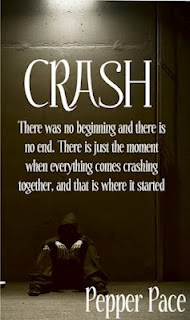
This issue proved particularly pressing for me this week as I read Pepper Pace's interracial romance Crash. On her Facebook page, Pace self-identifies as black, and notes that she is yet to be published. But she has self-published quite a few interracial (IR) romances, and was recommended to me by a commenter in response to a blog post earlier this year about wanting to read and feature more works by African-American writers.

As its heroine, Crash features a woman not unlike Pepper Pace herself, a forty-two-year-old woman of African descent who writes IR romances. Spotting a young runaway out her back window one night, at first Sophie chooses not to get involved. But when she sees that the person is still there hours later, Sophie's memory of her own mother vowing to protect her draws her outside. Sitting on the curb is a young white teen, homeless, the victim of a beating. Sophie invites the boy, Lucas, inside, then takes him to the hospital when she realizes he's not only been beaten, but robbed and raped.

Sophie believes that Social Services will take care of Lucas, but when it turns out that the boy is not a boy at all, but a man of twenty-two, Sophie ends up bringing him back home, offering him a place to sleep in her basement, and a temporary job working as her assistant. Thus begins one of the most unconventional romances you'll ever find, a romance that crosses not only differences of race, but also of age. Pace's novel is vitally interested in how to draw the line between loving and taking advantage, issues of power that come up in both racial and age-related situations such as the one in which Lucas and Sophie find themselves. I found her story unusual and intriguing, and deeply appreciated reading about characters whose stories and voices are so rarely heard in mainstream fiction.

One of the many truisms I've learned
about what constitutes "good" writing
But Pace's story breaks so many of the rules of good writing that I take for granted that, despite my interest in her characters and her story, there were many times when I wondered if it was worth it to keep going. Hopping from Lucas's POV to Sophie's and back again within the same scene, without any warning, made it difficult to keep track of who was thinking and feeling what. Several consistent word misspellings ("Ma'ame" instead of "ma'am," for example) kept tripping me up, pulling me out of the story, as did the constant misuse of semicolons. Long paragraphs that summarized actions instead of showing through scenes kept putting me at a distance, instead of drawing me in to the narrative, the position I most enjoy being in when I read, especially when I read a romance. If I had to give the book a rating based only on the writing, I'd probably give it a 2 out of 5. And that would be generous.

On Goodreads, though, Pace's books consistently earn ratings of 4 stars and higher, so it's clear that not everyone shares my beliefs about what constitutes good writing. Or, perhaps, believes that writing matters to quite the same degree that storytelling and characters do (interestingly, though, on Pace's blog Writing Feedback, she announced that she had been re-editing several of her previously published books, with the help of outside editors, suggesting that she herself is aware that there is room for improvement on the level of her prose).

Does it matter to you? How willing would you be to read a romance that you felt was not well written, but which presented a character, or a storyline, from an underrepresented group? Would you be interested in reading reviews of such books? Why or why not?

Tuesday, January 21, 2014

Questioning the Segregation of Romance: Ruth Wind's IN THE MIDNIGHT RAIN

The United States Supreme Court's landmark Brown vs. Board of Education case, declaring separate public schools for black and white students unconstitutional, was decided in 1954, more than fifty years ago. Racial integration in America's schools reached an all-time high in 1990, giving proponents of integration much to cheer about. But according to Dr. Adriana Villavicencio, senior research associate at the Research Alliance, New York University, segregation, not integration, has been the trend in American public schools since 1990:

In 1988, less than a third of Black and Latino students attended what Gary Orfield, Co-Director of the Civil Rights Project at UCLA, calls intensely segregated schools: schools with 90-100% minority students. Today, 40% of Blacks and Latinos—and less than 1% of white students—attend these schools. The percentage of white students nationally is only 56%, but on average they attend schools where more than 75% of students are white. At the same time, the percentage of Black and Latino students attending majority white schools has dropped by more than 10 percent.

As in our schools, so in our romance novels: romance publishing is still largely segregated by race. With a few notable exceptions, characters in the mainstream romance lines are largely white; black characters are largely segregated into their own separate (but equal?) lines, such as Harlequin's Kimani and Kensington's Dafina. We could talk ad infinitum about the whys and wherefores of such segregation. Instead, I thought I would honor the day set aside in the United States to celebrate the birth of Civil Rights leader Martin Luther King by writing about one of the few romance novels I've read that features an integrated community: Ruth Wind's RITA finalist In the Midnight Rain.

White thirty-something Ellie Connor arrives in Pine Bend, Mississippi on two fact-finding missions. One is public: to research the early years of the subject of her latest biography, Mabel Beauvais, an African-American blues singer who disappeared in 1953, just on the cusp of achieving nationwide fame. One is private: to try and discover the identity of her father, a man whom her wild hippie mother, who died when Ellie was two, never named. When she arrives at the place she's arranged to stay, she finds two men sitting on the porch, one white, one black. By the end of the novel, the two men, and the two searches, will become entangled in ways Ellie, and perhaps the reader, never could have imagined.

Though the novel's action takes place in the present, Ellie's two research projects give readers a sense of race relations in Pine Bend during three different periods in American history: the years immediately before, and immediately after, World War II, when segregation was a given; the late 1960s, when the country struggled against the backdrop of the Vietnam War to figure out how the legal victories of the Civil Rights movement would play out on the ground, in their communities; and 1990, when many overt racial barriers had been taken down, but many racial assumptions and beliefs still attained. Deep into her research, Ellie notices that most of the people she's interviewed are black, and makes a note to herself to talk to white people who were around during Mabel Beauvais' early days, realizing that things then weren't the same for blacks as they were for whites, something she'll need to understand not just on an intellectual, but on a personal level if she is to convey the truth of Mabel's life.

Wind's novel is hardly a didactic tract about race relations; it's a heartfelt, beautifully-written, and in many ways a quite traditional love story. With her penchant for falling for wounded men, Ellie's been down the bad relationship path more than a few times, and spends much of the novel warning herself against succumbing to her attraction to the emotionally-damaged man whom she met via an online blues newsgroup and who, in his hospitably southern way, offered Ellie a place to stay while doing her research in his hometown. And she's not the only one issuing warnings; almost everyone in town, whether black or white, counsels Ellie to stay away from Blue Reynard, since the privileged white boy is known about town as a "dog," a charming love-'em and leave-'em guy who'll only break her heart. But Blue, who sometimes thinks of himself as Job because of all the personal losses he's experienced, can't help falling for his intellectual equal, just as Ellie can't keep her heart free from bad-boy/smart-boy Blue. In traditional romance-novel fashion, each must both struggle to cope with and accept their fears of abandonment before they can find their HEA together.

Yet race serves as the compelling backdrop to this love story, quietly asking readers to consider what race meant in America's past, and what it still means in our present. What makes one person black, another person white? What secrets should one keep to protect a fellow member of an oppressed group? What does an integrated community look like? When is integration a problem? What does friendship across racial lines look like? What does love?

It struck me as significant that In the Midnight Rain was published in 1990, at the height of American public school integration. Can you think of any other romance novels that have been published since then that depict not an interracial romance, but an integrated community against which a romance unfolds?


Photo credits:
Diverse hands: Unity in Christ Magazine


In the Midnight Rain
HarperTorch, 2000

Friday, December 13, 2013

Is the Political Personal?

I've always been fascinated by the relationship between Republican strategist Mary Matalin and Democratic consultant James Carville. How could two people with such divergent political belief systems ever see beyond their obvious differences and fall in love? How, twenty years after marrying, can they maintain a respectful, loving relationship when their views about the way our government should function are so utterly different? I have a lot of friends with far more conservative political views than I do, but at the end of the evening, I can leave them and their (obviously misguided ;-) ) views behind; my political opinions and those of my spouse overlap enough that I can be sure we won't end up in a toothbrush duel over the merits of Obamacare or the efficacy of the TSA as we get ready for bed.

I've read several romances of late with protagonists on opposite ends of the political spectrum. In the most interesting, Karyn Langhorne's Unfinished Business (2007), Washington DC schoolteacher Erica Johnson and war hero U.S. Senator Mark Newman meet not cute, but antagonistic, when Erica stands up in the middle of a Senate Education subcommittee hearing to protest American involvement in Iraq: "If we weren't spending billions in Iraq, we wouldn't have to debate on cuts that take food from the mouths of our schoolchildren!" The senator, southern gentleman that he is, asks that the protester be treated respectfully—"This is still America... and dissent is not punished with manhandlin'." But Erica won't allow the Senator's good looks, charm, or arrogance to turn her protest into a photo op for himself, insisting on teaching her own civics lesson: that standing up for your beliefs has consequences, consequences that one must be willing to accept. Including being arrested.

Before she's hauled off to jail, Erica tosses a challenge to the irate upstaged senator: "Come to my school. Explain your policies—your war—to my kids. Erica Johnson's fourth-grade classroom. Any time you want. Door's open." Little does Erica expect the cocky, smirking senator to show up at her school, nor does she expect him to offer a challenge of his own: to accompany him on a week-long swing back through his (unnamed) home state while he campaigns during the reelection primary. But neither the white conservative southerner nor the black liberal northerner can seem to stand down in the face of the other's challenges.

Langhorne does a great job presenting the humanity behind the political stances. Both Mark and Erica come off as intelligent, well-informed political actors, though each initially draws on stereotypes and easy put-downs to insult the other's position and to bolster his or her own. Each chapter opens with an epigraph or slogan, sometimes from the liberal point of view ("Waging war to stop terrorism is like using gasoline to put out a fire"), sometimes from the conservative ("If we don't stand up for something, we'll fall for anything"), with neither side belittled nor denigrated. It's clear that both Erica and Mark enjoy matching wits with the other, enjoy being challenged to support their views in the face of doubt. And the physical attraction between them is obvious to everyone around them.

Although much of the narrative's energy comes from the knock-out verbal exchanges between "irritatingly granola flower-child" Erica and "conservative nut job" Mark, I expected that Mark would learn to moderate his views by visiting Erica's classroom, as would Erica after spending a week in fictional southern "Billingham." In order to make their relationship work, they'd have to meet somewhere in the middle, wouldn't they?

But instead of reconciling their politics, the narrative sidesteps the issue of Mark and Erica's differences by introducing a suspense plot that places both in physical danger. Once each's life is threatened, their political differences become far less meaningful, far less divisive. As Erica tells Mark's media advisor, who questions the viability of Erica and Mark's relationship:

"There's more criteria in a successful relationship than what political party you belong to, or what color you are. There's another whole list of characteristics and qualifications. Things like trust and loyalty, having passion for people. A passion for life. It doesn't matter how it's directed. It matters that you both have it, and that you both know that, when it's all said and done, you're willing to work together, to fight together, and to serve the common good together."

Initially, this felt like a cop-out to me: immersing Erica and Mark in danger simply to deflect attention from what really matters—the differences in their deeply-held values. But then I began to wonder. Do life-changing (life-imperiling) events make people hone in on the personal characteristics that underlie a person's values? Might it be a sign of a mature relationship when people can agree to disagree? Or could differences in politics sometimes be a reflection of different means to the same end, not always the sign of fundamental differences in deeply-held values?

It's a little difficult to say for sure in Unfinished Business. The novel ends with Mark and Erica agreeing to "try" to form a relationship, with an epilogue in the form of a newspaper wedding announcement describing them one year on. "I think they fight it out at home.... Then the senator comes in ready to work toward the best outcome. Marriage is all about compromise, and government is all about compromise. So it works for everyone," Mark's chief of staff is quoted as saying. But we don't hear much about any compromises: we don't know where they decided to live (in DC or in Billingham or both), whether Erica kept her teaching job, or whether she still publicly protests when Mark takes a stance with which she disagrees. The only sign of their compromise is their honeymoon in Baghdad, visiting servicemen and women: "they are both very committed to seeing our troops home safely." Have they compromised? Agreed to disagree? Decided never to talk politics? Readers are left wondering...

Have you read any romances with protagonists on opposite ends of the political spectrum? Do such romances tend to downplay political differences? Or do they show the two sides learning to compromise? Or do they argue that politics and the personal don't necessarily need to mix?


Photo credits:
Mary Matalin and James Carville: All Things CNN
Elephant, Heart, and Donkey cufflinks: Unicuffs